"Irish" John Smith - US Civil War


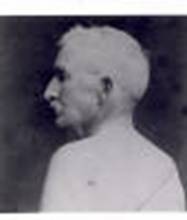
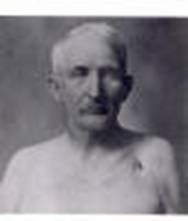
“Irish” John Smith
“Irish” John a.k.a “Honest Irish” John Smith was a young lad when he enlisted in the military. John lived near Pine Bluff, Wisconsin, which was quiet countryside filled with immigrants from Ireland and Germany. Previously John lived in Brooklyn, New York, which was a far cry from the bucolic lifestyle of mid-19th century Wisconsin. It has been some time since we wrote about John Smith. Smith descendants know the iconic images of John’s war wounds. One picture showing his war wound appears at the top of our webpage.
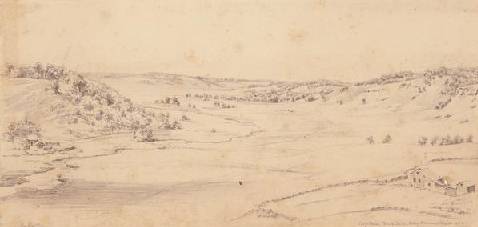
Black Earth Valley – 1855
Near Pine Bluff, WI
Mid 1862
July 1862 was a tumultuous time. Abe Lincoln’s war was not going well and for all intent and purposes the war was stalemated. States were required to provide a certain number of men able and ready to fight. Army recruiters scoured the towns and villages around Madison looking for fresh troops. Not everything was rosy.
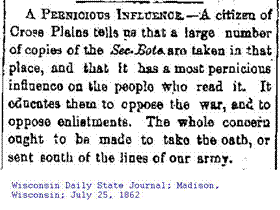
Anti-war activists also swarmed the countryside as the following article suggests. In Cross Plains, for example, a large number of anti-war newspapers (Sec.Bote) were seen. This German language newspaper was printed in Milwaukee. Both pro and anti war elements vied for the hearts and minds of Wisconsin’s fighting age population.
“Irish” John Smith enlisted for a three year hitch on August 15, 1862, and was given a $25.00 bounty. He gave his age as 20 years old. The officer who signed him up was First Lieutenant Oscar Mohr, later John’s immediate officer in the 29th Wisconsin Regiment, Company G.
November 1862 - March out of Wisconsin
In November 1862 the Twenty-Ninth Wisconsin Regiment moved out of Madison and began their travel to Cairo, Illinois. John was given a Springfield musket, and other necessary equipment except a tent.
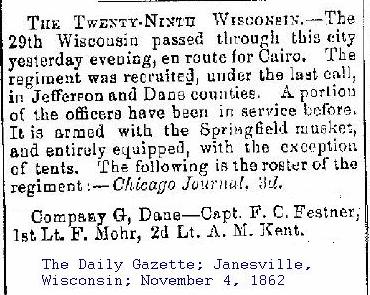
Union forces were normally supplied with two man tents, nicknamed “Dog Tents”. They were called that because these tents couldn’t keep a dog dry in a rain storm. From Cairo the 29th Regiment marched toward Vicksburg, Mississippi.
May 16, 1863 – The Battle of Champion Hill
You have to wonder what was going through “Irish” John’s brain as he lay critically wounded in a Mississippi hedgerow. The heat and humidity were unbearable. Union issued wool uniforms were ill suited for southern climates.
Earlier that morning John woke to the sound of Reveille, and lined up for morning roll call. After roll call John fell out for breakfast. We can never be sure what John ate that morning, but assume it was hardtack and some sort of boiled meat. General Hovey ordered his troops assemble after breakfast for a long march. At 7:00 AM John and his comrades began marching on the Raymond Road towards Vicksburg.
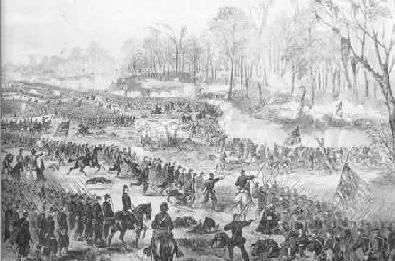
Five miles later they stopped at the foot of Champion Hill. From their vantage point their view was blocked by a thick growth of trees and brush. However, Union troops knew the Confederates were massed in front of them. At 10:00 AM the line of battle was formed, skirmishers were thrown out, and the line advanced. The Eleventh Indiana was on the left of the road, the Twenty-ninth Wisconsin on the right, occupying the brigade front. John would have been squarely facing the enemy on the first drive. The battery was opposite the center of the advance line. Companies B and C were deployed as skirmishers.
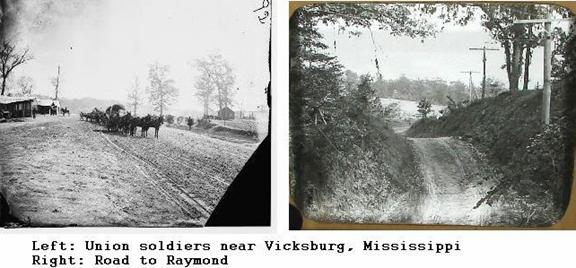
About Noon the Union brigade charged up Champion Hill toward the enemy battery at a rapid pace. Within a hundred yards of their charge the Confederate forces opened with grape and canister fire from four guns and gunfire from their infantry. The 29th Regiment continued moving a short distance, stopped and opened with a terrific volley from the whole brigade. An immediate charge with bayonet was ordered; the men gave a loud cheer and began moving “double quick” toward the enemy line. This sudden move surprised the enemy and many prisoners were taken on the first run.
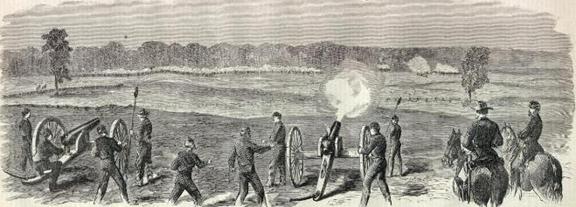
This assault scattered the enemy who moved back six or eight hundred yards to a more secure position. In the previous three hours the front line Confederate troops had no support from their comrades. From this new location they enjoyed additional support and ammunition. Confederate forces repulsed the initial Union push, and part of the Union forces moved back. Finally, Union troops regrouped and pushed out Confederate forces from their defensive position on Champion Hill.
We do not know if John was wounded on the first or second Union drive.
The ground fought was rough and covered with timber. The 29th Regiment captured a battery of brass pieces, the colors of the Thirty fifth Alabama, and about three hundred prisoners, among them several commissioned officers.
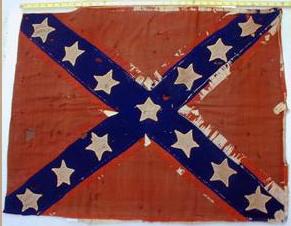
Flag captured by 29th Wisconsin
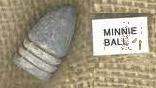
This battle changed John forever. An enemy Minnie Ball entered John’s left shoulder thus ending his short military career. Many friends from John Smith’s Regiment fell that day in battle in an area which would later be known as the "Hill of Death". John's buddies hid him in a hedgerow and covered him with brush.
Smith family lore suggests his buddies came back three later and found John still hiding. The story continues saying John leapt to his feet saying he would not die on Confederate soil. This is an interesting story but it did not happen that way. Actually, Confederate forces picked John off the field and carted him away to one of their field hospitals.
Union forces found John lying in one of these field hospitals some days later. At first John’s status was listed as ‘missing’ since his commander and buddies did not know where he was. Later his status was changed to "prisoner of war" and Confederate officers 'paroled' John back to the Union side on June 6, 1863.
Later John’s commanding officer, Lieutenant Mohr, would write: “John Smith bore his part without a murmur and fought like a Lion - he never flinched. He is a good and brave soldier and I am the more sorry for the misfortune which befell him.”
War’s Aftermath
For a long time no one knew where John was or if he was still alive. By definition war is chaos. Generally the home front knew battles had been fought, but news coming out of war zones was slow. News which did appear was not always reliable since most war correspondents did not go where battles were fought. In mid 19th century America we had no satellite news services, cell phones or television news crews embedded with troops. Folks in the home front waited days to hear news from their loved ones fighting these battles. Catharine Rooney may have known her son, John Smith, was missing in action. However, we do not know when she found out her boy was still alive.
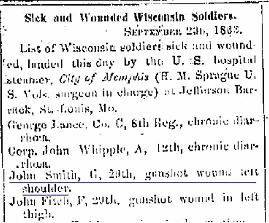
We found two news articles which mentioned John's name. One article
written in late 1863 states he was transferred to Jefferson Barracks in
St. Louis, Missouri. November 27, 1863, John F. Randolph wrote a letter
moving all records from the US General Hospital in Jefferson Barracks to
Harvey Hospital in Madison, Wisconsin.
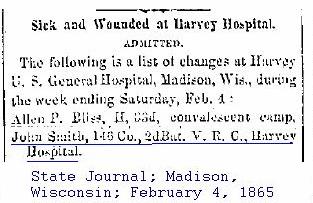
Another article written in February 1865 states John was admitted to Harvey Hospital. Actually, this may be misleading. In late January John was transferred from the 29th Wisconsin Regiment, Company G, to the VRC (Veterans Reserve Corps). This may only mean he was discharged as an active soldier and admitted to the hospital as a member in the new VRC group. My information shows John was not formally discharged from Harvey Hospital until late 1865.
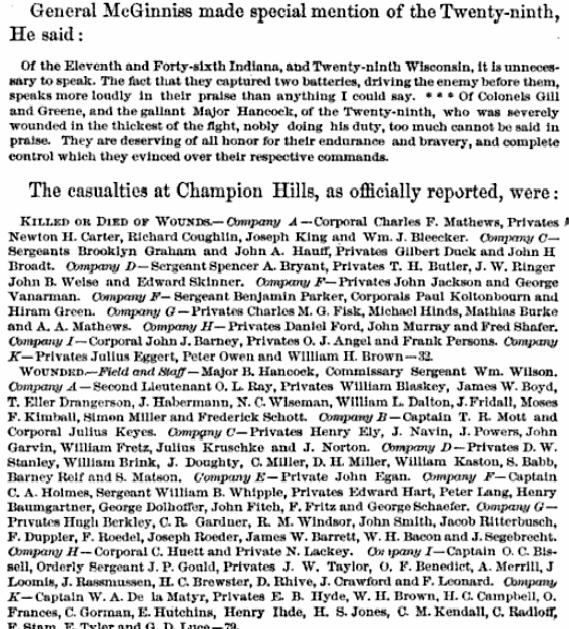
The following is taken from The Military History of Wisconsin, published in 1866. This book provides details of those Wisconsin 29th Regiment soldiers killed or wounded at Champion Hill, including our own ancestor, John Smith.
****************************************
June 2009