Jefferson Barracks Civil War Military Hospital


|
Jefferson Barracks Civil War Military Hospital
|
|
Old Ordinance, built 1851 Click to Enlarge |
Laborer's House, built 1851 Click to Enlarge. |
|
Jefferson Barracks was used for many
years as a staging area, post and military hospital from the early days
of the frontier until after World War II. The National Cemetery located
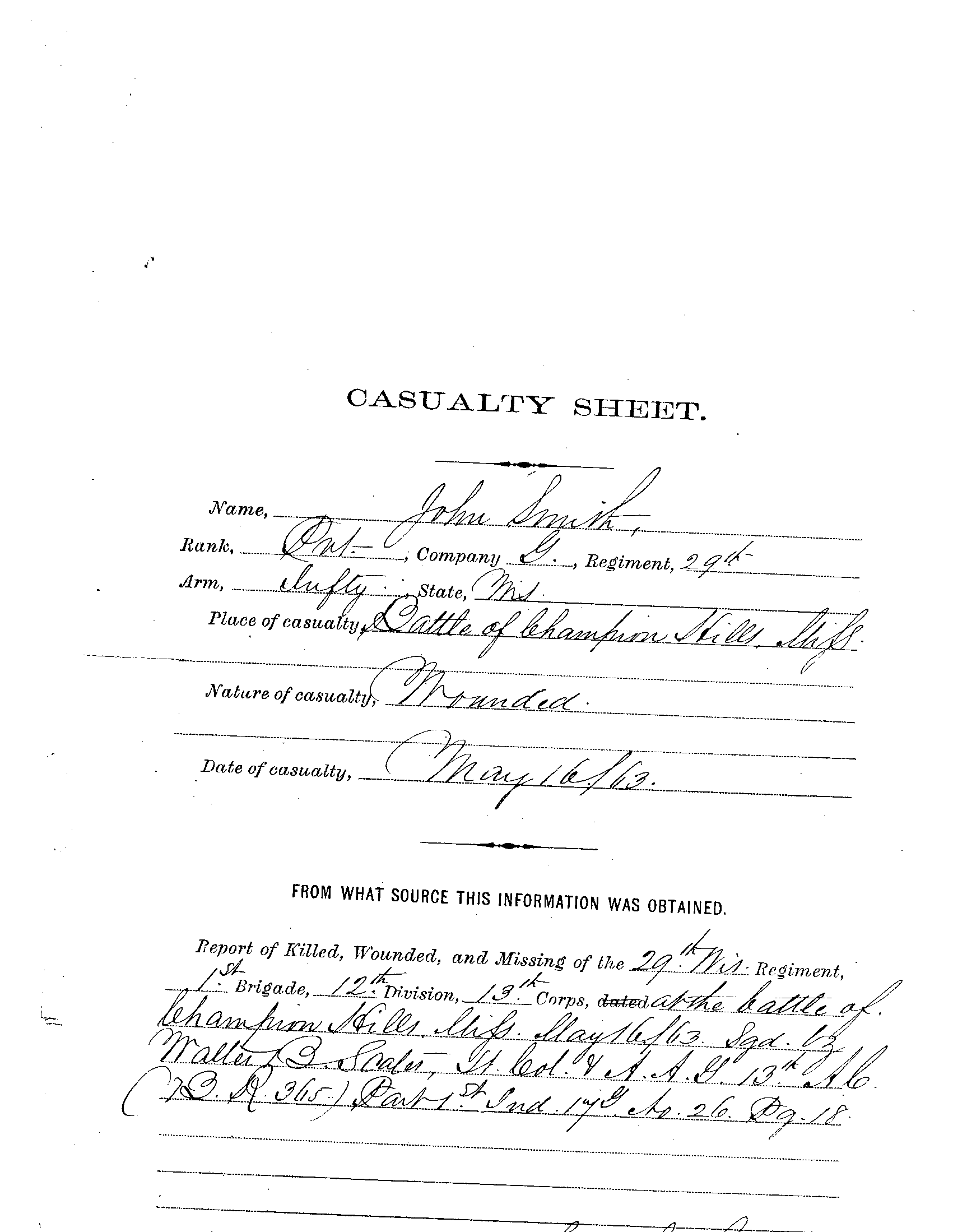
here was established in 1863. When Irish John Smith was
wounded at Champion Hill, outside of Vicksburg, he was transferred to
this hospital to recuperate. His claim that "he would
not die in rebel territory" and walked
back to camp gravely wounded may have some basis of truth. He laid
on the battlefield for several days before he was taken back to Camp.
He credited his survival to maggots...they were applied to the wound and
ate the decaying flesh around the wound. While the hospital's name
sounds like a Confederate stronghold (named after Jefferson Davis), it
was actually a major Union outpost in the West. Here are some highlights: 1828--2nd Lt Jefferson Davis, who came a year straight out of West Point, is sent to direct soldier work parties in gathering materials to build Fort Winnebago at the portage of the Wisconsin and Fox rivers. Troops from JB become increasingly involved in Indian problems and protecting traders between western Missouri and Santa Fe. 1862--Jefferson Barracks is becomes the largest and most important military hospital in the country. During the war, Jefferson Barracks had one of the largest Federal hospitals in the country with over 3,000 beds, accommodating patients from battles as far away as Vicksburg. 1864---In September Confederate General Sterling Price (commanded Missouri Militia in 1861) again invaded Missouri. Jefferson Barracks was an assembly point for the defense of St. Louis. A final engagement near Kansas City ended any large-scale Confederate threat in Missouri. |
Official letter in John Smith's files which showed he was a patient at Jefferson Barracks. Click to Enlarge Date of injury: May 16th. This occurred nearly 145 years ago this month. |
|
The 29th reunion in 1889 in Madison, Wisconsin. Click to Enlarge |
The Union Army called this the battle of Champion Hill...the South had a different name for this skirmish. Click to Enlarge. |
|
Doctor's assessment of John Smith's wound. This drawing was created well after the Civil War. Click to Enlarge
Jefferson Barracks Hospital sketch, 1864 |
Wisconsin gave young men a choice: either volunteer or wait for the draft. If they volunteered they received a $25 bounty and one month salary in advance ($13). If you were drafted you received no bounty and your salary was $11/month. Irish John received $38, which was probably a lot of money in 1862. In addition, they didn't have to pay Wisconsin $54 in taxes for not enlisting. Click to Enlarge |

|
Harvey Hospital - after Jefferson Barracks stay After being discharged from Jefferson Barracks, Irish John Smith continued his convalescence at Harvey Hospital near Madison, Wisconsin. Harvey Hospital, or the Soldiers' Orphans Home. The main octagon section was the home of Governor Farwell, and the wing of wood was added in 1862 and used as an orphans home. It stood on the west bank of Lake Monona. Click to Enlarge |
The short article written in 1864 describes the fort in more detail:
|
According to "The Western Sanitary Commission: A Sketch Of Its Origin, History, Labors For The Sick And Wounded Of The Western Armies, And Aid Given To Freedman and Union Refugees, With Incidents Of Hospital Life." By the Mississippi Valley Sanitary Fair; R. P. Studley & Co. St. Louis, Mo; 1864. Jefferson Barracks was formerly a military post at which United States troops were stationed, situated about twelve miles below St. Louis, on the west bank of the Mississippi river. It consists of long rows of buildings, one and two stories high, with basement kitchens and dining-rooms, and wide piazzas, extending on three sides of a large plat of ground, in the form of a parallelogram, shaded with fine trees, the open end of the grounds being towards the river, with a high flag-staff on the bluff, from which the flag of the Union is always unfurled to the breeze. The old post hospital stands near on an adjoining eminence, and is two stories high, and the post chapel is situated several hundred yards back from the river, in a pleasantly shaded spot, retired from the barracks. In April, 1862, these buildings, except the post Chapel, which is still reserved for worship, were converted into a large hospital, for which purpose they were admirably suited, the rooms being large, having numerous windows on both sides, opposite each other, and the piazzas and shaded walks, affording excellent opportunities for exercise. Beside the old buildings, the Government, during the summer of 1862, erected others on the ample grounds belonging to it, on the west side, so as to afford accommodations for two thousand five hundred patients. These new buildings are one story high, in triple rows six hundred feet long, divided into wards of three hundred feet each. There are three groups or sets of these new hospitals, some distance apart, the entire grounds in every direction being beautifully shaded by large oak trees. They are so arranged that each group has the central row appropriated to a dining-room, and surgeons, nurses' and stewards' quarters, the outside rows being sick wards. Besides these improvements, a system of water works has been introduced, with reservoir and pipes, by which the water of the Mississippi is carried through all the buildings. The institution is in charge of Surgeon J. F. Randolph, U.S.A., assisted by Dr. H. R. Tilton, U.S.A., and P.C. McLane, M.D.; A. L. Allen, M.D.; T. F. Rumbold, M.D.; Hiram Latham, M.D.; S. Leslie, M.D.; and J. J. Marston, M.D. The Post Chaplain, Rev. J. F. Fish, has been stationed here many years, and continues his services, in connection with Rev. S. Pettigrew, Hospital Chaplain. The number of patients received and treated in this hospital in two years, ending April 30, 1864, is 11,434. The percentage of deaths the first year was eleven and a half, which was much increased by the large number brought to it in a dying condition. The percentage of deaths for the year just ended [1863] is nine and eight-tenths.
|