

Daniel Ryan from Thurles
 About
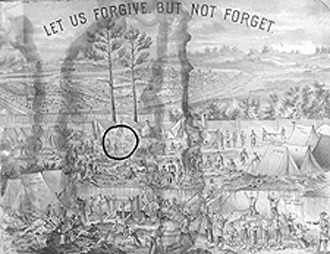
five years ago, Darcy Timmerman bought her husband Craig a birthday gift at an
auction in La Crosse, WI. Craig, a collector of military items, thought it was a
pretty nice present. The gift was a painting of the Civil War prison at
Andersonville in Georgia. The painting was done by G.F. Keller, a survivor of
Andersonville, and was "dedicated to my fellow survivors and 14,000 martyrs."
About
five years ago, Darcy Timmerman bought her husband Craig a birthday gift at an
auction in La Crosse, WI. Craig, a collector of military items, thought it was a
pretty nice present. The gift was a painting of the Civil War prison at
Andersonville in Georgia. The painting was done by G.F. Keller, a survivor of
Andersonville, and was "dedicated to my fellow survivors and 14,000 martyrs."
The figures on the print, primarily prisoners of that infamous prison, were each
numbered, with the numbers corresponding to a key at the bottom of the painting.
Figure 11 represents a "colored soldier of the 7th Regiment, Colored U.S.
Volunteers, who lost an arm by grapeshot, and had been captured in the Battle of
Olustee, Florida. The rebels had cut off his nose and ears and taken all
clothing from him. He was literally naked up to the time of his death in March
1865. [He] died from exposure and starvation, hastened by mortification of his
numerous wounds."
|
|
The Confederate
Civil War prison at Andersonville was established near Americus, GA in February
of 1864. In its fifteen months of existence, nearly 50,000 Union soldiers were
confined in Andersonville. By the time the prison was closed in April of 1865,
nearly thirteen thousand of those prisoners had died there, mostly from disease
and infections.
What most intrigued Craig about this painting, given him by his wife, was figure
number 5.Circled in the photograph, above, the figure was identified as a James
M. Lisher, of Company B, 1601 Regiment Infantry, U.S.A. who "was detailed as a
cook." It was further noted that at the time the painting was made, Lisher was
"now living in Lansing, Iowa."
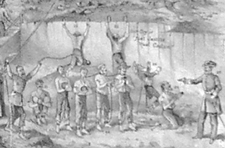
Figure 20 depicts
"a rebel soldier putting the prisoner, Martin E. Hogan, into the stocks for 24
hours." Figures 22 and 23 represent two prisoners being "tied up at the thumbs."
In its fifteen months of existence, nearly fifty thousand Union soldiers were
confined in Andersonville. By the time the prison was closed in April of 1865,
nearly thirteen thousand of those prisoners had died there, mostly from disease
and infections. Most of those who survived the horrors of Andersonville
struggled throughout their remaining years with health problems directly linked
to their incarceration there.
Andersonville Prison
The Confederate Civil War prison at Andersonville was established near Americus,
Georgia in February of 1864 to hold up to ten thousand Yankee prisoners, newly
captured or to be transferred from other prison camps. Exchange of prisoners
between the North and South had been a common event through the early years of
the Civil War, and Andersonville was meant to be a holding facility until the
prisoners were exchanged. When General Grant determined it was not in the best
interest of the North to exchange prisoners, events would compound the
difficulties at Andersonville. General Sherman's march through the South
destroyed crops and transportation facilities like railroads, vital to support
of a prisoner population that swelled to over 33,000 Union soldiers. Needless to
say, conditions at Andersonville deteriorated quickly. Shelter from the elements
for the prisoners was wholly inadequate. Clothing was not provided. The water
supply was contaminated and food supply was limited. Filth and disease were
prevalent. Mistreatment of prisoners was not uncommon. Indeed, the figures on
the print which Darcy gave Craig represent some of the maltreatment prisoners
experienced.
Allamakee county
connection
What most intrigued Craig about the painting given him by his wife was figure
number 5, identified as a James M. Lisher, of Company B, 1601 Regiment Infantry,
U.S.A. who "was detailed as a cook." It was further noted that at the time the
painting was made, Lisher was "now living in Lansing, Iowa."
Craig was curious about Lisher and his local connections and intended to look
into his history, but never really found the time. Recently his brother Delbert
"Tim" Timmerman decided to do a little research. His research led him to a
gravesite in Oakland Cemetery in Waukon. The records had indicated that this was
the final resting place of James M. Lisher.
However, the name on the gravestone read James "N." Lisher. The gravestone
reflected service in the United States Army during the Civil War in Company K of
the 37th Iowa Infantry. The gravestone further indicated that James N. Lisher
was born on May 20, 1797, and would have been sixty-four years old at the start
of the Civil War.
Further research indicated that James N. Lisher was the father of the James M.
Lisher depicted on the print. James N. had moved his family to
Allamakee County from Illinois in
1853, and settled on a farm in Hanover Township.
On November 12, 1862, during the Civil War, he enlisted in the 37th Iowa
Volunteer Infantry. The 37th Infantry became known as the "Graybeard Regiment"
because its members ranged in age from forty-five to eighty, with an average age
of sixty-seven. The regiment was formed to show that older citizens supported
the efforts of the Union in the war and were capable of serving. It was also
meant to encourage the sons of its members to enlist.
The Graybeards were not required to serve in combat, and primarily served as
guards at prisons, railroads, and arsenals, freeing up younger soldiers for
actual combat.
James N. Lisher returned to Waukon after his military service. He died Dec. 28,
1871. On December 28, 2001, 130 years to the date of his death, a G. A. R.
(Grand Army of the Republic) emblem was placed at his gravesite by Craig and Tim
Timmerman to recognize his service.
In 1862, at the age of seventeen, James M. Lisher enlisted in Company B, Second
Battalion, 16th United States Infantry. He was joined in the 16th Infantry by
other Allamakee County men
including Kathy Hogendorn's great-grandfather,
Daniel Ryan, also age seventeen.
Both would eventually end up as prisoners at Andersonville.
The 16th Infantry was a regular Army unit, in contrast to the State Volunteer
Infantry Regiments. Their first major combat was in the Battle of Shiloh in
early April of 1862. The 16th Infantry roster included twenty-four
Allamakee County men, only eight of
whom lived to see the end of the war. In a single action, the Battle of Stones
River, fought near Murfreesboro, TN from Dec. 31, 1862 to Jan. 2, 1863, one
third (eight) of those twenty-four were killed. Eight others died in other
engagements or in Confederate prisons.

Daniel Ryan of
Allamakee co., pictured here, was a
member of the 16th U.S. Infantry, would become a prisoner of the Andersonville
prison camp during the Civil War..
After Shiloh, Lisher and Ryan participated together in the battles of Stones
River, Perryville and Chicamauga. Chicamauga was one of the costliest battles of
the Civil War, with nearly thirty-five thousand casualties. Lisher was captured
at Chicamauga on Sept. 19, 1863.
In April of 1864, after spending time in two other Confederate prisons, he was
transferred to Andersonville. Weighing one hundred and eighty four pounds when
he arrived at Andersonville, Lisher weighed only 90 pounds when he was released
eleven months later.
After his discharge from the Army, Lisher returned to Lansing and operated a
livery business and hotel until a fire destroyed the property in 1876. He then
moved to Postville and operated the Burlington House Hotel (formerly the Key
City House Hotel) until he purchased the Commercial House Hotel in Postville. He
subsequently bought and operated the Descent House Hotel and the Commercial
Hotel in West Union.
Lisher was a successful and respected businessman in West Union for many years.
He died on Feb. 19, 1938 at the age of ninety-four, and is buried in West Union
Cemetery.
Lisher's seventeen year-old companion from the 16th Infantry,
Daniel Ryan, was born in 1844 near
Thurles, County Tipperary, Ireland and came to America in the early 1850's with
his family, initially settling in Michigan. In 1860, with his mother and sister,
he moved to Allamakee County and
settled on a farm near Lycurgus, between Lansing and Waukon.
After Lisher was captured at Chicamauga, Daniel endured an additional five
months of combat, including other major battles like the Battle of Chattanooga.
He was captured in Feb. of 1864 at Buzzards Roost during the Battle of Rocky
Face in Georgia.
He too survived the rigors of eleven months in Andersonville Prison, though he
was troubled throughout the remainder of his life by a vaccination he received
when he was first incarcerated at Andersonville. The vaccination created a wound
on his arm which never healed, and left his arm useless. Many prisoners lost
their arms or died of complications from the vaccinations they received at
Andersonville.
Released from Andersonville and discharged from the Army, Ryan returned to
Allamakee County where he was
married to a member of another Ryan family, Margaret Ryan, on Dec. 30, 1866.
They established themselves on a farm on West Ridge, northwest of Waukon, and
parented eleven children. Daniel Ryan
died Sept. 27, 1895 and is buried in Mount Olivet Cemetery near Waukon.
Many of Daniel Ryan's
descendants continue to make Allamakee
County their home. Descendants of James M. Lisher could not be located.
Note: More detailed information on the service of
Daniel Ryan and the 16th United
States Infantry can be found in the book From Iowa to the Sea, by Timothy F.
Preece, a relative of Daniel Ryan.
The book is available at Robey Memorial Library in Waukon. Also, a large
painting of the Andersonville Prison is currently on display in the lobby of the
Allamakee County Courthouse for
public viewing.

On December 28, 2001, 130 years to the date of James N. Lisher's death, a G. A.
R. (Grand Army of the Republic) emblem was placed at his gravesite by Craig and
Tim Timmerman to recognize Lisher's service.
++==++==++==++==
See Related Entries Daniel Ryan. Daniel Ryan lived two farms down from James and Ann Ryan, and records show that Batt Ryan was a baptismal sponsor for their second child, along with a sister of Margaret, Daniel's wife. Margaret's parents were "James and Catherine" Ryan, who also lived a few farms away from our family. Over the years, our families had much in common, including marriages.
