Deadwood Turgeons - Part 1
. 
Gold in Them Thar Hills
America was the land of milk and honey where all roads were paved with gold. In 1874 General George Armstrong Custer discovered gold at French Creek while exploring the southern Black Hills. Several of his soldiers discovered gold while placer mining. Word of Custer’s find excited the brave and foolhardy alike. The Black Hills gold rush’s peak was between 1875 and 1876.
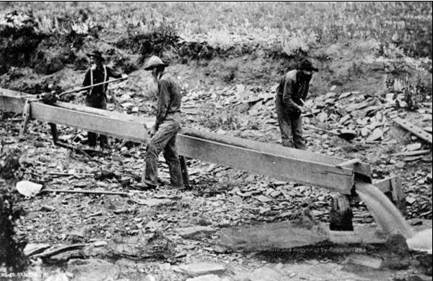
Above: Placer Miners in Deadwood Gulch - 1876
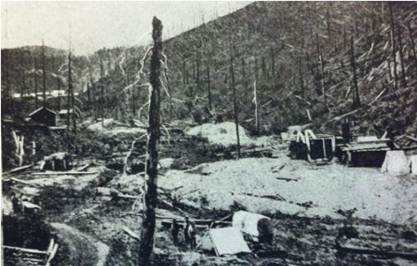
Above: Mining Camp near Deadwood
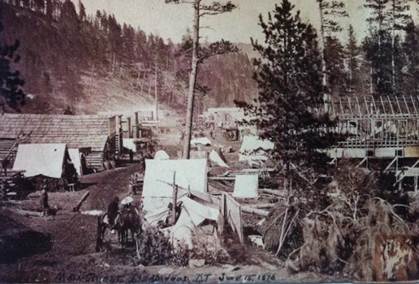
1876 Deadwood Main Street
Joseph Turgeon may have been one of the earliest prospectors in the Black Hills having arrived by at least 1876. The Black Hills Daily Pioneer dated September 27, 1876, reported a ‘J. Tujohn’ sold half his No. 12 claim to Smith Ehenger for $750. Smith Ehenger appears to be a partnership which owned neighboring No. 10 claim. ‘Tujohn’ is how ‘Turgeon’ is pronounced in Quebec.

The above photograph is interesting since it shows miners from Gold Claims No. 14 and 15 below Discovery. Joe Turgeon’s claim was nearby (No. 12 below Discovery) but do not know if his claim can be seen in the background of this photograph or if Joe’s claim is behind the cameraman.
Ferdinand and Joseph Turgeon moved to Deadwood in search of riches and gold. Perhaps Joseph was the first Turgeon to leave Union County. The following news article appeared in Deadwood’s local newspaper about a ‘Joseph Sturgeon’. It appears this surname was sometimes used interchangeably for Turgeon in Deadwood so it could reference Ferdinand’s brother. If not, it still is an interesting story about gold claim jumping in old Deadwood. However, the following article references Claim No. 12. We believe ‘Sturgeon’ referenced below and ‘Tujohn’ referenced in the previous news article are the same person. Both articles reference Gold Claim No. 12. Below is an 1877 picture of a Deadwood miner guarding his gold claim. Claim jumping appears to have been a popular ‘sport’ in Dakota Territory. Newspaper accounts report prospectors murdered or harassed for their claims. Law and order was either non-existent or corrupt. It was each man for himself.

Miner's Meeting
Black Hills Daily News
February 24, 1877
Page 4, column 3
Miners' Meeting.
A miner's meeting was called on the 19th Instant, on claim number 12, below discovery on Deadwood, to settle the title of said claim. It appears that Mr. Joseph Sturgeon was the original locator and owner of the claim, and worked it all the season, leaving for the East about two months ago. During his absence the claim was jumped by B.J. Johnson, W. Johnson and R. Moll II, they claiming right thereto on the ground of Mr. Sturgeon's being an alien. Their case was argued in a lengthy manner by Judge Miller, Judge Murphy and Major Gallagher. Mr. Sturgeon presented an affidavit affirming he declared his intention of becoming a citizen twenty-one years ago, in the city of Chicago, and has been a resident of the United States for over 29 years. In opposition to the eloquent arguments of the three opposing counsel. Judge Hollins appeared alone in behalf of his client, and in the clearest manner possible affirmed his fights, quoting the law which says the fact of the alien making affidavit that he had taken the necessary steps prior to his taking out papers of citizenship, was sufficient to decide the case, and on the merits he submitted it to the voice of the meeting. The vote being taken, a large majority sided with Mr. Sturgeon, and so the matter rests.
We believe Joseph Sturgeon and Joseph Turgeon may be one and the same person. Joseph Turgeon was known prospecting near Deadwood during this time period.
Mining was tough work. Most miners made an average of ten dollars a day. You could make anywhere on average between twenty to forty cents per pan of gold. Experienced miners made the most money because they knew the ropes. The less patient and inexperienced miners soon lost interest and left.
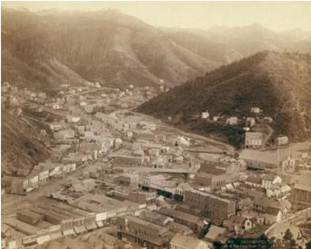
Picture of Old Deadwood

1876 Photograph of Deadwood

1876 Picture of Prospectors in Deadwood Gulch
Joseph Turgeon Marries
Joseph Turgeon married Mary Brouillette in either 1880 or 1881 in Sioux City, Iowa. Joseph worked as a miner in Deadwood during this time period. Mary Brouillette Turgeon was excited starting a new life in Deadwood and the prospects of richness this wild land provided. Her parents were Israel and Emilie Brouillette. Mary's mother, Emilie Brouillette, was apprehensive about her daughter's new life in the wilderness. Custer’s defeat in Montana was still fresh news, and relations between the white and red man were poor indeed.
Mary was born about 1862 in Dubuque County, Iowa. Her sister, Caroline, was born March 26, 1866 in Jefferson, Dakota Territory. Caroline married Charles Lavier and they moved to Deadwood first, later to Lead, Dakota. Their brother, John, was born March 2, 1870, in Jefferson, Dakota Territory; Emma was born October 17, 1877, possibly in Sioux City. Emma married Clifford Lamborn. Annie (Totsie) was born March 1, 1880, in Sioux City and later married John Dumphy. John died in 1870 aged 1 day old due to asphyxia. There was also a Louisa Brouillettte who died in 1870, aged 52, due to dropsy.

Wedding picture for Caroline Brouillette and Charles Lavier. They were married on June 27, 1887, at St. Ambrose Catholic Church in Deadwood, Dakota Territory. Caroline’s sister, Mary, married Joseph Turgeon. Unfortunately we do not have a picture for either Mary Brouillette Turgeon or her husband, Joseph Turgeon.

Photograph showing Lead, Dakota Territory dated 1878

Black Hills and Ft. Pierre Railroad, also known as Homestake Railroad. Charles Lavier one of two known engineers who worked for this railroad in its early days. Picture shows Wellman, engineer; H. Lavier, fireman; Bob Leeper; and Charles Lavier, conductor
In the 1860's the Brouillettes and many other French-Canadian families moved to the Jefferson-Elk Point area of Union County, Dakota Territory. The Brouillette children recalled happy times spent at their grandparent's farm in Union County.

Photograph showing old Deadwood, circa 1876
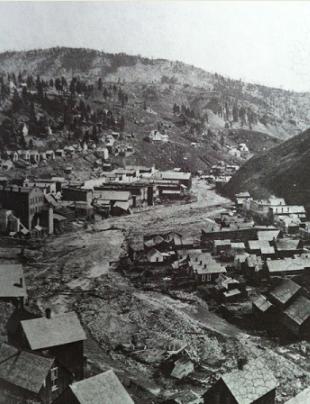
1883 Deadwood Flood
Caroline later wrote about the early days in Deadwood and the great flood that occurred on Friday, May 11, 1883. The Turgeons were living in Deadwood during this time period. It washed out houses and buildings throughout the town. Her mother, Emilie Brouillette, owned a boarding house at Brownsville, which was a few miles south of Deadwood. This was not the first or last flood ever seen in the Deadwood Gulch. It was in Brownsville where Caroline met her future husband. He worked as an engineer for the Black Hills & Fort Pierre Railroad, always known as the Homestake Railroad.

Picture of Emilie Brouillette, mother of Mary Turgeon and Caroline Lavier
The June 1890 register of Deadwood Catholics includes the following Brouillette names: Mrs. Aumelie (Emilie) Brouillette, Louis Brouillette, Topsie (Anna) Brouillette, and Marie Brouillette. All lived in nearby Elizabethtown. In 1888 before moving to Lead, Caroline (Brouillette) and Charles Lavier’s son, Charles, was baptized in St. Ambrose’s Catholic Church.

Towns and Mining Camps in Deadwood Area
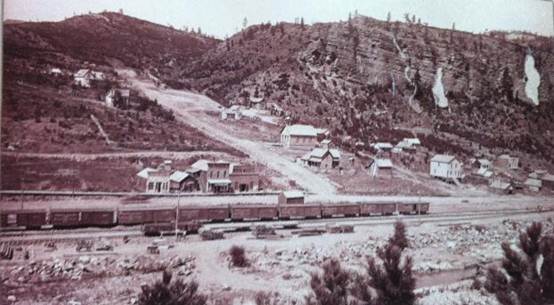
Elizabethtown located near Burnham Avenue in Deadwood. The Catholic Cemetery is located three blocks north on Burnham and turn right. The cemetery is a block off from Burnham. The mountains in the right side of the picture are locally known as ‘Brown Rocks’.
Below is the current view of the same location but looking up directly Burnham Avenue with Brown Rocks on the right.