Ryan & Campbell Homeland in "Cully", near Newport, Tipperary


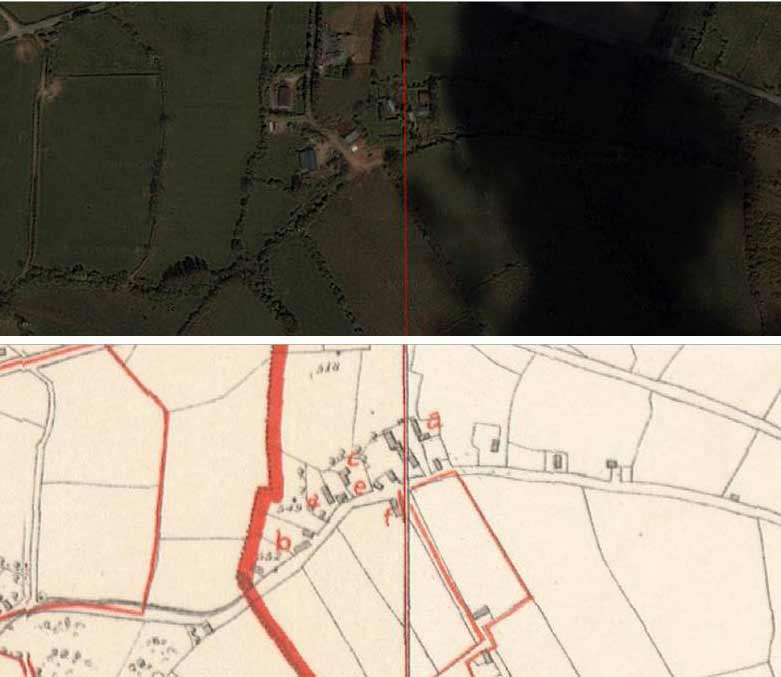
1850 Census Information . Click to Enlarge.
This map shows the leasees and tenants living on the land. The "red" houses show building locations in 1850 (the satellite map shows current farms). The names listed on this map align to the numbers reflected in the Griffiths survey, e.g., the surveys show that James Ryan leased the acreages in plots 10, 8 and 4 .
The blue house approximates where the Campbell family lived in Gortnaskehy townland. It appears that James Ryan farmed the lands that bordered Gortnaskehy.
Finally, each townland is relatively small. Perhaps 1-2 miles in length.
James Ryan in the 1850 Fiddane Townland
There were no "James Ryan's" listed as residents of Gortnaskey, even though most of the Ryan children were documented as being baptized there. We have located records where a "James Ryan" leased land from George Kinahan, a descendent of a Cromwellian settler, in Gortnaskhy, but these records do not show him living in the townland itself. On the other hand, we see James Ryan referenced multiple times in neighboring Fiddane townland .
At first we thought the land census was identifying more than one James Ryans, but if this were the case, then his family name would be listed in parenthesis behind his name. For example, you see this with J Ryan on the map. "J Ryan" are actually two are John Ryan's (son of Pat and son of John). Denis Ryan is listed this way as well - son of John and family of Carey. As we learn more about the surveys, we see that farmers leased multiple acreage, one acre to feed their family plus additional acres to eke out a living. Therefore, we believe that James Ryan of Fiddane is our great-great grandfather - father of Batt Ryan.
There is one interesting note in the land surveys - it says that James and Denis Ryan lived in Castlewaller townland (its northern edges). Castlewaller was initially called "Cully", and we know that Batt Ryan came from Cully. Batt's grandchildren thought he was saying "School Hill",
1850 View of Fiddane

The original 1850 Griffiths maps. Click to Enlarge.
but no one was able to find this mythical homeland. As we have learned this was a misunderstanding.. The old Gaelic phonetics of "Cully" sounds like school hill ( "skool he"). The linkage of Denis Ryan in the surveys supports our ancestry that James' father was Denis Ryan. We know that Denis was a tax assessor/collector in Birdhill, and eventually moved to Castlewaller to farm.

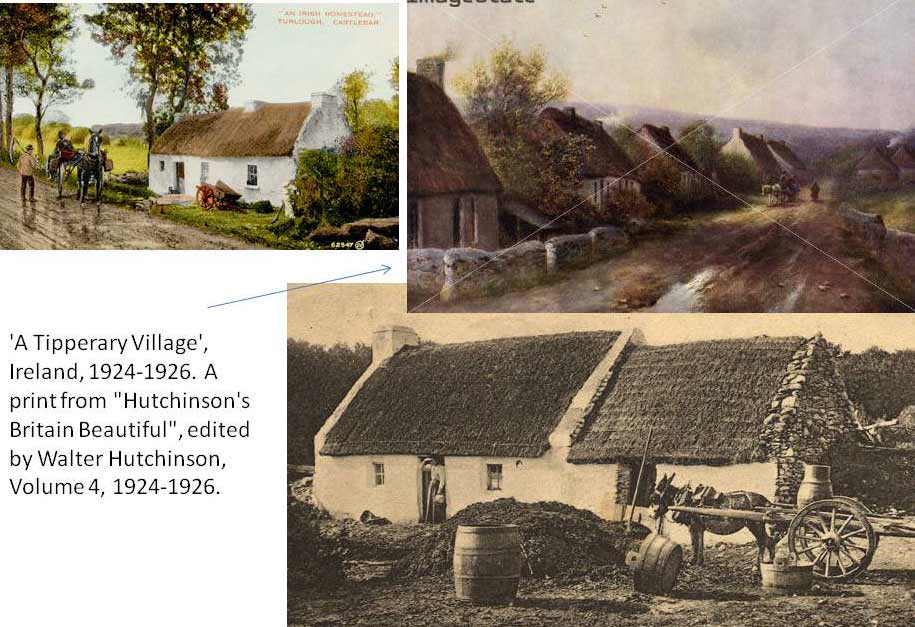
| On the back of this
card, it reads. "A Peasant home in Ireland. Collection of
Maggie Land Blanck. Click to enlarge. .On the back of this postcard it reads, "All their life long this unlettered man and woman had to fight against poverty, they have had worries and sorrows not a few, yet the Irish temperament is so cheery that they have sunshine to spare. This scene is typical throughout rural Ireland; the old, old cottage whose stone walls are as white as the woman's apron and the thatch of oat straw which is as neat as her hair. When you travel in Ireland you see many such roadside cottages, hospitable homes where the housewife is always busy. If she is not at some household task she is either spinning or knitting. She also takes care of the chickens and very probably the goat which gives rich milk. There is not a great amount of tillable land in Ireland, but it is very certain this couple have a little patch and somewhere in a pen very near there is sure to be a fat pig. There is generally a house dog also and where fortune permits a donkey and cart." |
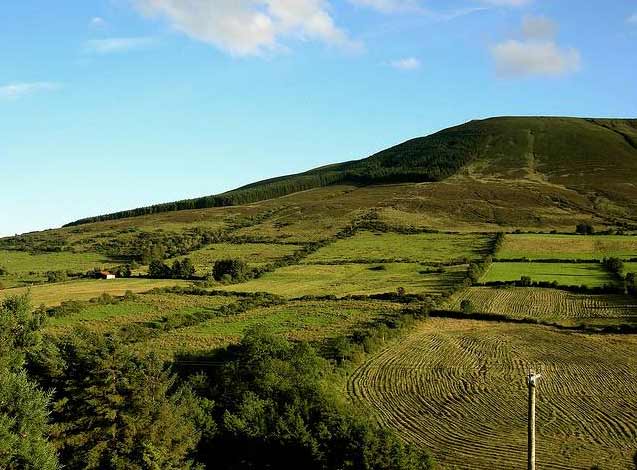
This is Keeper Hill, which was within walking distance from both Gortnaskehy and Fiddane Townland.
Click to enlarge.
|
Peasant Cottages of Tipperary The landscape was dotted with small cottages like those shown above (click to enlarge)...thatched roof with a little white wash on its sides. The Potato: * In 1836 the Poor Inquiry survey determined that one acre could yield an average of 6.5 to 8.5 tons of potatoes. One acre could feed 6 people annually. * One acre could feed 6 people for a year. The Irish ate potatoes 3 times a day, and was reported that men at 12-14 pounds a day (seems a stretch, i think). Potatoes were eaten boiled with the skin on, fried in butter or baked in the fireplace. * Potatoes were used to make poteen, a very strong liquor. It was considered to be among the most potent of alcoholic beverages in the world. It is also known as moonshine, and was outlawed in Ireland in 1661. The purpose of the law was not to save the peasant, but to levy a tax on all whiskey consumed in Ireland. Other Foods *Before the introduction of the potato into Ireland, the Irish typically at oat porridge. * Other products the Irish consumed included cabbage, wheat and turnips. Turnips and cabbage were mashed with potatoes and stewed in a concoction called "colcannon". Interestingly, Batt Ryan planted turnips the first year he homesteaded in Brule County. As his grandson Mark told us, "it was the last year he planted turnips", as the weather was not suitable for this crop. * The Irish seldom ate meat or bread. The average Irish peasant had meat and bread only once a year. Milk, on the other hand, was heavily consumed. * Wheat was grown widely. It was grown to pay the rent, and most of this was exported to England. |
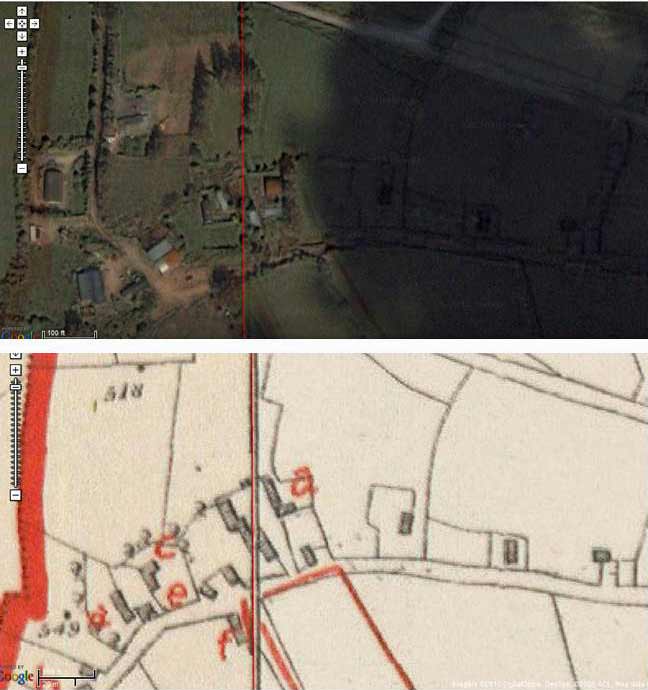
Gortnaskehy townland, specifically a cluster of homes on its northeastern border. The house listed as "d" (above) was John Campbell's home (Nancy Anne Campbell Ryan's brother). On the satellite map, it should be the farm on the bottom left. click to enlage.

So how "rich" were the Ryans?
The Irish peasant, in general, was not a wealthy class; but there were exceptions. In our family, we know that the Humphrey family was squarely in the middle class, even though they were Roman Catholic farmers. One of the Humphreys witnessed the our great-great-great Campbell grandparents marriage in Doonane (February 21, 1814).
When the Ryans came to America, they apparently had money. The family made their way to Quebec, courtesy of England who paid passage if the Irish immigrated to Canada or Australia. Unfortunately, 40% of the Irish immigrating to Canada made their way to the United States. We know that within a year, they sailed to New Orleans and made their way up the Mississippi by riverboat. Once they came to Allamakee County, they immediately purchased 3 farms (80 acres each) - James Sr., Denis, and John Boney. It seems that the family had a little wealth, and were able to use it to begin a new life in Iowa.