The Wisconsin neighborhood of Irish John Smith


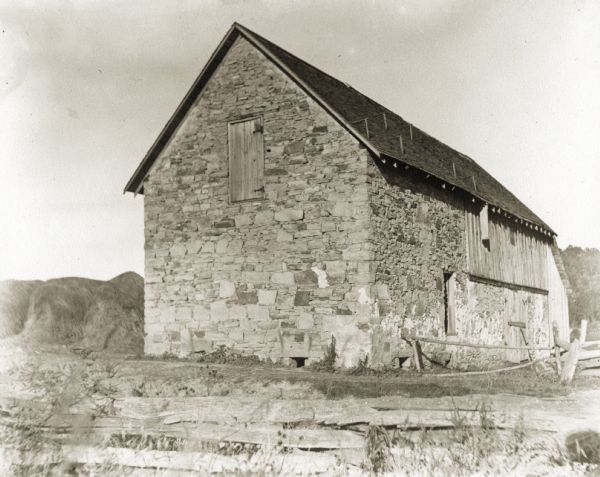
A Hops House in Franklin Township. Circa 1895. (click to Enlarge)

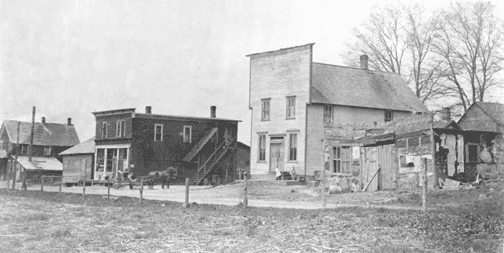
Main Street Cross Plains 40 years after John Smith worked on a farm near this small village. Circa 1909. (click to enlarge)
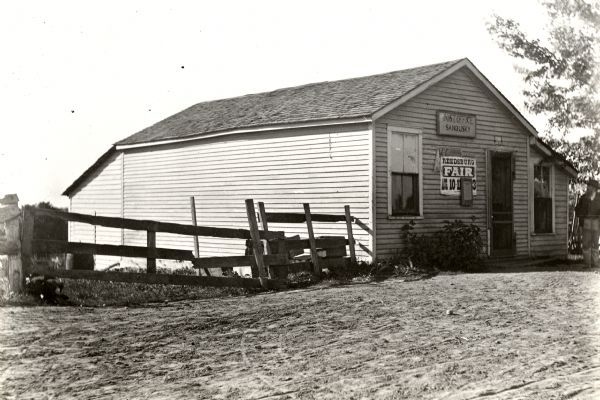
Post office in Sandusky, a small village a few miles north of Loreto. Circa 1910. Click to Large.
Irish John in Sauk County
These sentences that Bernard King wrote told us where Irish John Smith and his young family lived. Even though we drove through Franklin township, we didn't stop "to visit." See IJS.
"Susan McPhillips and John Smith fell in love and married in St. Mary’s Church, WS (?Bear Creek area) on April 14, 1874. Susan was 17 years old and John was about 27 years old. Family legend holds that when John returned to Bear Creek after the war he was given a free quarter of land because he was injured in the war. Their farm was in Franklin Township, Section 21 in 1877. It was there that their first (5) children were born (Peter, Michael (Mick), William, Mary and Catherine (Kitty). "
One of our action items is to find this military land grant. The practice of awarding land was fairly common in those days, but since so many land grants are not yet available on the GLO site, we will need to make a special request.
Below is a land grant awarded to "another John Smith" in Sauk County. He fought in the Indian Wars. A similar land grant was awarded to a second John Smith in Richland County for his service during the War of 1812.

Click to Enlarge
Franklin Township

(Click to Enlarge). This map shows Franklin township, and interestingly in 1857 there was a John Smith living in the area. Below is an article showing that Plain (also known as Logtown) was inside the township of Franklin.


Post office and St. Patrick's church in Loreto. Circa 1900. Click to Enlarge.
White Mound
by Bill
Schuette, Loganville, WI
Based on a history by Phyllis Dearborn, 2001
The ghost village
of White Mound (also known as Billy Town after William Welch who opened
a store there in 1899) was located near the banks of the northern branch
of Honey Creek, 5 miles north of Plain, on Valley View Road in Section
18, T10N, R3E, Franklin Township. It's name was probably derived from a
nearby outcropping of white limestone rock.
In 1851, J.B. Carpenter built a log house five miles north of Plain.
Known as the "Half-way House", it was a stopping place for stages
carrying passengers and mail operating between Spring Green and
Reedsburg.
A post office was established here around 1859, after the citizens
proved the need by carrying the mail weekly from Spring Green to the new
village of White Mound at their own expense for a year a test given by
the U.S. Government to determine that need. The post office closed in
1919.
The small village consisted of a church, cheese factory, store,
blacksmith shop, and a saloon with ice house. A two-sided stable, with
roof and open front was available during bad weather of patrons of the
store and saloon.
The Methodist church was the first building in town, constructed before
1877. During the late 1880's, as German Catholics moved into the area,
the English Methodists moved away. In 1902 the building was sold to
Richard Kaun and used as a granary.
A cheese factory was built on the nearby J. O'Malley farm in 1891 which
operated through various owners until 1936 when it closed. Farmers
brought their milk to the factory by horse and wagon. The cans were
lifted into the loft with hooks around the handles where it was weighed
and dumped into a large tank. Wood was burned which produced steam to
heat the vats where cheese was made. Harold Kaun recalled that for each
can of milk delivered, a farmer would receive back 2/3 of a can of whey,
which they took home to feed the pigs. During winter months, the factory
closed because cows were dry then.
Billy Welch opened a general store in 1899 next to the cheese factory.
It burned in 1901 and was rebuilt that same year. It was again destroyed
by fire on Halloween night in 1921 and not rebuilt Andy Hutter built a
blacksmith shop in the village in 1906.
The saloon was also built around 1906. Vera Bindle recalled that the bar
was on the first floor and an inside staircase led to bedrooms upstairs,
where stagecoach drivers sometimes bedded down for the night. An ice
house was adjacent to the building. The saloon was also consumed by
flames sometime around 1927.
At one time, White Mound was a very active and thriving community.
According to Hildegarde Thering's "History of Plain Wisconsin", an
orchestra was formed by locals which included violinists, John H and
Albert Liegel; George Liegel Sr. on base horn, John Mick, Clarinet, and
Rose Mick on the organ. It was known as the White Mound Orchestra. "A
toe-tapping good time could be had at gatherings, clapping and dancing
the squares sung by a caller," noted Phyllis Dearborn.
By the 1930's White Mound was only a memory, with a few cement
foundations remaining to remind folks that it existed at all.
The village of White Mound during the early 1900's |