

The Milesian McGonigles
The Historical and Milesian McGonigles County Donegal
Introduction
This is a hodge-podge of information concerning the historical McGonigle family. You will read about the origins of this surname, famous McGonigle kin who were kings and holy men, two famous Irish saints, and the Milesian ancestry for the McGonigle family. The latter is a fun piece as it takes the McGonigle clan back to the time of Noah. How many families can take their genealogical roots back that far? This article is the first in a series you will see regarding the McGonigle family.
Our Genealogical Heritage
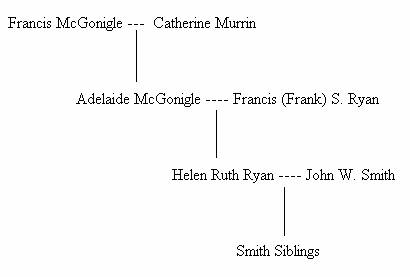
Just so no gets confused, I have added a genealogy chart which shows how the Smith family is related to the McGonigle family.
The McGonigle Surname
There are many variants to this name: McGonigle, McGonagle, McGonnigle, McGunnigal, McGonigal, MacGonigle, MacGonagle, Magonagle, Magonigele and Megonigle. In addition I have found misspellings of this name as well, such as McGonigile. You will find other variants such as Gonigle, McConville and Conwell. The English in their attempt to make all things English generally wrote the McGonigle surname as either ‘McConville’ or ‘MacConmhaoil’. This surname may appear as Conaghan in other parts of Donegal. Mid-nineteenth century land records for Killybegs show this surname spelled ‘McGonigle’. In the 1901 Irish Census for Killybegs this surname is spelled ‘McGonigal’. It really does not matter how you spell it as this name is an Anglicized form of the Gaelic name ‘Mag Congail’, which is a patronymic form of the personal name ‘Conghal’. The name ‘Conghal’ is composed of Celtic elements meaning ‘hound’ plus ‘valor’.
McGonigle Family and the Irish Catholic Church
The clan Mac Congail has long been associated with County Donegal. The name can also be seen in adjacent Irish Counties such as County Derry. This clan has been long connected to the Church. They were a herenagh family in Killybegs, which is a hereditary title. Herenaghs controlled and maintained Church land, and the Catholic Church in Killybegs is generally considered to be the McGonigle Church for County Donegal. Killybegs is part of the diocese of Raphoe, and in 1589 there were two bishops by that last name. The McGonigle family has a long tradition for religious life. Our branch of McGonigles came from the Killybegs area.
The Annals of Ireland by the Four Masters shows the surname ‘Mac Gonigal’ as early as 1238 AD. The Mac Congail (Mac Gonigal) clan was also counted among the warlike followers of O’Donnell.
The following was taken from the ‘Biographies of Ulster’ published in the nineteenth century.
McGONAGLE (Mac GONGAIL), DONALD
c.1520-1598
Donald McGonagle was a native of Killybegs, County Donegal, and in 1562 was
appointed Bishop of Raphoe. In the same year he was consecrated in Rome and took
part in the Council of Trent. He returned to Ireland and attended a provincial
synod in Ulster in 1587 when the decrees of the Council of Trent were
instigated. He lived in the Manor House at Killybegs and, according to a
manuscript in the British Library, 'could write well and spoke Latin and English
as well as Irish'.
The following information was taken from the Capuchin Annual; Publisher was Capuchin Franciscan Fathers, Dublin, 1976. The O’Donnell referred below was a powerful Irish King in Northern Ireland. The O’Donnell clan controlled great portions of Ulster for many, many years.
There is a manuscript in the British Museum giving a description of Doctor McGonagle as follows: - “He was an active and well qualified man. He could write well and spoke Latin and English as well as the Irish tongues. Commonly he accompanied O’Donnell when he came to Dublin before the State. He dealt much with the business of the Church, and at length he obtained letters under Sir Henry Sydney’s and Council’s hands, for the immunity of his church, that neither English nor Irish should have cess nor press upon Church lands. Should any person or persons offend contrary to the Lord Deputy and Concil’s order established in that behalf, it was ordered that such delinquent shall pay unto the Church tenfold as much as should be thus wrongfully exacted”.
Prior to the time of Bishop McGonagle the parishes of Killybegs and Killaghtee had been united under the vicarage of Cornelius McGonagle (another member of the Herenagh sept) in 1429, when Cornelius succeeded in displacing Christopher Mac Devenny from the parish of Killybegs and “could hold both:” the Conwell family like Herenagh septs elsewhere were obviously determined to retain control of the parish in the spiritual as well as the temporal spheres.
The Bishop of Raphoe in right of his bishopric was rector (parish priest) of Killybegs and had as his assistant a cleric with a status somewhere between vicar (curate) and rector that has been described as “endowed” vicar. Before Doctor McGonagle became bishop he was rector of Killaghtee and on his elevation he was given by the Holy See the special privilege of retaining that rectorship and adding the revenues of Killaghtee to those of the mensal parish of Killybegs. There was, of course, another vicar in the northern or Kilraine half of the parish, of which the sept of McGillespies were Herenaghs. Doctor Maguire relates there is a good reason to believe that Killaghtee only once regained its separate status after Bishop McGonagle’s day. (This status was in fact regained finally in 1973).
There is a very persistent tradition in the parish and throughout Tirconaill that when Doctor McGonagle went forth on his Episcopal duties he assumed the disguise of fish hawker, with his pony’s panniers filled with salted fish. It is somewhat difficult to reconcile this tradition with recorded facts but if the bishop feared molestation from any source, we can be sure that there were good grounds for such fear but if we are to accept the aforementioned manuscript in the British Museum that the Bishop commonly went out with O’Donnell before the State, and had obtained concessions from the Lord Deputy and Council it would seem a contradiction that he should be ‘on his keeping’ in his own diocese. Of course his was a long episcopate and a time of sometimes rapid and dramatic change in matters of religion, as well as in the loyalties of his native chieftains, and the bishop may have felt the need to have a care. He may well have incurred the displeasure if not enmity of one or more of the local chieftains for probable, merited condemnation of their actions. We have no record or tradition of the relationship which existed between the bishop and the McSwynes, chiefs of Tirboghaine (Bannagh) a branch of which resided in close proximity to the bishop’s manor, at their case in Killybegs. The succession to this chieftainship was more than once during Doctor McGonagle’s reign an occasion of fratricidal strife. Donough, last chief of the name, disposed of his predecessor and rival Niall Mirgeach, his uncle, in a bloody encounter in 1588 (the year of the destruction of the Spanish Armada) and the same Niall Mirgeach two years before had disposed of his rival and kinsman Brian Og McSwyne in the same bloody manner.

McGonigle - Descendents of Kings
The family name McGonigle was recorded in County Donegal from ancient times. The name is taken from the Irish ‘Mag-Congail’, meaning ‘son of the most valorous one’. McGonigles claim descendance from Conaill Gulban, son of King Niall of the Nine Hostages, the great General and Irish king, who died in France in the year 365 Anno Domini. Their original territories were in Tirconnell. They became distinguished ecclesiastics of North Ireland and by the 15th Century had branched into West Tyrone County. Later in this document you will see this descendency in greater detail.
Conaill or Conall Gulban was the son of Niall Noigiallach, an Irish King who founded the kingdom of Tir Conaill in the 5th Century, comprising much of what is now County Donegal. His descendents were known as the Cenel Conaill. King Conall Gulban was murdered by the Masraighe at Magh Slecht sometime in the 5th Century.
The Cenel nEogan, descended from Conall’s brother, Eoghan. The Cenel nEogan became the other premier Ui Neill sept in Fochla, also known as In Tuisceart. Their kingdom was known as Tir Eoghain, which is now modern day County Tyrone. The Kings of Tir Conaill and the Kings of Tir Eoghain were very powerful in their time. They comprised the last native rulers and fled in the incident known as the Flight of the Earls.
George Washington
The most powerful of Conall Gulban’s descendents were the Dunkeld Royal House of the Kings of Scotland (11th – 13th century), and the O’Donnell clan. The O’Donnell clan became the Kings of Tir Conaill (Conall’s land) and Inishowen. They were also Overlords of Connaught as well as many less powerful noble houses of Scotland, Ireland and England. Among his famous descendents was the Washington family of northern England, including one named ‘George Washington’.
Descendents of Conall Gulban
Through Conall Gulban other great Irish families trace their heritage. Two powerful Irish families, O’Donnell and O’Neill, also trace their ancestry through this early Irish King. In addition of McGonigle, there are many notable northern Uí Neill clans such as O'Neill, O'Donnell, MacLoughlin, O'Donnelly, O'Doherty, O'Cannon, O'Muldory, O'Kane, O'Gallaghers, O'Gormley, O’Flaherty or O’Laverty, O'Hamill, O'Lunney, O'Carolan of Clan Diarmada, among many others.
The chart below shows the lines descended from Conall Gulban.
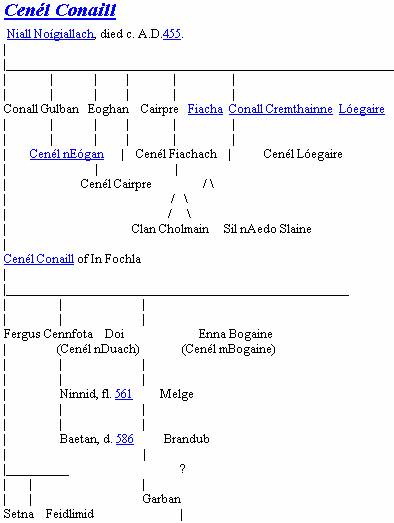


The following is another way to look at the Cenel Conaill family chart shown above:
Cenél Conaill Sovereigns of Ireland
Other Lords
St. Patrick
I found the following on-line and thought it of interest as it relates to the McGonigle family’s early ancestor. These four items are part of Irish folklore which associate St. Patrick with the Beltany area. (Source: Saint Patrick’s World, by Pe Paor, Liam. Published 1993)
1. Folklore: ‘The church at Donaghmore was a Patrician foundation’. Bishop Tirechan’s account of St. Patrick states that Patrick “proceeded through the Pass of the Sons of Conall to Mag Itho and founded a great church there”.
2. Folklore: ‘A wheel came off the saint’s chariot crossing at Tyleford. He sent to Ballindrait and Rossgeir for help to repair his wheel. People refused to come. The saint cursed these two places and said Ballindrait and Rossgeir would never prosper and become cities’. The legend of losing the chariot wheel at Tyleford is a local legend and must be of very early origin. It would be difficult to place this story anywhere else in Donegal or the rest of Ireland.
3. Folklore: ‘The saint met Conall Gulban and his two sons Fergus and Conaill on Croaghan Hill. The saint ran forward to bless Fergus and prophesied that his line would produce a great saint. He was to become the grandfather of Saint Columcille. Saint Patrick marked Conall’s shield with a cross as a token that he and his descendents would defend the faith’. Local folklore has Conall Gulban living at Croaghan Hill where he and his family received a blessing from St. Patrick thus establishing a Christian basis for continuing in their patrimony of Tirconaill. Yet, Bishop Tirechan’s account of St. Patrick states,
“He came to Conall son of Niall, in the house that he had built for himself where the Great Church of Patrick is now (Donaghpatrick, County Meath). Conall received him with great joy. Patrick baptized him and established his throne forever”.
The Croaghan Hill legend appears to be one of these stories where times and place have been changed to give credence to a claim which may have had an unsteady foundation. When this tale first became current, there may well have been tribes still living in the area that had different loyalties. Perhaps they recalled earlier rulers of Tirconnell who came from a different dynasty that may have been pre-Christian and possibly from Ard Macha.
4. Folklore: ‘St. Columcille’s grandmother was born beside a well where St. Patrick’s church, Murlog, now stands. She became one of Patrick’s early converts. He was also said to have blessed the well at Liskey’. This lady left a will dividing her property in Clonleigh parish amongst her sons. She seems to have come from the Dalriadan branch of the Ulidians. She married to Conall Gulban’s eldest son, who was also named Conall, by whom she had a family. Conall the younger appears to have died at an early age. The widow married Conall Gulban’s other son, Fergal. Fergal and this woman were grandparents to St. Columcille. Conall Gulban’s family, who were the conquering invaders, would appear to have needed her in order to consolidate their dynastic control over Magh Ith. She for her part seems to have encouraged the Christian religion and some of her sons founded the first monastery at Coolatee near Lifford.

Very Short Story of the McGonigle Family
The McGonigle name was extremely rare in Ireland except in Inishowen Peninsula in County Donegal. This name is also common in Tyrone, Galway and in some parts of County Sligo. “Mac Gonigal” is derived from the Gaelic “Mac Congail” or “son of Congail”. This Congail was Congail (Conall) Gulban, son of Ard Ri Niall. He was the high King of Ireland at the time that Saint Patrick was taken prisoner and enslaved in northern Ireland. Congail’s name also means ‘fierce as the wolf’ which might reflect his character. Not very much in the way of folklore surrounds Conall, but his father was legendary. Conall’s father, Neil, was known as ‘Neil of the Nine Hostages’ because he was behind many raids on Britain and France at that time.
Variations for McGonigle include variations of ‘Mc’ or “Mac’ surnames: Gonigle, Gonegle, Gonagle, Gonigal, Gonegal, Gonagal, Gonigul, Gonegul, Gonagul, Garingle, Gunnigle, Carnicle, Conway, Conwey, Convey, Conwell or Monigle. One sees McGonigle or its variant in this part of Ulster.
The Milesian Ancestry: Ancient Ireland
The Leabhar Gabhála (Book of Invasions) is the most important record of the legendary history of Ireland and the Gaels. Written in the 11th century, it has been described as being of "fundamental and enduring importance to the shaping of Irish historical thought."
Leabhar Gabhála begins with the creation of the world and the origins of the Gaels, and proceeds through Irish legendary history with accounts of the Firbolg and the Tuatha De Dannan, to name just a few of the major figures of Irish legend. One of the last invasions of Ireland recorded in the book is that of the Milesians, also known as the Gaels or the Sons of Mil. These people are said to be the true ancestors of the Irish race.
The legend of the Milesians is an amazing one, and covers half the then known world. This brief version of the story starts in Scythia, the name given by the ancient Greeks after about 800 BC to the homeland of the Scythians in the southeast part of Europe, eastward from the Carpathian Mountains to the Don River.
Scythia was ruled by the King Fenius and was the land of a nomadic people famous for their horsemanship. One day a poisonous snake bit the King's grandson Gaedhuil (Green Gael). His father, Nuil, carried the boy to the Israelites, where Moses healed him with his staff.
Moses told the boy that his descendants would travel to a land where there were no snakes, an island in fact that lay in the setting track of the sun (to the west). Later in the story after much traveling either Gaedhuil, with a new name of Milesius, or a son of Gaedhuil with this name is found in Spain. Here he has a wife named Scota who is the daughter of an Egyptian Pharaoh and he is a King of the land.
Milesius had a brother named Ith, who discovered an Island. In the course of investigating whether it was the legendary Innisfail (Island of Destiny), Ith was wounded by the Tuatha de Danaan (Gaelic for People of the Goddess Danu), and died on the journey home to Spain. Upon their arrival home, the remaining explorers found that King Milesius had died. His sons along with their mother Scota led a force that returned to punish the Tuatha de Danaan for killing Ith. After a large battle they conquered the Tuatha de Danaan and took control of Ireland. The mother Scota was killed in the fight and her surviving sons, Eber and Eremon, became rulers of the land.
Eremon took the northern half of the Island while Eber took the south. The northeastern corner was given to the people of their brother Ir who had also died in the fight, and the southwestern corner was given to their cousin Lughaid, the son of Ith who had died discovering the island.
The sixteenth century scholar, O'Flaherty, fixes the Milesian invasion of Ireland at about 1000 B.C. - the time of Solomon. Others give varying dates for this invasion from 3,500 BC to 300 BC. Like other legendary histories based on oral tradition, monks who interpreted them from a Christian perspective documented these stories. Over the passage of time these stories have been augmented and changed so that it has become virtually impossible to sift fact from fiction.
Nonetheless, there are many other sources of information that survive to this day which support the existence of the Milesians as a race. The Old Irish genealogies record the Kings of the Milesian line, many of whom are verified by other records and archeological information.
Some of the more famous Kings of the Milesian line are Ereman (first), Tighernmas (seventh), Ollam Fodla (twentyfirst), Niall of the Nine Hostages, Conn of the Hundred Battles and many more. Almost all of leading families of Ulster, Leinster and Connaught trace their descent from Ugani Mor (the Great) another of the Kings of this line.
That the Milesians existed is no longer a question of merit. Whether they came in a Celtic wave from France or from Spain as the stories suggest remains to be seen. The truth of their origin and time of settlement in Ireland is the real question that needs to be answered.