Irish John Smith's Journey in 1908
The Relatives of Urcher, County Monoghan, home to the Greenans and Catherine.
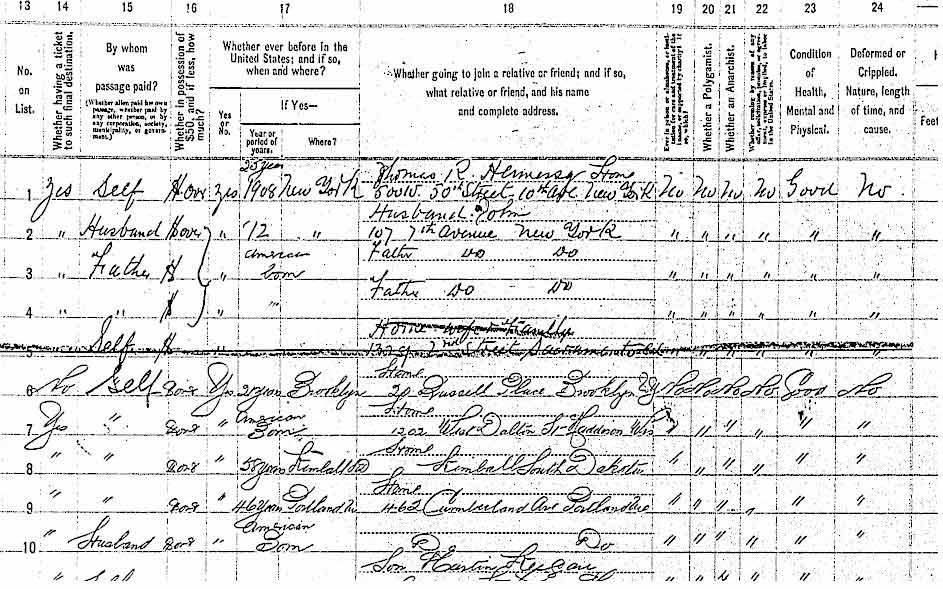
| We know Irish John visited two Greenan
families in Urcher - John and Terrence. Urcher Townland can be found
near Aghabog Civil Parish in neighboring Kilmore Civil Parish. This
townland is located about 2 miles to the northeast of Rossnaglogh East
Townland, Aghabog Parish, County Monaghan. This townland has long been of interest in our research. It is the only time we saw the name 'Terrance Greenan' listed in the Griffith Valuation Surveys. These surveys are considered census substitutes for the mid-nineteenth century. Terrance Greenan was the brother of our great-great grandmother, Catharine Greenan Smyth. You will also see something else of interest in the Griffith Valuation Survey. Near Terrance Greenan lived a Catharine Smyth. These surveys began in 1848, or one year after Peter Smyth's death in 1847. |
|
|||||||||||||||
Click to Enlarge. Census of Urcher, as referenced by John Smith.
 |
Irish John met an Irish Greenan cousin
in Mill Town. Milltown townland is located just south of
Rossnaglogh East in neighboring Ematris Civil Parish. In the
mid-nineteenth century there lived two Greenan families - Edward and
William. Both leased land in this townland, and they lived side by
side. These families would be related to Irish John on his mother's
side. John's mother was born Catharine Greenan.
Click to Enlarge |
|||||||||
 |
 |
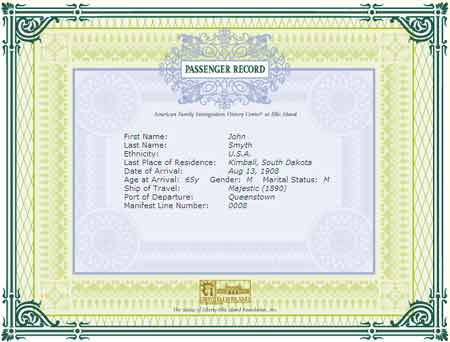
Boarding certificates & records of voyage. Notice that John Smith lists his surname as "Smyth". Below are the Manifests for the trip that Peter and John Smith/Smyth took to Ireland.
|
|
Click to Enlarge |
| Tullycorbet Parish -
& Blackrock (Sisters of Mercy) The Roman Catholic
Church document actually has several items. First, it lists the
address of Tullycorbet Parish, which is located in Ballybay. I also
added information about Ballybay, which is taken from Lewis's
Topographic Dictionary printed originally around 1834. |
RELIGIOUS ORDERS SISTERS OF MERCY The Sisters of Mercy in the Derry Diocese are part of the Northern Province. Their headquarters are in Clogher, Co Tyrone. At the invitation of the Bishop of Derry, Most Reverend Edward McGinn, Mother Mary Ann Doyle, Convent of Mercy, Tullamore, County Offaly, founded the first Convent of Mercy in the diocese at Pump Street, Derry City on July 21, 1848. The Convent of Mercy in Strabane was founded on June 9, 1868, by Mother Catherine Atkinson from the Mercy in Navan. The Bishop then was Most Reverend Francis Kelly. On Monday, July 26, 1982, the Bishop of Derry, Most Reverend Edward Daly, officially inaugurated the Union of the sisters of Mercy of the Diocese of Derry at a ceremony in the convent Chapel in Thornhill. The first superior elected on that occasion was Sister Mary Gertrude Teresa Gallagley. |
Civil Parish: Tullycorbet
Map Grid: 8
RC Parish: Tullycorbet
Diocese: CG
Earliest Record: B. 4.1862; M. 5.1862
Parish address: Ballybay, Co. Monaghan

Civil Parish: Ballybay
Map Grid: 17
RC Parish: part Tallcorbet; part Aughnamullen East
Diocese: CG
********************************

BALLIBAY, a market and post-town, and a parish, partly in the barony of
 MONAGHAN, but chiefly in that of CREMORNE, county of MONAGHAN, and
 province of ULSTER, 8 miles (S. by E.) from Monaghan, and 50 miles (N. W.
 by N.) from Dublin; containing 6685 inhabitants, of which number, 1947
 are in the town. This place, which is situated at the intersection of
 the roads from Castle-Blayney to Cootehill and Clones, and from
 Carrickmacross to Monaghan, derives its name from a pass between the lakes at
 the southern extremity of the town. A battle was fought in the vicinity,
 at a place called Ballydian, between De Courcy, first Earl of Ulster,
 and the Mac Mahons and O'Carrols. Prior to the introduction of the
 linen manufacture the town was of very little importance; but since, the
 establishment of its linen market about the middle of the last century,
 it has rapidly advanced, and now contains about 400 houses, many of
 which are respectable and comfortably built, and has become the principal
 mart for the inhabitants of the surrounding country. The manufacture of
 linen, of a texture from nine to fourteen hundreds, is extensively
 carried on throughout the parish. The market is on Saturday, and is amply
 supplied; great quantities of butter are sold, and from October to
 February inclusive not less than from 8000 to 12,000 stone of flax is sold
 weekly: there are also extensive markets for grain on Tuesday and
 Friday. Fairs are held on the third Saturday in every month, and are
 remarkable for large sales of horses, horned cattle, and pigs. A reading
 society was established in 1816, and is supported by a proprietary of annual
 subscribers; the library contains nearly 1000 volumes. Petty sessions
 are held in the market-house irregularly: and here is a constabulary
 police station.

The parish comprises, according to the Ordnance survey, 874l 1/4statute
 acres, of which 181 are in the barony of Monaghan, and 8560 1/4in that
 of Cremorne; 180 acres are under water. It was formed by act of
 council in 1796, by separating from the parishes of Tullycorbet and
 Aughnamullen several townlands, ap-plotted under the tithe act and valued at
 £6957 per annum. Its surface is studded with lakes and boldly diversified
 with hills and dales. About four miles from the town is the mountain of
 Bunnanimma, at the base of which are bleach-greens and mills. The
 approach to the town opens upon an extremely beautiful and picturesque
 tract of country. To the east are seen, at the distance of 20 miles, the
 deep blue summits of the lofty Slievegullion, with the village, about a
 quarter of a mile beneath, apparently embosomed in hills and situated on
 the margin of a lake a mile in diameter, which forms its boundary on
 the east and south, and is itself bounded by a rich amphitheatre of
 woods. The soil is of a fair average quality, but agriculture is not in a
 very forward state: the growth of flax has been much encouraged, and
 large quantities of very good quality are raised. There is no waste land.
 Very extensive tracts of bog supply the inhabitants and the various
 works with abundance of fuel; so great is the quantity consumed that many
 of the manufacturers employ from 60 to 100 persons for three months
 every year to dig and prepare it. The draining of these bogs, and the
 numerous population around the works, have caused a great change in the
 climate of the Bunnanimma mountain, which formerly was liable to be
 enveloped in thick fogs for ten or twelve days successively; but now the
 drying of the turf is seldom interrupted for a single day. The mountain
 lands, though naturally very poor, have on this side been nearly
 reclaimed. The prevailing substratum is whinstone; slate also exists, and was
 formerly quarried for roofing; and there are extensive quarries of
 greenstone, called " Ribbil," of which the town is built. A lead mine was
 opened at Laragh, about half a mile from the town, but it has not been
 worked since 1826; it is very rich in ore, and from silver found in it has
 been manufactured some plate in the possession of Col. C. A. Leslie.
 About half a mile from the town is Ballibay House, the seat of that
 gentleman, on whose estate the town is built; it is a handsome and spacious
 mansion beautifully situated on the border of a lake, and backed by
 some extensive plantations. The other principal residences in the parish
 are Derry Valley, the seat of T. McCullagh, Esq.; Aghralane, of T.
 Lucas, Esq.; and Lake View, the residence of the Rev. Hercules Langrishe,
 the incumbent.

The living is a rectory and vicarage, in the diocese of Clogher, and in
 the patronage of the Bishop: the tithes amount to £383. 5. The church
 is a neat edifice occupying a romantic situation on an eminence rising
 abruptly from the lake; the east window is embellished with stained
 glass, and there are some tablets to the memory of the Leslie family. The
 glebe-house is a handsome residence, towards the erection of which the
 late Board of First Fruits gave £100: the glebe comprises 25 acres. In
 the R. C. divisions this parish forms part of the union or district of
 Tullycorbet: the chapel is situated at Ballintra, about a mile and a
 half from the town; and there is a small chapel of ease in the town,
 connected with the clergyman's residence. There are two places of worship
 for Presbyterians in connection with the Synod of Ulster; one of which,
 in the town, is a handsome building in the later English style, and is
 of the second class; the other is about a mile distant, and nearly
 adjoining it is a place of worship for Seceders. About 150 boys and 110
 girls are taught in four public schools; and there are also six hedge
 schools, in which are about 140 boys and 70 girls; and two Sunday schools.
 A dispensary is open two days in the week for the gratuitous aid of the
 poor.

*********************************************************************

BLACKROCK, a village, in the parish of HAGGARDSTOWN, barony of UPPER
 DUNDALK, county of LOUTH, and province of LEINSTER, 2 miles (E.) from
 Dundalk; containing 434 inhabitants. This place is situated on the bay of
 Dundalk, and contains about 80 houses, which are neatly built. The
 beach is smooth and soft, and peculiarly adapted to sea-bathing; and, if
 due accommodation were provided for visiters, it might become a
 watering-place of general attraction. It is at present much frequented, during
 the summer season, by the farmers of the inland counties, both for the
 purposes of bathing and drinking the sea-water. Alexander Shekelton,
 Esq., of Dundalk, has a beautiful marine villa here. --See HAGGARDSTOWN.
|
|
|
||