Land Evictions
Land Evictions in Tipperary
Absentee landlords were common in Ireland and for many landlords the primary focus was income rather than their tenants welfare. Many landlords realized that they could get a higher income by turning their properties into pasture than continue with the old practice of collecting rents from tenant farmers. Poor Law Unions taxed landowners by the number of houses built on their properties regardless of condition. Evictions were the most common way of getting rid of unwanted tenants, reduce overhead and taxes.
The tenant farmer frequently built his cottage from local materials. However, his rent was higher if he had windows, if his door was over a certain height and if he made any type of improvements or enlargements to the dwelling.

Landlords practiced "Rack Renting" in order to get rid of unwanted tenants. Rents were raised to the point that the tenant could not afford to pay them. The landlord then had the tenant evicted for non payment of rent. There were no appeals, no mercy shown, and best of all for the landlord this was all perfectly legal.
Although the only legal reason for eviction was non payment of rent there were numerous examples of landlords who evicted tenants if they did not conform to the landlord's wishes. During the height of the Irish Famine it was estimated 10% of Tipperary’s population was evicted.
The following news articles appeared in Irish newspapers nationwide, which described evictions in Tipperary and its effect on the local Irish. In fact, newspaper editors were appalled by the huge number of tenants evicted each week. It did not matter whether the tenants were old or young, sick or healthy, man or child, male or female. Many landowners no longer lived in Ireland and did not have to face their tenants languishing on the side of a road with no place to go.
EVICTION OF TENANTRY.
Waterford Chronicle; Waterford, Ireland; June 14, 1845
Dublin Evening Post gives an account of numerous evictions in Carlow and Tipperary. On the estates of one nobleman in the latter county, 253 families have been turned out within a few years, and several more are under notice. The Kilkenny Journal gives us a list of 255 persons ejected from one property in the county of Carlow, in order that a "Protestant Colony" should be established. That journal adds --"We have further heard that some of the oldest and most respectable inhabitants of the town of Borris whose leases have expired and who have always paid their rents well, are warned off--one in particular, it is said, was told that he should expect no quarter as his son was seen to wear a repeal button. Here, too, must be established a little Protestant colony. To the credit of Lord Courtown, who has considerable property in this persecuted district, he and his agent treated all tenants alike who voted at different sides, not the least distinction has been made. Though some who voted for the Liberal candidates were heavily in arrears, they received the same indulgence as those who voted at the other side."
**************************************************
Violence in Ireland was all too common during the famine years, and Tipperary was no exception. Local Irish outraged over the double whammy of starvation and eviction, assaulted landowners and their agents alike. As described in the following article three men - James Tracy, Martin Tracy and an unidentified man named Hill - chased Edmond Ransford who hid in a house where he finally was shot by Martin Tracy. Ransford earlier evicted the Tracys from their home. The surname ‘Hill’ is interesting but not surprising. Early 19th century Newport baptismal records show three sons (John, William, and Michael) born to Francis Hill and Bridget Tracy. So it appears the Tracy boys and Hill were possibly all related. Francis Hill is related to our ancestor, Edward Hill.
MURDEROUS OUTRAGE
Derry Journal; Londonderry, Ireland; November 5, 1844
On Wednesday evening about eight o'clock, as a man named John Ransford was proceeding from Bird Hill towards Ballinahinch, he was met by a party of four or five armed men, who immediately attacked him, beating him severely on the head. He, however, escaped, and ran along the road to the house of a relative named Edmond Ransford, and knocked at the door, which was fastened. Before the door was opened his pursuers approached, and he was obliged to fly again. He ran on to the next house, pursued by the armed men, and, the door being fortunately unfastened, gained admittance. He had scarcely entered the place when a shot was fired, which wounded him in the thigh, but without breaking the bone. In the meantime, Edmond Ransford had followed the assailants, and, on the shot being fired, went and informed the police at the Murragh station, about a mile and a half distant from the scene of the outrage. Sergeant Goore instantly ordered out a party of the police, and pursued the ruffians, who, after firing the shot, fled in the direction of O'Brien's Bridge. After proceeding about two or three miles into the county of Clare, he succeeded in arresting three men, named Martin Tracy, James Tracy, and Hill. Edmond Ransford has since fully identified Martin Tracy as the man who fired the shot. John Ransford lies at Ballynahinch dangerously ill, and but few hopes are entertained of his recovery. The cause assigned for the murderous attack is a spirit of revenge, instigated by Ransford having taken some land from which the Tracys had been evicted. -- Tipperary Vindicator.
*********************************
Some of this violence hit close to our Ryan family’s home in Gortnaskehy. Even though our great-great grandparents, James and Ann Ryan, lived in Gortnaskehy, they may have leased land in Fiddane Townland too. The following story would have been well known to our ancestors. Patrick Madden assaulted James Shea, process server, who tried serving him a writ for nonpayment of rent. Shea traveled to Fiddane with five writs in his pocket. The first few houses he approached no one answered, but he got a different response when he tried serving a writ on the Madden residence. Shea walked toward the Madden yard when two men bolted on him. Someone yelled, "Shoot him! Shoot him!" One man had a brass pistol and the other had a “short one”. Then Shea heard what he though was the crack flash of a pistol behind him, and as he turned around he was struck with a rock. In court Madden claimed Shea only heard the crack of a hammer blow on wood. The map below shows Fiddane Townland and adjacent Townlands.

Outrage in Fiddane
Newry Telegraph; Newry, Ireland; March 26, 1846
Patrick Madden was given in charge for inflicting grievous bodily harm on the person of James Shea, at Fiddane, near Newport, in May, 1843.
James Shea deposed to having been sent by Mr. Sandy Boucher, Solicitor, of Limerick, to serve writs on Mr. Roses’ tenants at Fiddane; he took a letter to the driver, John Liddane; having stopped at his house that night, they both went the next day to serve the writs; having gone to two houses, they found them shut; on going into the bawn of a third house, two men rushed in on them; they did not mind Liddane, but ran at witness; one of them was armed with a large horse pistol, and the other with a smaller pistol; witness ran for his life; the two men followed; he heard the snap of a pistol; he turned back several times, but they had their faces spotted, or slightly blackened; when they closed on witness, he pulled out a pistol and missed fire at them; he then got a blow of a stone, which knocked him on his knee; they then beat him with a stick, until they fractured his skull, as the Doctor told him; he was five months unable to do anything from the effects, for he is a little deaf; the prisoner at the bar is one of the men who beat him; he had not the least doubt about him; he identified him among thirty-six men in Major Voke's yard, at Limerick.
His LORDSHIP charged briefly, and the Jury, after some deliberation, found a verdict of Guilty. The prisoner was removed.
*****************************************
BONEY EVICTION
This eviction, although undated, serves as an example of ‘Tenancy at Will’ in Irish legal books and documents. This eviction was cited during the latter 19th century while drafting legislation to curb landlord abuses and redefine lessee rights. James Boney was ingloriously evicted from his home after making many improvements to it.
The History of Law of Tenures of Land in England and Ireland with Particular Reference to Inheritable Tenancy; Leasehold Tenure; Tenancy at Will; and Tenant Rights; William Francis Finlason; Stevens & Hayes Publisher; 1870; page 146
“...In the third case the man ejected, James Boney, had only a house, for which he paid 30s. A year. There was a time that Boney had also a little farm, but the landlord long ejected him from that, and then let him the skeleton of a house at the rent named, with a promise to give him timber and slates to roof it if he did the remaining work himself. The house is now roofed and covered. The landlord was offered by Boney the amount of rent due and the cost of the ejectment -- but no; we presume he ‘wanted the house,’ and so he has got it. To Boney he would not give even a yearly tenancy, for then he could not eject him without a six months’ notice, and so he has had to pay 3 pounds as compensation to Boney for his labour in roofing the house.”
********************
Extreme Poverty in Newport Parish
Things got so bad in Tipperary during the Famine years that notices seen below appeared in local newspapers. These notices described destitute Irish families headed by men unable to find work. In the first notice, James Brien of Kilnacappagh stated he wanted work but could not find employment. We believe our ancestor, James Ryan, was born in Kilnacappagh Townland to Dennis Ryan and Mary Gleason. Mary Brien served as baptismal sponsor for one of Dennis Ryan’s sons.
Limerick Reporter; County Limerick; November 6, 1846


**********************************
Forcible Re-entry After Eviction
Tipperary Free Press; March 23, 1837, page 2
MONDAY - Before Baron Foster.
William and John Dwyer, William Burke, Patrick and Bartholomew Ryan, forcible possession. The prisoners party were evicted on the expiration of a lease. They, in the first instance, gave up the peaceable possession; but when the lands were set to another they re-entered. The land belongs to Lord Stanley...verdict, guilty.
****************************
In 1848 Irish newspapers nationwide reported widespread tenant evictions going on in County Tipperary. 1848 may be the same year our Hill ancestors were evicted from their homes and when they moved to America. The following three articles describe evictions in Newport and Killoscully Parishes, places where our own ancestors lived. In the first article we discover the Catholic Church in Birdhill (part of Birdhill Catholic Parish) was forcibly seized by the landowner. In the second article we learn Killoscully Parish tenants were wholesale cleared from their land. Killoscully Parish is where our Edward Hill family ancestors lived. We learned about a Humphreys family that had means to pay rent in advance but were forcibly evicted as well.

The third article is unusual in that it actually reports the family names of those who were evicted from their land. Normally this information was not readily available to news reporters. Interesting enough it indicates various Humphreys families from Doonane Townland were evicted. James Humphreys served as sponsor to our great-great-great grandparents’ wedding (James Campbell and Mary Carew). As a reminder, their daughter, Nancy Ann Campbell, married our ancestor, James Ryan.
EVICTION OF TENANTRY.
Waterford Chronicle; Waterford, Ireland; April 22, 1848
The Tipperary Vindicator in detailing the eviction of 189 human beings from the lands of Birdhill, in that county, gives the following:--
Mr. Twiss, accompanied by Mr. Gason, Deputy Sub-Sheriff, and a large police force, proceeded to the Roman Catholic Chapel of Bird Hill on Friday, and took possession of it as well as the holding of some of the persons above mentioned. No sooner had Messrs. Twiss and Gason, the deputy, invaded the holy precincts of the Chapel, than the former presented himself to a number of Catholic spectators on the road and delivered a harangue on the conditions by which he would give to the parishioners a lease of the Chapel, namely, that is should be used for religious purposes, and none others. There was no one present to receive the possession, nor, I believe, did the Catholic Ecclesiastical authorities deign to notice the proceedings.
Newport, April 17, 1848
MY DEAR MR. LENIHAN -- As you seem to be already in possession of the affair of Bird Hill, so far as last Friday's business, I have no further information to give you on that bead except, that I had to offer the Holy Sacrifice of the Mass on yesterday in a house on the mail coach road, the congregation kneeling in the puddle under heavy rain. I remain, dear sir, yours,
R. BURKE, P.P.
EVICTION AT NEWPORT.
Limerick and Clare Examiner; Limerick, Ireland; July 1, 1848
Every post, every day, every hour brings us accounts of evictions, of the havoc of families turned out on the world to beg or starve. In our last the letter published from our special CORRESPONDENT told us sad and truthful tales of the desolation of Clare and the all but consummated destruction of the rural population of the Kilrush union. We can to-day speak from documentary evidence of the sad effects of the clearance system in the parish of Killoscully, near Newport. A family of the name of Humphreys, in comfortable circumstances, able to pay their rents up to the day of their eviction, and willing to afford security for the ensuring year's rent, have been recently turned out by a landlord of the name of Philips, of Mount Rivers.--This Mr. Philips is the bosom friend of Mr. Twiss, of Bird-Hill, near the Stirnbout nursery. We shall return to this subject again.
EVICTIONS IN THE HALF BARONY OF OWNEY, COUNTY TIPPERARY.
Southern Reporter and Cork Commercial Courier; Cork, Ireland; August 31, 1848
A faith worthy correspondent furnishes us with the following list of the number of families recently ejected from their holdings on two properties, in the parish of Killoscully and above barony. From the Townlands of Curraghduff, and Crossguile, the estate of the Rev. Mr. Roe, but at present under the courts:--
Daniel Corboy, 5 in family; Michael Corboy, sen. 5; Michael Corboy, jun. 1; John O'Brien, 3; Kennedy Ryan, 3; Misses Boland 2; Pat Mara, 4; Denis Humphreys, 3; Michael Waltho, 8; James Waltho, 3; Widow Waltho, 6; Pat Fogarty, 7; Andy Ryan, 6; Larry Gleeson, 8; Widow Dwyer, 5; Widow Cyan, 6; Widow Moylan, 7; John Ryan 6; Widow Boland 3; Denis Slattery, 7; John Flannery, 5; amounting in the whole to the appalling number of 104 human beings! cast upon the world without the shelter of a roof. From the Townland of Doonane, adjoining the above, and being the estate of Richard Philipps, Esq., the following have been ejected:--
Thomas Collins, 7 in family; Widow Humphreys, 9; David Humphreys, 7; John Humphreys, 6; Pat Collins, 3--in all 32 persons.
Nor is this all. In the same ill-fated parish Lord Bloomfield has evicted a great number whose names, with the particulars of their cases, our correspondent is at present engaged in procuring; and Mr. Augustus Stafford (not O'Brien) has likewise added his mite of the exercise of landlord power to thin the "superabundant population." God grant patience to these unfortunate victims of a ruthless code! -- Limerick Reporter
**********************************
The good Rector of Nenagh placed this notice in the Tipperary Vindicator stating he had nothing to do with the recent evictions. Violence against landowners grew more commonplace during the famine years.
EVICTIONS IN OWNEY AND ARRA
September 4, 1848 - The Pilot - Dublin, Dublin, Republic of Ireland
“We are authorized by the Rev. James Hill Poe, Rector of Nenagh, to state that he has not had anything whatever to do with the eviction of a number of families near Newport, not being in any way connected with that property. -- Tipperary Vindicator.
************************************
As we say in the United States, ‘Fiddane be Crazy!’ Here is another example where Irish tenants in Fiddane Townland conspired to murder land bailiff, Timothy Leddin. Various news items about this same incident did not clearly state the reason why Leddin thought his murder was imminent.
CONSPIRACY TO MURDER.
Clare Journal, and Ennis Advertiser; July 5, 1849
A few days ago, a conspiracy to murder Timothy Leddin, land bailiff and under agent to Mr. Roe, Solicitor was discovered by the police authorities.-- It is alleged to have been got up by some tenants on the lands of Fiddane, near Newport, in consequence of Leddin being an obnoxious character in that part of the country, and being about to prosecute some of them at the approaching Quarter Sessions of Nenagh for assault and rescue.-- Nenagh Guardian.
***********************************
Eviction notices increasingly became too common and newspapers around Ireland took notice. More than one parish priest wrote letters to the editor about these outrageous evictions happening all over the country.

EVICTIONS FOR NO GOOD REASON
Tipperary Vindicator; December 16, 1848
“The work of undermining the population is going on stealthily, but steadily. Each succeeding day witnesses its devastations - more terrible than the simoon, and more deadly than the plague. We do not say that there exists a conspiracy to uproot the 'mere Irish;' but we do aver, that the fearful system of wholesale ejectment, of which we daily hear, and which we daily behold, is a mockery of the eternal laws of God - a flagrant outrage on the principles of nature. Whole districts are cleared. Not a roof-tree is to be seen where the happy cottage of the labourer or the snug homestead of the farmer at no distant day cheered the landscape.”
"Those who laboured to bring those tracts to the condition in which they are - capable of raising produce of any description - are hunted like wolves, or they perish without a murmur. The tongue refuses to utter their most deplorable - their unheard-of sufferings. The agonies endured by the 'mere Irish' in this day of their unparalleled affliction are far more poignant than the imagination could conceive, or the pencil of a Rembrandt picture.”
"We do not exaggerate; the state of things is absolutely fearful; a demon, with all the vindictive passions by which alone a demon could be influenced, is let loose and menaces destruction. Additional sharpness, too, is imparted to his appetite.”
*********************************
So far we have not reported on any land evictions in our ancestors Townland, Gortnaskehey. Landowners cleared out multitudes of tenants in surrounding areas of Newport and Killoscully, but the outer lands which included Gortnaskehey appeared untouched. Eventually their day of reckoning arrived once the landowner, Daniel Kinahan, died circa 1855. Heirs to Kinahan’s estate put his land up for sale to the highest bidder as shown in the Public Sales sheet below.
COUNTY OF TIPPERARY.
Walnuts Irish Land Schedule; December 15, 1855
Estate of Daniel Kinahan and others, owners and petitioners. The fee-simple estate of Balyyvowne, comprising the lands of Gortacoola, Gortnaskeha, Gleneroe, Bleanbeg, Tourraggart, Knockacupple, and Knockacullen, situate in the barony of Owney and Arra.
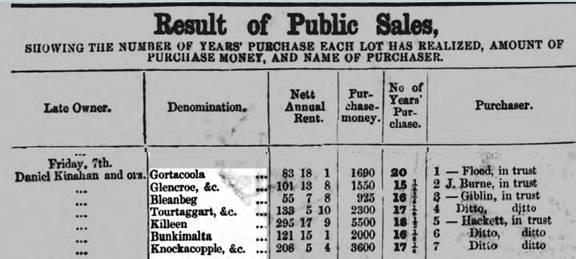
By 1860 it appears this land had been sold, and the new landowner cleared out his tenants to create a game preserve. This notice says the land had been POISONED for game preservation. I find this interesting as it assumes these poor farmers could read.
Glencroe, Bleanbeg Killeen, Knockacopple Townlands had tenants related to Irish living in Gortnaskehey Townland. This land clearance would have affected Campbells, Ryans, Kennedys, Commons, and Russells and others. These surnames are seen on our ancestor’s baptismal and marriage records. Our Ryan ancestors probably saw the writing on the wall and viewed America as one place where they could continue raising their family.
Limerick Reporter; Limerick, Ireland; March 20, 1860

***************************************
Bad Luck Comes in Threes
This short news snippet captured our attention because it reported evictions for James and David Humphreys. This was the third time they had been evicted from their land. Their whereabouts after this last eviction are unknown.
Tipperary Vindicator, December 18, 1862, page 2
EVICTIONS:
Sir Wm Haartigan Burrington, Bart; John Vanderkiste, and Henry Barry, against James and David Humphreys, residing on the lands of Glenstall.
***************************
Although this next event occurred almost 20 years after the era of wholesale evictions ended, this news item hearkens one back to an earlier time circa 1776. In the 1700s Irish landlords took back leased land to raise livestock. This required Cottiers and other small farmers to pay the same rent for less land, inflaming ire among the local peasantry. One secret agrarian society, Whiteboys, rose out of this anger and they violently defended farmer land rights. Whiteboys ensured tenant farmer conformity by use of a dreaded messenger known as ‘Captain Moonlight’.
Threatened.
Flag of Ireland; December 10, 1881
The Rev. Mr. M---- gave notice to his tenants at Fiddane, Newport, county Tipperary, that if they did not pay their rents now due they should give up their farms. Captain Moonlight visited the tenantry on Friday night, and posted the No-Rent placard on the doors of their houses, and threatened death to them if they paid rent while the suspects were in prison.
************************