The Origin of the McPhillips Surname


The Origin of the McPhillips Surname
Smith Family Genealogy

As we have written before, it is very difficult tracing one’s Irish ancestry due to lack of good records. It is especially difficult tracing an Irish lineage unless you can link to Irish royalty. There is a website connected to the County Monaghan GenWeb site devoted to the McMahon family. This website indicates the McPhillips’ surname is linked to the McMahon family.
The McPhillips’ surname is not found in the Milesian legends. Milesians are people figuring in Irish mythology and represent the origin of the Irish Celts. The Irish race of today is popularly known as the Milesian Race, because the genuine Irish (Celtic) people were supposed to be descended from Milesius of Spain, whose sons, say the legendary accounts, invaded and possessed themselves of Ireland a thousand years before Christ.
Most Irish surnames claim lineage to one of the three sons of Milesius. Because McPhillips could not be found in the Milesian records it was assumed this surname’s source laid outside Ireland possibly. However, this is not the case.
The surname McPhillips is of Irish origin and found predominantly in the counties of Cavan, Fermanagh and Monaghan. In Ulster, the McPhillips are in Gaelic, MacPilib, and considered descendants of Philip McMahon who died in 1468. Philip McMahon was the “Coarb” for the Church in Clones and he was related to the Lords of Ergal. The McMahon family was the leading sept of Oriel and ruled Monaghan from the early thirteenth century until the end of the sixteenth century. In addition, the surnames Mathews and MacArdle are also branches of the McMahon Clan of Oriel. Did Philip McMahon become angry at his family over some long forgotten wrong? Whatever the reason, Philip found some loophole and was able to keep his lands, but his descendants changed their name from McMahon to McPhillipp.
Other variations of McPhillips in Ireland are sometimes noted as McKillop, Philbin, Phillips and Phillipson, which mean “Son of Philip”. However, none of these variations tie in with the Ulster McPhillips clan found in Cavan, Fermanagh or Monaghan Counties.
The following snippet was taken from the History of the County of Monaghan by Evelyn Phillips Shirley. The last entry shows the original McPhillips’ ancestor, Philip Mac Mahon.

In another book Philip McMahon (or Mac Mahon) is identified as a Canon, Abbot of Clones and parson of Dartry. Dartry includes land found in Aghabog Civil Parish, where our own ancestors lived in Monaghan.

Within a few years two noted abbots died who were related to the Lords of Ergal. Philip McMahon died in 1486 and James MacMahon died in 1502. Clones Abbey was dissolved by Henry VIII, and much later the Abbey lands were confiscated by the Crown under Elizabeth during the latter part of her reign. Henry VIII died in 1547. The manor of this Abbey is still called “St. Tierney”, and the lands were granted together with the Abbey to Sir Henry Duke. The MacMahon family controlled the ‘coarbship’ of Clones until the time of the Elizabethan rebellion. Later the ‘coarbship’ transferred to Sir Francis Rushe, whose daughter, Elinor, in 1629 again conveyed it in marriage to Sir Robert Loftus, eldest son of Adam, Lord Loftus, Primate and Chancellor of Ireland, and first Chancellor of Trinity College in Dublin.
What is a Coarb? In medieval Ireland and Scotland the Coarb (comarba, meaning abbott) was the president of a collegiate church (i.e. Celtic monastery following the Rule of St Columba), who had the privilege of holy orders and said mass ('serveth the cure'). As a successor of the founder of his order he had a seat in the mother church, a stall in the choir and a voice in the chapter. Although the Coarb was in clerical orders, he was usually married, and if one of his sons was qualified by learning he would be chosen in time by the Dean and Chapter to be Coarb. Thus the coarbship was in a manner hereditary. After the Reformation and the Dissolution of the Monasteries the role of coarb became subsumed into that of the parish vicar.
Fortunately, we can find information about the early McPhillips’ family. The following item dated 1571 describes a MacPhilip with others in Madrid. Many Irish landed gentry left Ireland due to turmoils and troubles with the English Crown.
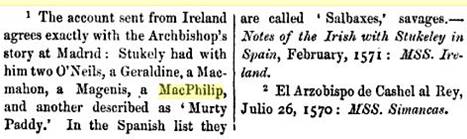
Irish records are spotty, but we can get some idea of land ownership between 1591 and 1606 in County Monaghan where we find McPhillips’ surnames listed. In the Barony of Dartrey during this time the lands of Killevan and Aghabog comprised the demesne granted to Brian McHugh og McMahon. The following map shows how land was divided in southwestern County Monaghan during this time period.

The principal families of the McMahons, most of whom by Irish law were historically entitled to succeed to the McMahonship, were allocated relatively extensive demesne lands. The following list shows McPhillips’ landowners and is dated between 1591 and 1606 for Dartrey.

In 1641 to 1642 the Catholic Ulster Landowners revolted against English rule. However, the Ulsterman could never get together as a cohesive group and the rebellion was easily put down by British troops. Many Irish gentry were imprisoned for their role inciting rebellion. The names of the landed men named McPhillip are shown below who were arrested and put in restraint, Their land was also confiscated in Dartrey.
Barony of Dartrye:
Monaghan:

Cavan:


Hearth Money Rolls - 1663
In the 1660s the government introduced a tax on hearths as a means of raising revenue. The returns, arranged by parish and usually with townland locations, list the names of all householders paying this tax. Aghabog is where our own ancestors lived.
Barony Dartrey
Parish Ematris Townland Name Year
Annaghyban Patrick McPhillipp 1663 and 1665
Carragarray Edmond McPhillipp 1663
Parish Currin Annaveagh Farrell McPhillipp 1663
Neil McPhillipp 1665
Edmond McPhillipp 1665
Coolnacarte Farrell McPhillipp 1663
Drumgrone Patrick McPhillipp 1663
Tonnytallagh Cahir McPhillipp 1663
Murphy McPhillip 1665
Parish Aghabog Drumbrean Bryan McPhillipp 1663
Hugh McPhillipp 1663 and 1665
Phelem O’Greenan was listed living in Drumbrean.
****************

We find the MacMahons whose chiefs were lords of Oriel in counties Louth and Monaghan. They reputedly descend from Mahon, ninth in descent from Cairbre an Daimh Airgid (the learned and wealthy), King of Oriel who died in 516 AD. Cairbre was of the line of Kings of Oriel who descended from Conn of the Hundred Battles.
Between them, these two septs account for about 10,000 of the name today in Ireland, and still very much at home in their respective ancestral territories.
The last chieftain of the Ulster MacMahons of Oriel, Hugh Oge MacMahon (1606 - 44), was a lieutenant-colonel in the Spanish army. He inherited a rich estate in County Monaghan and when he returned home in 1641 he became involved with Conor Maguire in the conspiracy to capture Dublin Castle. They were betrayed by Owen O Connolly who had won their confidence. For several years they were imprisoned in the Tower of London. Making a brief escape, they were discovered hiding in Drury Lane and were charged with high treason and executed in 1644.
Hugh Oge's cousin, Heber MacMahon (1600 - 50), who was born in Monaghan and ordained in Louvain, was Bishop of Down and Connor. He was also deeply involved in politics and was a leading member of the Catholic Confederation that met at Kilkenny. Owen Roe O Neill of Ulster was his trusted friend and, when he died mysteriously in 1650, Bishop Heber MacMahon was made a general. Although he was not expected to demonstrate any military prowess, he took part enthusiastically in some small bloodthirsty battles, which led to his capture and execution.