Edward Hill worked for the Concord Railroad
|
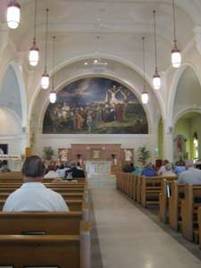
St. Bernards interior, Keene, NH |
Introduction
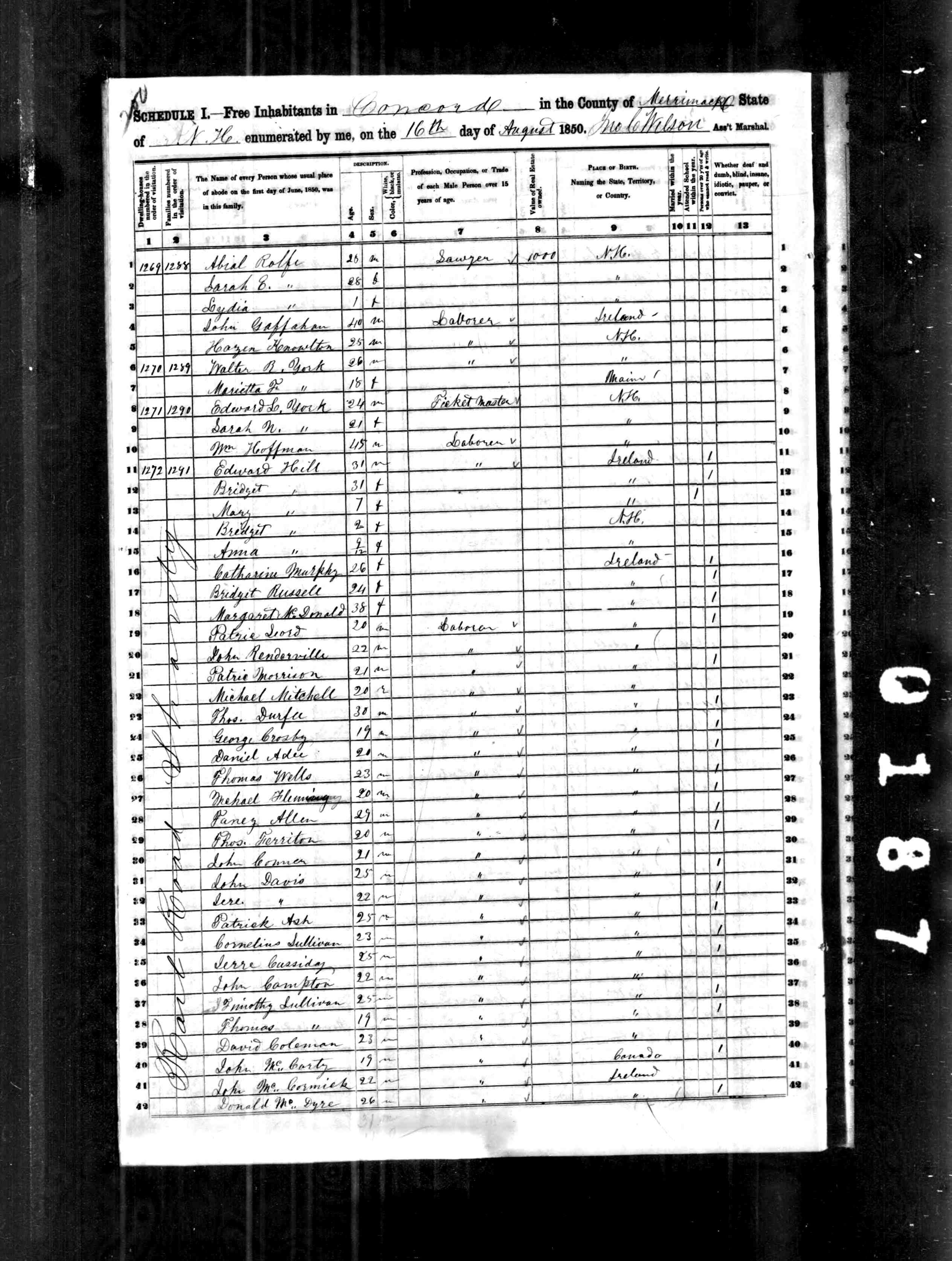
Edward and Margaret Hill made their way to America after the birth of their first daughter, Mary, in 1846 and prior to the birth of their daughter (Liza) in Keene, New Hampshire in 1852 and Anna at Concord in 1850. While we are not certain when they arrived or what port they entered (Boston or Quebec), we do have an idea how they lived. The keys are found in the 1850 Concord census and a census record for Elizabeth Hill Ryan. These keys also tell us what type of work Edward Hill was engaged in.
Initially, we believed that they made their way to Concord, New Hampshire to "hook up" with other family members. But based on information we have, it appears that the Hill family didn't go to Concord to be with family, rather they were in Concord and Keene because his work took him there. That "work" was working with the Concord and Claremont Railroad. In those days there was a huge expansion to connect the country by rail, and gangs of Irish immigrants were hired to build a railroad line between Nashua, New Hampshire and Keene, New Hampshire. Eventually the railroad would erect a secondary line between Keene and Concord. Keene is where our ancestor, Elizabeth Hill was born.
|
|


Keene, New Hampshire, Ward 5. Click to Enlarge. |
The Irish of Concord
The newspapers began to record the presence of Irish in Concord in the 1830s, but it was not until after the famine in Ireland did the Irish appear prominently in local print. The Irish were attracted to the Merrimack for several reasons: less prejudice in Concord towards the Irish and the plethora of available work, particularly with the railroad, which were large employers of Irish unskilled labor. The residents of Concord were proud of their embracement of the Irish as historical documents noted, “…in no American Protestant community was the Catholic-Irish stranger more kindly received and considerately treated than in Concord.” The Irish had an opportunity to become successful, which was the “birthright of every American”, and subsequently by the late 1890s many of their children had become lawyers, doctors, successful merchants in this New Hampshire city.
The social life for the Irish immigrants in the Merrimack Valley revolved around family, the church and social clubs that catered to the Irish. We have no actual recordings of how the Edward Hill family lived in New Hampshire, but we can rely on others who wrote of their existence. In particular, Nathanial Hawthorne and Henry Thoreau wrote extensively about their lives, and both were known to move freely in the shanty communities.
Hawthorne wrote:
“…there is a little hamlet of huts or shanties, inhabited by the Irish people who are at work upon the rail-road. There are three or four of these habitations, the very rudest, I should imagine, that civilized men ever made for themselves, constructed of rough boards, with protruding ends. Against some of them the earth is heaped up to the roof, or nearly so; and when the grass has had time to sprout upon them, they will look like small natural hillocks, or the species of anti-hill, or something in which Nature has a larger share than man. These huts are placed beneath the trees, (oaks, walnuts, and white pines) wherever the trunks give them space to stand; and by thus adapting new ones, they do not break or disturb the solitude and seclusion of the place. Voices are heard, and the shouts and laughter of the children, who play about like the sunbeams that come down through the branches. Women are washing beneath the trees, and long lines of whitened clothes are extended from tree to tree, fluttering and gamboling in the breeze. A pig, in the style even more extemporary than the shanties, is grunting, and poking his snout through the clefts of his habitation. The household pots and kettles are seen at the doors, and a glance within shows the rough benches that serve for chairs, and the bed upon the floor. The visitor’s nose takes note of the fragrance of a pipe. And yet, with all these homely items, the repose and sanctity of the old wood do not seem to be destroyed or prophaned; she overshadows these poor people, and assimulates them, somehow or other, to the character of her natural inhabitants. Their presence did not shock me, any more than if I had merely discovered a squirrel’s nest in a tree. To be sure, it is a torment to see the great, high, ugly embankment of the railroad, which is here protruding itself into the lake, or along its margin, in close vicinity to this picturesque little hamlet. I have seldom seen anything more beautiful than the cove, on the border of which the huts are situated; and the more I looked, the lovelier it grew. The trees overshadowed it deeply; but on the one side there was some brilliant shrubbery which seemed to light up the whole picture with the effect of a sweet and melancholy smile. I felt as if spirits were there – or as if these shrubs had a spiritual life, - in short, the impression was undefinable; and after gazing and musing a god while, I retraced my steps through the Irish hamlet, and plodded on along a wood-path.”
...and they did fill the newspapers with notable items. It is likely that the Hill family knew these people as Concord was not a large metropolis in the mid 1800s (1840 was 4,897; and in 1850 was 8,576):
The Concord Railroad
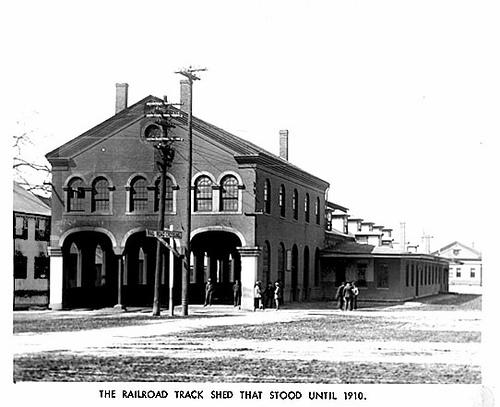
By the time Edward Hill came to Concord, the initial railroad link between Nashua, New Hampshire and Concord, New Hampshire, was completed. The charter for the Concord Railroad was granted in 1835 and by September 1842 the track from Manchester to Concord were completed. In the following month, the first train puffed its way to the Corporation grounds, later to be known as Railroad Square.
But in the mid 1840s another surge in railroad construction began. The passenger station was erected in 1847, and a second rail line between Nashua and Concord in 1848. Once this link was completed, then other new tracks were being constructed to connect other points in New Hampshire. It was during this time that Edward Hill began working for the railroad.
We don’t know how much he made or what his specific occupation was, but we do know that the earnings per day wasn’t high. We can assume that, as an unskilled laborer, his pay would have been on the lower pay scale. The following came from the Concord Railroad logs:
Value of Work
In 1850 the superintendent had a salary of two thousand dollars a year; the president, the treasurer, the two master mechanics, and the road-master, one thousand dollars each, and the ticket agent eight hundred dollars. The passenger-train conductors were paid fifty dollars a month, freight conductors the same. Engineers on passenger trains got two dollars and twenty-five cents a day, on freight trains two dollars (a trip to Nashua and back being reckoned as a day). Brakemen on freight trains were paid one dollar and fifty cents a day, on passenger trains one dollar and twenty-five cents. The wages of mechanics in the machine shop ranged from one dollar to one dollar and seventy-five cents a day, there being, however, on blacksmith who had two dollars. Station agents’ pay ranged from one dollar a day at Robinson’s Ferry to eight hundred dollars a year at Manchester. Switchmen were paid one dollar and twenty-five cents a day, some of them a little less.
Life in Keene, New Hampshire
By the mid 1840s, gangs of Irish immigrant laborers pushed the rails northward to Keene; and in 1848 the first scheduled trip between Nashua and Keene was made. We know that Edward and Margaret lived in Keene during the line's secondary expansion in the early 1850s, and it was here that Elizabeth (Liza) was born in 1852. We don’t know exactly where they lived in Keene, however, the most likely place was on Emerald Street. Before it was officially laid out in 1851, the street was initially a road to the gas works. In the fields on either side were shanties, housing mostly Irish immigrants. The area was called at one time the “Black Patch” more commonly known as “The Patch”. It is likely that the railroad shanties, which hired predominantly Irish immigrants, was also located in The Patch. Especially since the "patch" was a block away from the major railroad terminal and round house (click on map).
Money and Allamakee, Iowa
So the next question is: did they save any money? The answer is most certainly "yes". It is likely that Edward wasn't the sole provider for this family, and quite possible Margaret also made money by cooking or washing clothes for the bachelor railroad workers living nearby. By the time they found themselves in Allamakee County, Iowa, he would have needed enough to buy the land along with other start-up and living expenses.
A typical pioneer Iowa farm was 80 acres in size and was generally purchased for about $1.25 per acre. Through passage of The Land Ordinance of 1785 , the Federal government established a means by which lands west of the original 13 colonies would be divided and sold to settlers. By 1882 this investment would turn out to be a wise one. For example, in 1882, John Breen a Waukon farmer owned 80 acres of land valued at $40 per acre (est. value $3200) |
|
Even though the railroad offered Edward Hill employment, it was considered dangerous work. The following are Irish men who lost their lives in railroad accidents in the Concord area while his family lived there: |
|
Railroad Station in Concord, NH. |
|