|
Interview with
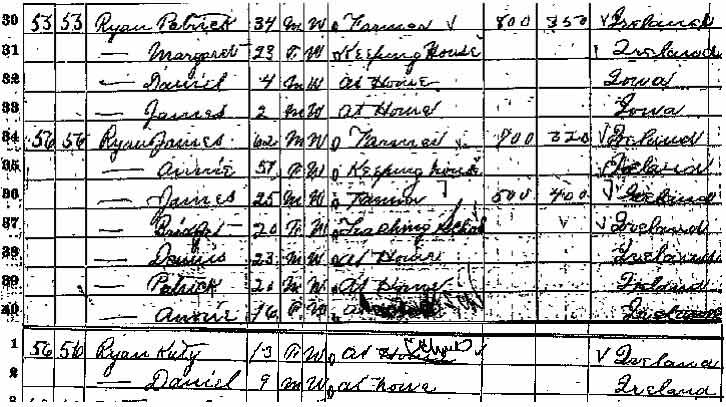
Daniel J. Ryan (1866-1962)
Written by Pat Nelson, granddaughter of Daniel
Ryan (Contributed January 2007)
For an assignment in my English class, I
interviewed my grandfather, Daniel J. Ryan, who was living with my
family at the time, in Prescott, Iowa. He was 84 years of age.
The interview: (Daniel's
mother, Margaret, was the daughter of James and Ann Ryan)
My grandfather was born in Waukon, Iowa, October 20, in 1866. In 1874,
he and his family moved to Lenox, Iowa (Taylor County) and lived and
farmed in Southwest Iowa all his life.
His parents, Patrick Ryan and Margaret Ryan, came
to Iowa from Ireland. His father was 20 years old and they traveled to
America by Steamer. It took about one month for the trip. His mother
came over when she was about ten years old, by sail because it was
cheaper and her trip cost about three months.
Patrick Ryan, my great grandfather was a miner
before he came to America. He met his wife-to-be, Margaret Ryan, in
Canada. After they were married, he became a farmer.
There were thirteen children born to Patrick and
Margaret. That made it almost a certainty that there would be a full
table at every meal.
When he was a little boy, most of the country was
still prairie. There were about seven houses between their house and
Bedford, Iowa, which was 17 miles away, and only four houses between
their house and Lenox, which was about 10 miles away. At night, in
Conway, Iowa, grandfather would like and watch the prairie fires as far
away as Clarinda, Iowa.
His house had two rooms downstairs and two rooms
upstairs. They moved in the fall of 1876 and it didn't have any plaster
on the walls for about a year. In the winter, when they got up in the
morning, there would be snow on the covers and the floor. Some of the
houses didn't even have floors in them. They were log houses. The wall
paper was nothing like it is today. The walls of his house were
plastered and white washed.
Clothes were rather scarce in those days. The boys
were lucky to have one pair of overalls, one shirt and one pair of
shoes. All the dresses were to the floor. The mens' shoes were button
shoes and the ladies shoes were laced. My grandfather never had a pair
of button shoes until he was 18. Up until that time, he wore boots like
engineer boots. His first good pair of shoes cost him $2.00. A pair of
overalls cost about .90 cents.
Everyone, who wanted to, went to school -- at least
to country school. They started when they were about six years old and
went through at least sixth grade. Some pupils were as old as 20 years.
In some schools, there were 52 pupils in all grades, with only one
teacher. They had benches along the walls with home-made tables pushed
up to them, for desks. There were slate blackboards on one wall. Anyone
who had an eighth grade education could get a state certificate to teach
school.
My grandfather told me he was a school director
after he was married. He hired a teacher that walked seven miles night
and morning from Clearfield, Iowa. The teacher's salary was $28 a month.
This was around 1889.
The churches had coal stoves in them. There weren't
any electric lights in either churches or homes. His family used coal
oil lamps. His grandmother (Catherine) always used candles because she
was afraid of the lamps. (Evidently James and Catherine Ryan moved to
Southwest Iowa when Patrick and Margaret did)
Families made their own entertainment. They
wrestled, had horse races, watched the Punch and Judy shows that came to
town, went to the Literary (Chatauqua), dances, strawberry festivals,
oyster suppers, church suppers, and parties (dances).
There were no books or magazines in his home -- or
comic books -- back then. Probably a newspaper. He didn't read much --
people were made fun of if they read the "dime novels".
There weren't many bridges across the rivers and
streams. When his folks moved from Waukon to the Lenox area, it took
them 18 days. It was a distance of about 300 miles. They had to send a
horse across first to see how deep it was and then they would lead the
wagons and wade across the rivers and creeks.
My grandfather's first job was for his father; he
was ten years old. His father agreed to take him to the State Fair if he
would plow a field with a team of oxen. The second day, the oxen learned
that the boy could not control them and they started for the barn. He
could do nothing but follow them! (I don't know if he got to go to the
Fair or not!)
His first car was a Model T Ford -- black of
course. It had a canvas top and celluloid curtains. It was purchased in
1917 -- there weren't many cars around until about 1910 - 1915.
When my grandfather lived in Creston, Iowa (Union
County) after he retired, his son (my father) bought their first radio,
a Freshman Masterpiece. This was in 1923 and they paid $150 for it.
(end of interview)
Postscript: My grandfather lost all his money in
the Great Depression. He was so depressed, he never worked again.
|