Guillaume Couture Turgeon Family Genealogy


Introduction
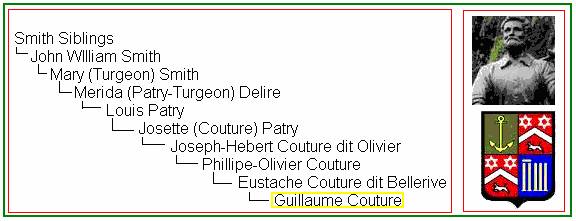
This is my most interesting family story, because it includes all the elements of a good tale. Our ancestor, Guillaume Couture (aka Cousture), is an important historical figure in New France, and his name also appears in history books for early New York and Pennsylvania. The following chart shows how the Smith Siblings are related to Guillaume Couture.
It’s a tale of high adventure and danger. Much of it started on Lake George, which James Fenimore Cooper named Lake Horicon in his novels. In fact, this story may remind you of any Cooper novels including The Deerslayer or Last of the Mohicans. It is a story about a man who did not see himself as a hero, nor aspire to be one. Events shaped his destiny. As a young Jesuit missionary he was far more interested in saving souls then shaping the course of history.
This story has been written and repeated many times. Three names always appear together in all these stories – Guillaume Couture, Father Isaac Joques and Rene Goupil. Both Joques and Goupil were canonized by Pope Pius XI on June 29, 1930, and recognized as martyrs of the faith. Now that I have your attention…
 |
Guilaume Couture was born in 1617 in the Parish of Saint-Godard in Rouen, the capital of Normandy. The picture to your left shows the old section of this French town. His father was named Guillaume, and both son and father were carpenters by trade.. |
Madeleine Mallet and Guillaume Cousture, Sr., gave birth to two children: Guillaume and Marie. Why young Guillaume left France for the New World is not known; however, he left France sometime before 1640. By 1640 Cousture took his oath as a "donné", or lay missionary with the Jesuits. He vowed to spread the gospel of Christ to the Huron missions. On June 26, 1641, before the Notary Martial Piraube in Quebec Guillaume Cousture left his father’s inheritance to his family still living in France.
From that point on Guillaume worked among the Hurons with other Jesuits. Until then, Cousture had never seen any Iroquois.
Captured by the Iroquois
 |
In 1642 one Jesuit Priest and two lay ministers left Trois-Rivieres for an expedition to the land of the Huron. Jesuit Father Isaac Joques, Jesuit Surgeon and Missionary Rene Goupil, and our ancestor accompanied 19 Huron Indians for a trip to Huronie. Near Lake Saint-Pierre, this small group was attacked by approximately 80 Iroquois warriors. |
 |
One of these warriors was an Iroquois Chief, who aimed an arquebus at him. An arguebus is an old style musket/rifle, an example of which is shown to your left. |
 |
hearts these warriors ripped out
Guillaume's fingernails with their teeth. His fingers were
crushed and bleeding and caused him great pain. One Indian
pierced his hand with a javelin or sword. They tied him up
and led him to the camp where Father Joques and Rene Goupil were
being held. The Jesuits were tortured further. Father Joques later wrote about these events. In his notes he indicated Guillaume was exposed to the Indian's full fury for killing one of their Chiefs. They undressed him and beat him with wooden sticks. One of the Iroquois cut off half of Cousture's right middle finger. The pain was unbearable as no knife was used, only a small piece of shell which exposed a nerve ending. In his notes Father Joques stated that this Indian could not cut the nerve, but twisted and pulled it with such violence that a nerve the length of his arm came out. The arm became greatly swollen. Groupil and Joques endured horrible torture too. The heat was unbearable. Their wounded fingers festered and bred maggots. They had no medicines or clean bandages for tending their wounds. |
The Iroquois took their captives on a thirteen day march from the St. Lawrence where they reached a palisade town on the banks of the Mohawk River. Here the captives were forced to run the gauntlet between a double line of yelling and screeching natives, who beat them with rods. Father Joques fell down but managed to rise and stagger forward. Both Joques and Rene Goupil’s thumbs were cut off. Their beards were plucked out. They were bound to stakes, and at night children cast hot coal and ashes upon their bodies. Father Joques wrote later that the torture lasted seven more days.
Of the Hurons who were captured, only two were burned alive. One, Teresa, was killed when she refused to marry an Iroquois warrior. Two Bibles belonged to this group. One was owned by Father Joques, the other by Guillaume Cousture.
At some point, the Iroquois decided to ransom these three Frenchmen; however, not all would make it back alive. Goupil was killed by a tomahawk blow to his head on September 29, for making the sign of the cross on an Iroquois’s forehead. Dogs feasted on his body. Cousture’s bravery saved him from further torture for he bore his torture silently. He was adopted into the tribe. Father Joques was forced to serve the Indians, and at the same time tried to teach them about Christianity.
Living with the Iroquois
 |
Cousture was sent away to live in
the village of the Chief he had slain in battle. In
Iroquois tradition, the warrior's widow decided his fate.
Here Guillaume witnessed the torture and execution of the Huron
warrior, Ahatsistari. Later, he was adopted by the widow
and lived as a member of the tribe. She treated his wounds
and tended to his recovery. Despite many offers, Cousture
maintained he had remained true to his vows as a "donne", or lay
missionary. He learned their language and ways, including culture, beliefs and traditions. Eventually be became a member of the tribal council. |
Father Joques was later killed by Mohawk Indians on October 18, 1646. Joques received a special dispensation from the Pope to say mass. In the 17th century no priest could be physically deformed.
Release from Bondage
By 1645 Guillaume had lived many years with the Iroquois. The French Governor released a captured Indian with a peace message. Chief Kiotseaeton and Guillaume Cousture went to Trois-Rivieres for peace talks. No one recognized Guillaume because they thought he had been long dead. Plus he dressed like an Iroquois warrior. As soon as he was recognized everyone threw their arms around him. This was Lazarus coming back from the grave.
A peace treaty was signed between the French and Indians. Cousture convinced his Iroquois friends that these Frenchmen had good intentions. Cousture was sent as an ambassador to negotiate a permanent peace between the entire Iroquois nation and France. In 1646 Cousture asked the Jesuits to be relieved of his religious vows. This was accepted.
Later Life
 |
In 1647 Cousture left for the Huronie to renew a truce with the Iroquois. Although his efforts met with failure, he was welcomed back home as the conquering hero. He established himself in Point-Levy in the seigneurie of Lauzon. He became the first settler of Levis, where his statue stands today. In 1649 he married Anne Aymard of Poitou. From this union ten children were born. |
He traveled to Albany, New Netherlands in 1657, 1661, 1664 and 1666. In 1666 he was sent by the Governor to Albany, New Netherlands to protest the murders of two French officers. In one Iroquois village Cousture ordered the murderers to surrender; otherwise, there would be war. In late 1666 Cousture traveled back to New France with these two prisoners in tow. He thought this would be his last expedition.
In 1665 Cousture was shipwrecked on one of his expeditions to the northern reaches of New France (Quebec).
In 1666 he was named Captain of the Lauzon militia, and by 1667 he was assigned to the office of Judge Senechal. He was a notary and leader of his community. His duties also included coroner. However, in the 1681 census he simply listed his occupation as ‘carpenter’.
In 1690 the British lay siege to Quebec City. Our ancestor managed to stop the British from landing in Lauzon. He was 73 years old at this time. On several occasions he was asked to sit on the colony’s Sovereign Council when a regular member (Governor, Bishop or Intendant) was missing. Finally, Cousture passed away on April 4, 1701; however, his gravesite in unknown.
Guillaume Cousture is the ancestor of all Coutures in America; however, not all descendants kept his name. Of his six sons, only one (also named Guillaume) will keep the original family name (from which the "s" has now disappeared). Jean-Baptiste, the older son, becomes the ancestor of the Lamonde family. Charles takes the name of Lafrenaye, Eustache chooses to be called Bellerive and Joseph-Odger will be known as La Cressonnière. The Smith family is descended from Guillaume Cousture through the Bellerive line.
There are many books written about this man, some of them quite old. You can read more about Guillaume by searching old books in the Google website.