Old Ships - Immigration Ships for Smith and McPhillips


Click to Enlarge
| The "Nestorian" was a 2,466 gross ton ship built by Barclay & Curle, Glasgow in 1866 for the Allan Line of Liverpool. Her details were - length 317.7ft x beam 38.5ft, clipper stem, one funnel, three masts, iron construction, single screw and a speed of 11 knots. There was accommodation for 115-1st and 600-3rd class passengers. Laid down as the "Acadian" she was launched on 11/9/1866 as the "Nestorian" and sailed from Liverpool on her maiden voyage to Portland on 31/1/1867. On 24/10/1871 she commenced her last Liverpool - Halifax - Montreal sailing and on 2/1/1872 commenced her first voyage Liverpool - Halifax - Norfolk - Baltimore. She was laid up from 1874-78 and in 1878 was rebuilt to 2,689 tons and compound engines fitted by Laird Bros, Birkenhead. She commenced sailing from Glasgow - South America on 17/10/1878 for two round voyages and on 15/5/1879 started sailing between Glasgow, Quebec and Montreal. She commenced her first voyage Glasgow - Boston on 30/11/1880, and Glasgow - Philadelphia on 17/9/1884. On 10/6/1885 commenced her first voyage London - Quebec - Montreal and on 4/6/1889 resumed the Glasgow - Boston service. Subsequently sailed Glasgow to Boston or Philadelphia until 5/2/1897 when she commenced her final Glasgow - Boston voyage and was scrapped later the same year.[North Atlantic Seaway by N.R.P.Bonsor, vol.1,p.311] [Posted to The ShipsList by Ted Finch - 23 November 1997] |

Click to Enlarge (oil panting)

Announcement of port landing.
Factoid about the SS Nestoria: In 1870, at age 23, Alexander Graham Bell, his brother's widow, Caroline (Margaret Ottaway),[33] and his parents travelled on the SS Nestorian to Canada.[34] After landing at Quebec City, the Bells boarded a train to Montreal and later to Paris, Ontario to stay with the Reverend Thomas Henderson, a family friend. After a brief stay with the Hendersons, the Bell family purchased a 10-and-a-half acre farm at Tutelo Heights (now called Tutela Heights), near Brantford, Ontario. The property consisted of an orchard, larger farm house, stable, pigsty, hen-house and a carriage house, which bordered the Grand River.
Click to Enlarge
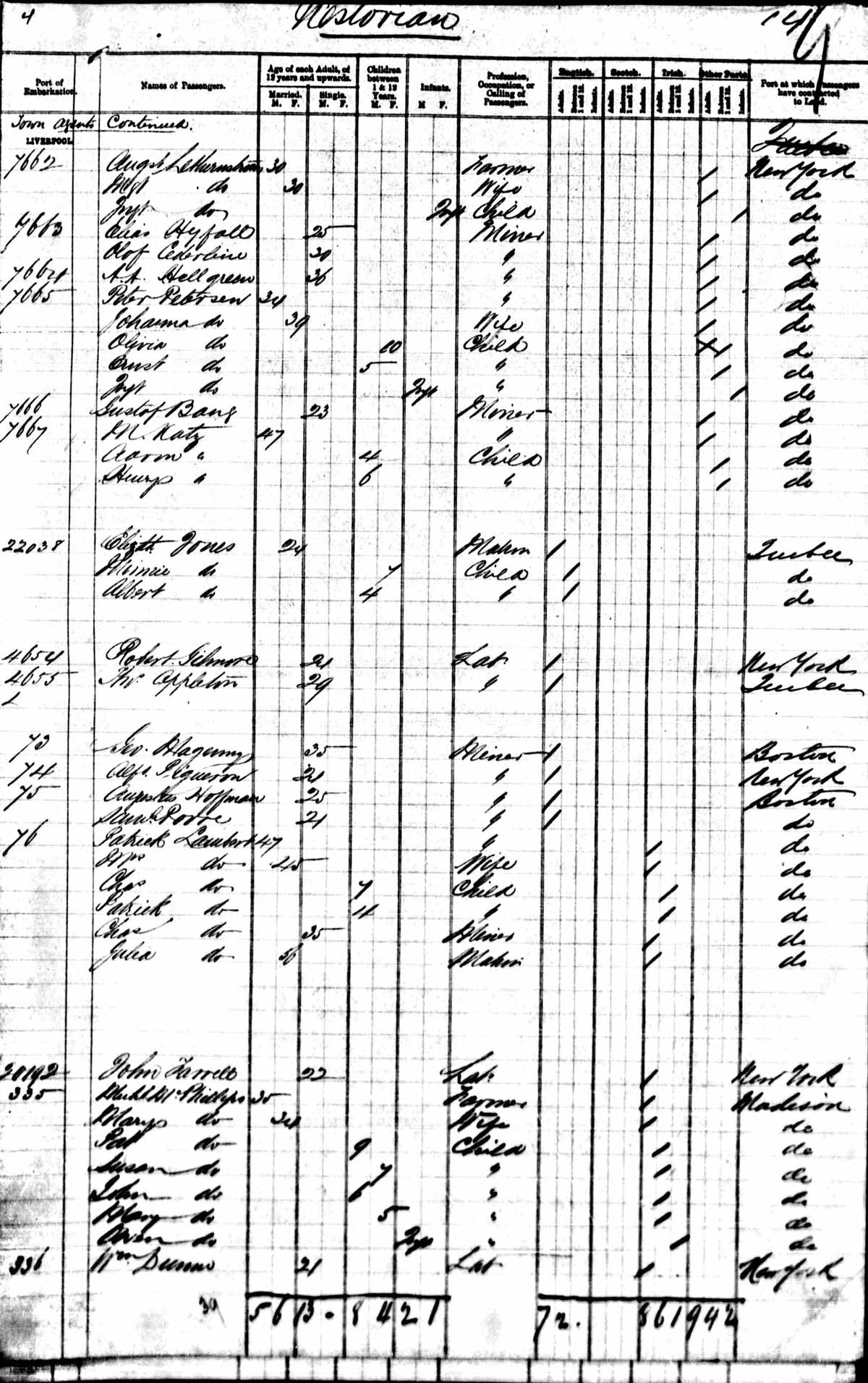
Below is a partial ship's log showing the McPhillips
in 1867. They landed in
Quebec originally before going to Detroit. The ship's name
was the 'SS Nestorian' not 'Historian'. Owen McPhillip's
naturalization document said Historian, and as Tim found "probably
hit Quebec City first."
Look at the ages of the children. Owen is listed as
an infant under the age of 1. Was he born at sea as McPhillips
family lore suggests? Perhaps. We know what port they left from
Ireland (Dundalk),
but the boat did not head directly to America. According to this
documetation they left UK from Liverpool. The log says their
destination was Madison.
If you look online you will see this ship carried a
lot of emingrants over the years, many were assisted emigrants. It
was 'broken up' in 1897. It looks like another SS Nestorian was
built later but also shipwrecked.
McPhillips Manifests
Click to Enlarge

Click to Enlarge
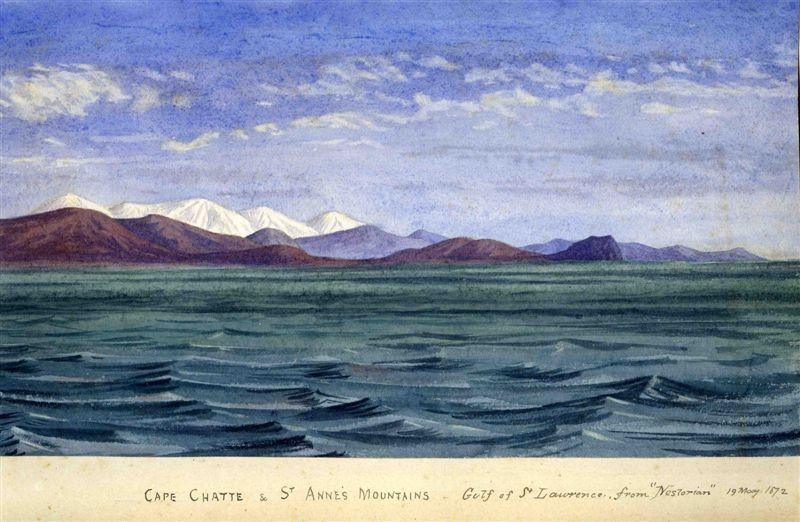
Nestorian Painting
This scene was painted aboard the Nestorian, and most likely a scene our ancestors, the McPhillips, saw as they went down the St. Lawrence River.

|
By the time the McPhillips made their way to Canada, most of the great sailing ships had been retired and replaced with boats with metal hulls. However, in 1850 the most common immigrant vessel was like the Centurion above, which carried John, Bridget Smith to the port of New York. They were accompanied by their uncle, Terrence Greenan, who is buried along with Owen and Catherine in the Wisconsin family plot. The logs state that the hull was made of wood. During the 19th century the brig was a standard cargo ship. A brig is defined as a two-masted ship carrying yardsails on both masts. The brig was fast and well sailing, but required a large crew for the yardsails. Around the turn of the century the brigs lost in competition against the steamers and the gaffsail schooners, which needed much smaller crew. |

Eight ships of the British Royal Navy have also been named HMS Centurion, after the centurions of ancient Rome. Many of these war vessels were originally cargo ships and retrofitted with long range guns during wartime.
Above is the fourth HMS Centurion.
HISTORIAN - MISTAKEN SHIP LISTED AS McPHILLIPS TRANSPORT

On a government document, it was noted that the "Historian" carried the McPhillips to Detroit. This was a distortion of the real boat that carried this family to the new world, i.e., "Nestorian".
When we looked up Historian, the first reference to this boat was in 1870, which meant it was built several years after the McPhillip's arrival. It too was a cargo vessel, however, it only could a few passengers as it had only 12 rooms for passenger travel. When Tim learned it was the "Nestorian", this made more sense than the Historian.

