

Our Family Tree (144 AD to 900 AD)
1. Cathoir Mor, King of Ireland A.D. 144, 12th in descent from Breasal Breac, grandson to Goalta Gooith
2. Fiacha Baiceada, son of Cathoir Mor
3. Labraid
4. Breasal Bealach, son of Fiacha Baiceada
5. Enna Ceannselaigh, King of Ireland, A.D. 350, line
6. Crimthiann, son of Enna Ceannselaigh
7. Nathi, son of Crimthiann
8. Eoghan Caud, son of Nathi
9. Fergus, son of Eoghan Caud
10. Cormac, son of Fergus
11. Coleman, son of Cormac
12. Crunneasil, son of Coleman
13. Aedarein, son of Crunneasil
14. Hugh, son of Aedarein(Hugh is anglicized, Aodh (Aed) Ron)
15. Coleman, son of Hugh
16. Laighnan, son of Coleman
17. Carbry, son of Laighnan
18. Hugh, son of Carbry (Hugh is anglicized, annals record only
Aodh, Aed or Aedh)
19. Bruadar, son of Hugh
20. Durgilla, son of Bruadar
21. Rien, son of Durgilla, 900 A.D.
Who was “Ryan”, the ancestors of our family line?
When looking up “Ryan” in the genealogical books, you will see several meanings behind the surname of Ryan. According to the “Book of Irish Names”, it says that the Ryans formed their name from an old personal name which could mean either ‘administrator’ or ‘water.’ Dr. M.A. O’Brien, in his index to the “Corpus Genalogirum Hiberniae” says that Rian should be pronounced with a silent “I” and and a long “a”. He did not associate Rian with “Ri” which is the celtic term for king because the name would equate to Rigan. Another professor of Irish antiquities, Dr. Ryan, suggested that the name comes from the Irish ‘riin’ which derives from the latin word ‘ritus’. In this case, the Ryan (or Rian) name would mean a person who sets in order or marshalls.
What is my personal preference? I like the idea that the name derived from ‘water.’ Many Irish surnames have their origins from the natural world. As such, you find surnames depicting earthen colors (Black, Grey), body features (Kennedy, for example in ancient Gaelic, translates to “ugly face” or “cat’s face”), or geographical features (plains, tree lines, water, etc.). Ancient Celtic society held a closeness with the environment and the spirits associated with the air, land and water. Having the surname associated with water would give it an ancient origin. The Rhine river, for example, is of Celtic origin; and its name pre-dates the Celts arrival into Ireland. As such, I believe the name “Rian” has similar etymological origins, and holds some supernatural belief our ancestors once held.
When did our Ryan line originate?
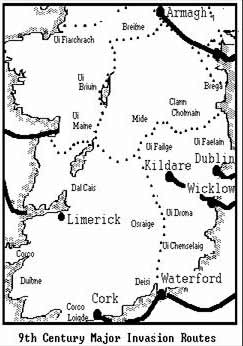
In historical documents, the off-spring of Rian, have been described as “Ua Riaian”, “Ua Rian”, and in later years as “O’Mulrian” or “O’Ryan”. Quite simply, all of these appellations suggest that the tribe’s leadership traced its orgins to “The Ryan.” The Rian was a member of the Ui Drona, one of the major septs (tribes) of Southeast Ireland. This major sub-division of Ireland was known as the Leinster, which covered an area from Dublin to Kildare to Wicklow and to Waterford. The Ui Drona’s territory defined a smaller kingship in what is now present day County Carlow, and in ancient times Carlow was known as Idrone.
What you may not know is that the lineage associated with the Ryan clan contributed to most of the kings of Leinster (sometimes referred to as Liagon). Most of our male line since Cathor Mor’s reign in the 2nd century were High Kings (Ard Ri) of Leinster, and it remained nearly unbroken until the MacMurroughs assumed the kingship prior to the Norman invasion. MacMurrough, a distant cousin of the O’Rians, was voted in as Ard Ri (the regional kings within Leinster would cast their vote for Ard Ri, and this king would remain in place until his death). After McMurrough was tossed out for incompetence, he made his way to Normandy to recruit an army to help him re-take his kingship. When the Normans arrived…well they sort of liked the place…and decided to keep the kingships for themselves. As one would say, “the rest is history”.
Just to make things a little more confusing…within Leinster, there were several layers of kingships (think of County, State and National). The Ui Drona’s territory would be similar to “County”, and they were part of the Ui Cheinnselaigh which is similar to State, and Leinster would have been their nation. The Ui Cheinnselaigh generally dominated the kingships in Leinster for almost 800 years, and you’ll see that our ancestors were among the dominant lords of this kingship.
Now back to original question, “when did Rian live”. The answer is that our ancestor reigned around 900 A.D.
The Ui Drona were relatively quiet in the 10th century, and it was at this time that Rian (Rien, Rian) son of Dubghilla ruled his kingdom in Leinster. Riain's Laigin tribe underwent a period of relative calm after Aedh's death (Aedh was Rian’s brother, who had been the king of Leinster). It appears that Riain ruled Ui Drona of the Three Plains around 900 A.D., and may have commanded this kingdom for many years as one of his sons was known to have been Idrone's sovereign in 976. Rian’s historical importance has been lost over the years; but because his son Muiredach was shown to have been king of the Ui Cheinnselaigh, it suggests that Riain must have been highly influential within this Leinster dynastic group. Rian’s father was king of Leinster as was his son Muiredach, but no records suggest that Rian himself was their national king.
By the time Muiredach became king of the Ui Cheinnslaigh, the Danish invaders (often referenced in the annals as 'foreigners') had invaded the shores of Ireland and began constructing port cities (for example, Dublin). The annals documented a bond of friendship crafted between the foreigners and Leinster in 976. This bond was made by Muiredach, son of Rian, but unfortunately it resulted in a disastrous outcome for Muiredach’s army when warfare erupted unexpectedly.
When did the O’Rians move to Tipperary?
The question of 'when did the Ryans enter Tipperary' has long puzzled historians. While neighboring Leinster tribes, such as the O’Gormans, can trace their westward migration, the Ryans mysteriously appeared on the Munster plains; and by the late 13th century they are referenced as a major sept in the territory. (Tipperary formed one part of Munster, and its current name originated much later in antiquity). Some historians believe that the O’Rian tribe’s arrival in Munster pre-dated the Danish assault, while others contend that they were squeezed out of Carlow by their new English proprietors.
So what do I think? The clue may be in their lordship title “lords of the three plains”, which was first used around 800 A.D. No one has been able to identify where exactly the three plains were – certainly the Barrow River cutting Idrone into two could account for two of their plains (east and west). It seems likely that the Ryans had been in northern Munster before Rian’s reign, and it would make sense that after the Normans overtook Idrone (or Carlow), the Ryan tribes moved in large numbers to their western “plain”.
This assumption can be supported by genealogical information. Rian’s father and grandfather were still kings of Idrone during the Danish invasion, and we see Rian’s son and grandson playing a leadership role of the Ui Chennselaig into the second millennium. We also see one of Rian’s great great grandchildren fighting the Normans in the late 11th century, in which O’Rian was killed by an arrow through his heard. After that, the clan grew quite, and within 100 years was referenced in the annals as being among the more important tribes with kingships near Newport and Thurles.