

Mother Teresa (Born Agnes O'Brian)
(Editor’s note) In late 2005 Mother Teresa (aka Agnes O’Brian) died. She was 105 years old. She was the oldest daughter of James O’Brian and Mary Ann McGonigle. Mary Ann McGonigle’s parents were Peter McGonigle and Ann Murrin. Peter and Ann were married in Killybegs before moving to America. Mary Ann was born in Brooklyn. We have written about this family before. Peter McGonigle’s brother was named Neil McGonigle. Neil McGonigle lived outside of Rock Island, Illinois, and we suspect Neil may be Francis McGonigle’s ‘missing brother’.
The following tribute was written by the Sisters of Carmel after Mother Teresa’s death. The Sisters remembered Mother’s stories and included these stories in this document. They also included information about her family, stories about her younger years, and Mother’s life in Carmel.
God’s Masterpiece of Joy
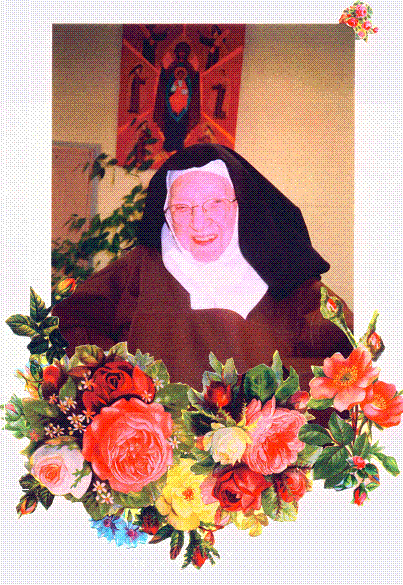
Second Title Page

All Has Become Gift
On November 10, 2005, our dear Mother Teresa made her final journey home. She was surrounded by all of us who bade her a tearful farewell amid prayers of praise and thanksgiving for the tremendous gift we have been so privileged to have in our midst for so many years. Mother Teresa was one hundred five and a half years old.
In the wee hours of the morning, as we prayed the Office of Readings for the Dead and sang some of Mother’s favorite hymns, we could only imagine what it was like for her as she was simultaneously being greeted by her Spouse of over 70 years, his Mother and foster father, her namesake, St. Teresa, her role model, Sr. Therese, the whole choir of angels and so many of her family and friends who have long awaited this moment.
Our imaginary tug-of-war was over. So often over the last few years, Mother Teresa was very close to death. We used to laugh and say that we were holding on to her ankles praying, “please, dear God, not yet” and her blood sister, Sr. Marie, from her heavenly vantage point, had a hold on her hands saying “Come on, what is keeping you?” This remarkable woman’s life spanned a little over a century and what a century it has been and what a remarkable life she has lived.
Kansas City, Missouri, like most of America in the year 1900 was a city caught up in the winds of transition. Immigrants were flooding our shores. By 1900 there were just 75 million citizens who, on an average, had five years of schooling. It was a nation of dirt roads, tight corsets, kerosene lamps, outhouses and an amazing conglomeration of ethnicities. Human speech was transmitted by radio waves for the first time, the telephone was coming into its own via the party line system. Horse and carriage was the mode of travel. Many of the fancier carriages about town were painted and delicately decorated by Mr. O’Brian, himself. Luckily for the economy of the O’Brian family, the model T Ford was still a thing of the imagination. The Niagara Falls hydroelectric plant had just opened up, helping to make this century the century of electricity. William A. McKinley, the 25th President of the US had just been reelected and was assassinated the following year. It was into this kaleidoscope of events and discoveries, changes and possibilities that this child of Mary Anne McGonigle and James Henry 0’ Brian made her appearance. Agnes was the seventh and last child of this hard-working couple. Their eldest child, Hugh, died as a youngster. The remaining five: Bartholomew (Hart), Francis (Frank), Leo (Lee), Anne (Sr. Marie) and John were eagerly awaiting the birth of this new addition. Lee was so excited when he heard that he had a new sister, that he ran across the street to the convent of the Mercy Sisters to tell them of her arrival. Unfortunately, for little number seven, the superior of the convent was celebrating a special feast. Her name happened to be Agnes. The Sister portress put the idea into Lee’s head that it would be lovely to name the new baby in honor of the superior. Hence the O’Brian’s new arrival was christened Agnes Frances O’Brian. Mother Teresa’s only consolation was the fact that her father did not allow any nickname for the baby. Agnes was bad enough but Aggie would be intolerable.
Aside from the ordinary challenges of family life, the O’Brians had a particular challenge in that Mary Anne, the mother, was deaf. During a previous pregnancy, she was given medication that robbed her of her hearing. Because of this, Mrs. O’Brian did not socialize very much. She spent her time working in the home and became quite a seamstress. Mother Teresa was told by her older siblings that they always ate dinner before their father returned home from work. Then once the children were fed, Mama, who was able to read her husband’s lips, and Papa, sat down to enjoy each other’s company over a quiet meal.
The happiness of this family was short-lived. When Agnes was two her mother died leaving her husband, James, the difficult task of raising six children without a mother. Relatives stepped forward and wanted to take the girls to raise as their own, but not the boys. Mr. O’Brian had other plans. He wanted to keep the family together which necessitated hiring a string of housekeepers to try to keep house, prepare meals, and keep an eye on a household which resembled a mini version of Cheaper by the Dozen. Unfortunately, the women he hired were not trustworthy and many of the family heirlooms disappeared, as did the housekeepers. God was saving the best for last, however. Providentially, one day, a young Irish lass, who had come to America seeking employment, heard of the predicament Mr. O’Brian was in and went to their home for an interview. When she saw the six motherless children, her heart went out to them. She took off her hat, rolled up her sleeves, and got to work that very day. Margaret Crowe became the maternal heart that held the O’Brian family together for the next ten years. Mother Teresa always spoke with such love and gratitude of Margaret. “She was a real Mother to us kids. The sun rose and set on Margaret.” Actually, Margaret was the only mother Agnes knew. Unlike her older brothers and sister, she had no remembrance of her real mother.
Now that Margaret had become a permanent member of the family, Mr. O’Brian moved his household to a new location on Bell Fountain Street.
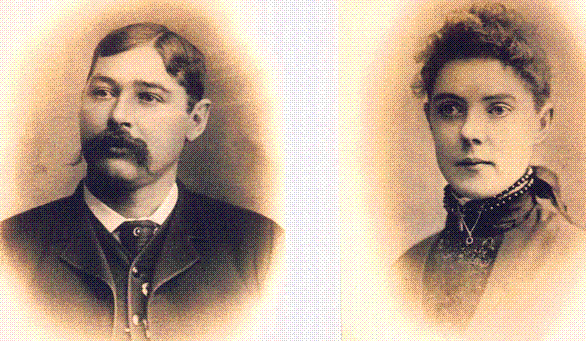
Here little Agnes grew up. The inhabitants of this street filled her life with wonderful memories. They were so vivid to her that one hundred years later she was still able to convey the charm, humor, and personalities of these Bell Fountainians with crystal clarity.
We invite you to take a stroll down the street through the eyes of Agnes, the precious “Ann Landers of the neighborhood.” First let’s visit the O’Brian house itself. Mr. O’Brian added a second story for the “girls of the family.” Here, Margaret, Anne and Agnes set up housekeeping. They all shared a spacious room which made it possible for Anne and Margaret to read late into the night, with Agnes, fast asleep, snuggled close to Margaret. Eventually a bathroom was installed on this floor. Agnes and John, her senior by 11 months, had great fun pulling the string of the water closet and watching the water disappear until Mr. O’Brian received the first utility bill. It wasn’t too long before John and Agnes were made aware of the fact that every time the string was pulled seven and a half gallons of expensive water went down the pipe. This short-lived indoor sport was soon replaced by other new discoveries and adventures. Before we go downstairs, there is one incident that always made Mother Teresa laugh with glee in the retelling. It seems that Anne was quite fond of water and loved taking a bath. She would prepare for the event with great care. Towels in place, soap and shampoo handy, tub filled to just the right level and temperature - sheer bliss! On this particular Saturday, all was in readiness as usual, when Anne saw that she forgot something. When she went to retrieve the item, Lee, the family trickster, slipped into the bathroom, locked the door and settled down to a good soak. Mother would break out into laughter as she recalled how angry Anne was. Lee even added insult to injury by singing at the top of his voice. Lee was also the one who made a seemingly delicious sandwich for Grace, Agnes’s lifelong best friend.
He could hardly contain his delight when he saw the horror on Grace’s face when she discovered, a split second before her first bite, the meat in the sandwich was a nice juicy worm from the garden. Brothers!
The family dining room was a place of wonderful memories. There was always room for one more. It seemed on most nights that there were at least one or two more around the table. Frequently, Frank, who was older and working, would invite a fellow worker home to experience what it was like to be a member of a large family. Periodically the table expanded with the arrival of Grandpa, the father of Mary Anne and / or one or two of Mary Anne’s brothers, who needed a place to stay for a time. This elastic table did not seem to bother Margaret, however. She always had a nice meal for the family and enough food for anyone who arrived unannounced at the last minute. Mr. O’Brian, as head of the family, served each of the plates. All were expected to eat whatever was given. There were assigned seats for the little ones. Each night poor John sat under the watchful eye of his father. Agnes, however, sitting safely on the far side of Margaret, was able to slip off unwanted food onto Margaret’s plate. This little transgression did not escape the watchful eye of John, who used this knowledge as ammunition whenever he wanted to employ his little sister.
It was around this dining room table that Agnes experienced a tragic personal loss. The family had chickens in the backyard, which provided eggs and the main course for many a Sunday dinner. Agnes bonded with one of the hens that would waddle up to greet her as soon as she stepped out the back door. The hen knew that a delicious crust of bread was not far off. The two of them became buddies. One day, her grandfather, trying to help Margaret, offered to go out and get a hen for the Sunday dinner. The ill-fated hen waddled trustingly up to the grandfather only to lose its head with one stroke of the ax. This was one time the whole family, had permission from Mr. O’Brian to “pass” on the main course. Needless to say, Agnes was heartbroken.
The family living room became a wonderful place of nightly gatherings. All the family were great readers. Frank had a wonderful reading voice and entertained everyone by reading stories aloud. The room, filled with pipe smoke by the men and older teenage boys, became a magical space that transported the entire family to places far removed from Bell Fountain Street. One could almost smell the pipes, hear the turning of the pages of the Saturday Evening Post, and feel the closeness of this family as Mother Teresa recalled and shared these experiences with us.
The family circle did not deter Agnes from making wonderful friends of the neighbors. We all have come to know the next-door neighbor, Mrs. Goodrich, who was “like a mother to us kids.” Evidently, most of the neighbors had an open back door for Agnes, who felt quite free to check up on everyone on her way to and from various errands for Margaret. She would marvel at how much adults would share with this little tyke. Mr. O’Brian would say, “If you want to know anything, just ask Agnes.” This wonderful ability to make people relax and share became a great source of grace and support for others all through her life. She had an innate sense of confidentiality and discretion. Throughout all her one hundred and five years, Mother Teresa lived wisdom gently and guided many a troubled heart. We, in Carmel, have been so blessed to live with a woman of such great integrity and love of God. Over the years, we, her sisters and so many others, have been led and guided by Mother’s gentle hand and heart. Agnes had a priceless quality of joy and concern which was evident even as a child and accompanied her into Carmel. However, we are jumping ahead of the story. There are many significant milestones that come into the O’Brians’ life before Mount Carmel comes into view.
Bell Fountain Street contained a world of adventure for the O’Brian clan. The empty lot next door became a field of endless dreams and possibilities. It was here the boys built their forts, lost their father’s tools, and played many a game of “Kick the Can” and “Run Sheep Run.” The limbs of the old apple tree became a place of dangerous mountain climbing as well as the perch for a pesty crow who interrupted many a soft ball game by cawing “Foul Ball.”
There were many children living on both sides of the street. As is true of kids everywhere, many an adventure took place out of the approving eyes of their parents. At the far end of Bell Fountain Street was a Holy Roller Church. Services were held there every Saturday evening. Sometimes the O’Brian youngsters, along with a few of their friends, would sneak down around the back of the building and peer through a window. Mother Teresa would say with eyes of amazement, “and you know they really do roll on the ground.”
One of Mother’s favorite stories on herself was about a Johnny Meany. He had a reputation among the children of living up to his name. Agnes, who always had a loud voice and was not shy in using it, called out from a safe distance at the end of the block, “Beat it back to the bread box, crumb.” Johnny’s response was nothing compared to Hart’s, her eldest brother, who just happened to turn the corner at the other end of the street. Bart, the very proper member of the family, was mortified. He shared his displeasure with his youngest sibling who by her remark had dishonored the family name down to the tenth generation.
The O’Brian’s were very active members of their parish. Mother Teresa was always proud of their Dominican Church and believed her great love for the Blessed Sacrament and the rosary had their beginnings there. Even though she and John had to transfer from the parish school to the local public school because of finances, they all remained an active part of the parish life. Mother always spoke with such high regard for the educational foundation they received from the Sisters and of the rich liturgical life they experienced.
Mr. O’Brian was a very active member of the various parish groups and fundraisers. Once, as head of the fundraising committee, he had Anne draw the winning name for an upright piano. Much to his embarrassment and obvious joy the name on the ticket was none other than his own. The piano, a treasure well beyond the economic means of the family, was placed in the living room and provided many an evening of enjoyment.
Before we move on to the next phase of Mother’s life, we must introduce you to Grace, the one to whom Lee tried to feed a worm sandwich. Grace and Mother Teresa were as close as sisters. They even looked alike and were often taken for twins. Grace Cassidv was raised as an only child. Her older brother met a tragic death before Grace was born. She and Agnes were inseparable. They were in the same class in school before Mr. O’Brian moved his family a few blocks away. Even though they now were in different schools, the distance between houses, five or six blocks was not an obstacle to their friendship. Each one’s home held a natural attraction for the other. Grace loved being surrounded by so many children and all of the kidding and teasing that was part and parcel of life at the O’Brian’s. Mother Teresa loved to go to the Cassidy’s where she always received special attention in such a small family setting. Both girls loved to coffee-klatch, eat and go for long walks even as little children. Very often the two of them would eat Sunday dinner at both houses on the same day. Mrs. Cassidy was very dear to Mother Teresa. Mother could not mention Mrs. Cassidy without saying; “She was always like a mother to me.” After the death of Mr. O’Brian these words were proven very true.
Sorrow was not too far away for the O’Brian family. When Mother Teresa was ten, Margaret Crowe returned to Ireland. The situation back in Ireland required her presence and so amid much tears, the O’Brians had to say good-bye to Margaret. Agnes’ heart was broken.
Anne, who was five years older than Agnes, and her father kept the home fires burning but there was a missing glow without Margaret. Anne, who had a natural ability of organization, was an outstanding student in High school. Fortunately, she not only excelled academically but also shone in cooking and dressmaking. She organized the family so that each one had a share in the running of the house. By then the three older boys were launched on their careers and two of them were starting families of their own.
Two years later sorrow once again found its way to Bell Fountain Street and to the O’Brian door. When Agnes was twelve, Mr. O’Brian died suddenly. As this orphaned family was trying to cope with life on their own, the entire world was quickly changing. There were rumors of unrest abroad. Within a few short years nations would be engaged in the horrors of the First World War. Lee would enlist in the Navy. John, suffering from a momentary lapse of memory regarding his age, would enlist in the Army. Agnes would withdraw from high school to get a job. The house on Bell Fountain would be sold and the O’Brian girls would begin life together on their own.

Agnes as a Young Woman
The O’Brian girls did their best to keep the home on Bell Fountain Street. As always, wonderful neighbors tried to help them as much as possible. Mrs. Goodrich, the neighbor on the left with no children of her own, would come in once a week to help with the cleaning of their near empty house. Eventually life on their own became too much for the girls. They put the house up for sale and moved to another part of town to live with their oldest brother, Bart, and his wife, Estelle. While there, Agnes enrolled in the local high school and Anne found a job. By this time, however, the girls, having been on their own for a while, found life with their brother and his wife too confining. They decided to try living on their own one more time.
Anne was able to find a small affordable apartment for the two of them. She was also able to find a secretarial job with a lumber company. Agnes continued on in high school and worked part lime. They were now living in another part of town, away from their Bell Fountain community. Following the example of their father who always valued the life of the parish to which he belonged, the young O’Brian girls became active members of the choir and generally got involved in the social life of the parish.
One of Agnes’s close friends was the son of the local theater owner. Mother Teresa would tell us of the hours she spent previewing possible feature films and passing judgment on the moral suitability of the movie for family viewing. If the two teenagers did not approve, the rest of the neighborhood never saw the film. It is remarkable the trust placed in these two young people. In later years, in Carmel, these same qualities of trust, discretion and wisdom instilled in the community a great sense of confidence in Mother’s leadership ability.
Eke theater always held a great attraction for both Anne and Agnes. Even though money was very tight, Anne managed to procure two season tickets for the theatrical performances that came to Kansas City. Kansas City, at that time, was the testing ground for plays and musicals before they went on to try their luck in New York. Though their seats may have been up halfway to heaven, they still enjoyed the thrill of attending a live performance and the delightful snack that always followed each show. Years later in Carmel, both Sister Marie and Mother Teresa would bring much joy to the community through impromptu entertainments and humorous skits. Perhaps their theatrical skills were honed in the upper regions of the Kansas City center for the performing arts!
By cutting corners, the girls manage to scrape enough money together to take a train trip to Niagara Falls. They were both looking forward to this so much. Their enjoyment was short-lived, however, when Anne came down with a very high fever and had to remain in bed for the whole length of their stay. Agnes was quite frightened and very disappointed. On their way back, they had planned to visit their brother, John, who was living in New York. Because of Anne’s illness however, they missed this meeting. They were unable to contact him to let hint know they could not come and never saw him again. Years later, when they were both in Carmel, they heard that Johnny had a tragic fall that resulted in his death.
Shortly after the girls moved into their apartment, once again counting their shekels, they made a Christmas visit to their brother, Frank, and his family who were living in Texas. Mother Teresa would recount with obvious joy the fun she and Anne had in getting ready for this trip. By this time, Frank had three children upon whom the young aunts wanted to make a good impression by providing the children with as many toys as possible. For the first time in their lives, she and Anne had the experience of being carefree children themselves by shopping and playing with each present before it was safely wrapped and tucked -away. When Mother was growing up Christmas presents were a rarity in the O’Brian household. They did have a wonderful visit with their Texas relatives. The highlight of the visit was a conversation the aunts overheard between Jimmy and his two sisters. He huddled them together and warned them with the superior tone of a five-year-old wisdom figure to “watch out for these ladies from the north.” Eighty years later, these words still made Mother Teresa chuckle in the retelling.
Though they never visited Lee’s family who lived in Illinois, strong ties of family held them all together. The O’Brian brothers instilled in their children a great love for their two aunts and managed to stay connected with them despite the distance or length of time between visits. This same love and devotion extends down to the third, fourth and fifth generation. Nieces, nephews, as well as great nieces and nephews have kept in contact with their beloved relatives by letter, phone, photos and visits. Whenever possible, they traveled great distances to spend time with Sr. Marie and Mother Teresa and then for the last twenty years with Mother alone. We all have such happy memories of Mother’s hundredth birthday party and the gathering of both Frank’s grandchildren and Lee’s children and grandchildren, several of whom met one another for the first time in our speak room. As the time for Mother’s one hundred and fifth birthday came into view, there was a great deal of concern as to where she would be having her celebration, here with us or home with Sr. Marie. Some relatives from Lee’s side of the family came before the actual date to have one last visit with Dear Auntie. She was so happy to have this opportunity to be with them even though she fully intended to be here to celebrate her 105th with the rest of the family who were planning to come. Come they did, representing Frank’s side of the O’Brian clan, helping to make her one hundred and fifth birthday a glorious day for a very special person in all their lives. Now we are getting ahead of the story once again. At the time of the trip to Texas, grandchildren and great grandchildren were still in the mind of God and so were celebrations at Carmel.
God always provided lovingly for these two young women by making sure there were many caring people in their lives who became their guardian angels. They watched over Anne and Agnes with maternal love and concern. Their next door neighbors in the apartment complex where they lived were a childless couple who took the O’Brian girls under their wings. When the young ladies returned home from a day of work, they would find a nice casserole or home baked cake waiting. If the weather was hot and muggy, they would he invited out for a ride in the couple’s car to “catch the breeze.” Seventy years later, Mother Teresa would still recall with a deep tone of gratitude all the goodness of people to both herself and Sr. Marie. Those of us who have had the privilege of living with both these wonderful women can certainly understand why people responded to them as they did.
Sixteen-year-old Agnes, realizing the strain Anne was under to provide for both of them, decided to leave school and get a full time job. She was not as proficient as Anne was in skills necessary for the working world, but she did manage to he hired as a telephone operator for the same lumber company that employed Anne. Anne was a secretary on the third floor and Agnes answered the phone one floor below. Mother Teresa said that she did not have much to do and had plenty of time to read novels while she waited for the phone to ring. As always, Agnes was quick to make friends. In her office there was an office boy, Charlie Bell. They were both about the same age and enjoyed each other’s company. Like teenagers of every age, they liked to tease one another. This did not please the spinster member of the office who would tut-tut at their antics. She was quick to remind Agnes, whenever Agnes would begin to whistle a tune, “whistling girls and cackling hens all come to no good end.” Agnes and Charlie would just roll their eyes, giggle behind stacks of paper and get back to work for a while. Charlie became quite fond of Agnes and proposed that they get married and she become Mrs. Bell and raise a whole bunch of “little ding-dongs.” Charlie certainly had a way with words! Needless to say, Agnes laughed and passed on this offer though at this time in her life she had no plans regarding her future.
For a time, Agnes and Grace Cassidy lost contact with each other. Remember, Grace was her childhood friend from her Bell Fountain days. Once they reconnected however, it was not too long before the Cassidys invited the two girls to move in with them and become part of the family. This offer was an answer to prayer. Once again they were part of a loving family. Mother Teresa was back in her element. She thrived on the dynamics of family life. Later, it was the same family dynamics which she held so dear, that animated her as a community member and then as a prioress of our Carmel. Up to the last ten days of her life, she was with the community as much as possible and was never happier than when the community was doing something together. In the Cassidy household there was always something going on. Mrs. Cassidy, many years younger than her husband, ran a boarding house for a few residents. She was delighted to have her dining room table increased and to share in the lively conversations that took place after a day of work. Every one seemed to be night owls so cards usually followed dinner and then a midnight snack in the kitchen before bed. The three girls, Anne, Grace and Agnes had the complete second floor to themselves. Life once again seemed wonderful.
Grace and Agnes were again going for long walks after dinner. They reconnected with old friends. They began going on outings into the country, on shopping trips downtown and spending evenings of song around the piano. Once again Agnes and Grace were inseparable. Mrs. Cassidy became “like a mother to us,” and Mother Teresa loved her as much as any daughter could.
Though Anne and Agnes were very close, they each had their own circle of friends and enjoyed life to the full. Agnes always enjoyed being with a group of young people. She was outgoing and generous to a fault. In years to come, her magnanimous spirit followed her into Carmel. Legions are the people Mother Teresa helped in countless ways. She had a special care for her “Josephs” who made daily trips to the monastery of Capitol Hill. They always left with a hot meal and a few coins to jingle in their pockets. Grace was forever trying to reform Agnes but to no avail. If the group of girls were taking the streetcar downtown, Agnes would be the first one on board paying for the fares of all the rest. Grace would be horrified. Even as a child, Grace knew the value of a penny. When Grace was a young child, Mrs. Cassidy offered to pay Grace a penny for every gray hair she pulled from her mother’s head. At age five, it was not too long before Grace figured out that one long gray hair could easily be cut in two, thus, two pennies for one hair. Her financial career came to a halt when Mrs. Cassidy discovered this enterprising technique.
Agnes especially enjoyed going on hayrides out to the country for picnics. One such ride resulted in a trip to the doctor and permanent eye damage. She was part of a whole group of young people who went out to the country one delightful spring day. After a picnic lunch, the boys in the group began a contest to see who could throw the farthest. One throw went astray and Agnes was hit in the eye with an apple. An emergency trip was made to the local doctor, who assured her all would be all right in a few days, but it wasn’t. All through her adult life, this eye was troublesome. This did not deter her from the next hayride, however.Anne and a close friend of hers decided to take a trip out to Seattle.
Both girls fell in love with this part of the country. Anne decided to stay in Seattle and find employment. She moved into St. Teresa’s Residence for young Catholic ladies, that was run by the Sisters of St. Joseph of Peace. It was a heartbroken Agnes who received the phone call from Anne in Seattle, telling her of her decision to remain. Agnes continued to live at the Cassidy’s. About this time in our story, Morris entered the scene. Morris was a very willing escort for the two girls and a welcome visitor at the Cassidy home. Unbelievable as it was to all Agnes’ friends, she managed to save enough money to buy a car. In those days (mid-twenties) you did not need a driver’s license. Agnes only drove this car once. The three friends decided to break in the new car by going for a drive in the country. Agnes was at the wheel, Grace in the middle and Morris on the passenger side. Bravely they started out. All went well for a time. Agnes, who had became a little fatigued and nervous, thought it would be safest to drive in the middle of the road, that way there would be plenty of room on both sides. The disgruntled driver behind them had other thoughts. In a moment of frustration he swerved around the obstacle. Agnes was frightened and sent the car somersaulting into a ditch. They ended upside down and miraculously unhurt but trapped inside the car. After some time, Morris was able to work his way out and then free the girls who, by this time were dissolved in gales of laughter. From then on they either walked or took the streetcar.
Agnes would telephone Anne whenever finances permitted. These calls usually ended in tears on both ends. The holiday conversations were especially difficult for both of them. Agnes did visit Anne in Seattle a few times but these were bittersweet experiences especially as departure dates for return to Kansas City advanced closer and closer. No one could have been more surprised than Agnes when Anne called to tell her she had decided to enter the Carmelite Monastery in Seattle.
Agnes was not at all sure what entering the monastery meant but she knew it was ominous. She went to her parish priest to ask him about this latest development. As best he could, he tried to explain Carmelite life and the tremendous privilege it was to be called to religious life and to have a sister in religion. Agnes, though she loved her sister and wanted what was best for her, could not help feeling her world was ending because she was losing the one person she loved most.
Anne did enter Carmel and took the name of Sr. Marie of Jesus. Agnes came out a few times to visit Sr. Marie and each time it was a joy and a tremendous sorrow for her because she was living so far away. Grace by this time had married Morris and began raising her own family. Agnes decided to move to Seattle where she would be closer to Sr. Marie. She lived at St. Teresa’s Residence and was soon the friend and confidante of many in Seattle.
She was especially fond of the Sisters of St. Joseph of Peace who provided the residence. It was not long before Agnes was considering a religious call to join them. She decided to discuss this matter with Mother Cyril, the Prioress of the Carmel, who convinced Agnes she did have a call. The call was not to Bellingham to join the Sisters of St. Joseph of Peace, however, but to Carmel. Once this possibility was broached, Mother Cyril lost no time in setting up an entrance date for Agnes.
Life moved pretty quickly for Agnes once the date was set, Nov. 24, 1931. Before entering, Mother Cyril arranged for Agnes to go to visit her own sister Rosemary McDougal, an invalid who still lived in the family home in Orillia. This site has great meaning for our Carmel because the founding sisters spent a few months there when they first arrived from Baltimore. The Monastery was not completed when they reached Seattle. Mother Teresa is the only community member, aside from the four foundresses to have actually seen this property, as it was when they first arrived. She remembered it quite well and was able to answer a bevy of questions posed by the newer members about our beginnings in Seattle. We all treasure the many stories she was able to share with us about the earlier years of our foundation.
Another phase in her life is about to unfold. Agnes, who five years ago never heard the name Carmel, was about to become the sixth permanent member of the community. God’s ways are mysterious and wonderful indeed!

This next period of Mother Teresa’s life is marked by a certain silence — the silence of Carmel. Unknown to her at the time of her entrance, Nov. 25, 1931, Agnes was about to begin the mystical climb up Mount Carmel. Mother never talked much about her life in Carmel. We know that Sister Marie (Anne) was taken by total surprise when Mother Cyril announced to the nuns that their new postulant was none other than Agnes O’Brian. Agnes was thirty-one years old at this time and was considered a “late” vocation. With true O’Brian aplomb, Agnes embraced Carmel with her whole heart. She suffered the usual ups and downs of any postulant. In a rare sharing about these early years, she told us she would go to her cell, stretch out on her cot, and through tears, say to God, “and to think I asked for this!” Well, ask she did and the Lord heard her prayer. For the next seventy-five years, in silence and hope, Mother Teresa responded with her whole heart to whatever the Lord asked of her. As a professed nun, Sister Teresa, competently and quietly, went about her assigned work. She rotated in and out of the different areas of responsibility doing the best she could to make the peace and harmony of community flow and flower. She became a great cook, a skillful seamstress, an attentive sacristian, a resourceful provisor, an incomparable turn-sister, an understanding novice mistress, an attentive subprioress and grace-filled prioress. In general, she was a “jack of all trades” and able to wear many hats at the same time. Her real forte though was the turn and the telephone. Many a needy person found both material and spiritual help emanating from a mysterious voice behind the turn. Years later we would receive letters from persons writing to thank Mother Teresa for the help she provided when they were down on their luck. In some cases, this gratitude was passed on to the second and third generation who wrote to express their thanks for helping their parents, grandparents, brothers, or sisters at a particularly painful time in their lives.
As a young professed, Sister Teresa was asked to be the infirmarian for Mother Ignatius the Prioress at the time. She ministered to Mother with great love and devotion. Years later, when she was in the infirmary herself, she would like to share with her nurses a frequent prayer request of Mother lgnatius. Mother Ignatius would always pray that when I (Mother Teresa) became infirm, “there would be someone to care for me as I had cared for her.” Mother lgnatius’ prayers were doubly answered by providing two willing souls who dubbed themselves, “Queen Tess’ ladies—in—waiting.”
It soon became apparent to the community that Sister Teresa had great leadership ability. From 1943 to 1952 Mother Teresa was sub-Prioress and First Councilor. From 1952 to 1977 Mother Teresa served off and on as Prioress for a total of fifteen years.
She and Mother Ann spearheaded the building of the new monastery between the years 1964 -1966. This was a very courageous act on their part. The monastery on Capitol Hill, though built with love in 1908, was not designed for monastic life. It was dark and inadequate in size and space. Over time it became bound on all sides by apartment buildings and large two-story homes. Archbishop Connolly, supportive of their wish to relocate, wanted to keep the nuns in Seattle, which greatly limited their choice of location. They procured the last five-acre lot available in the city limits of Seattle. This site was the home of a riding academy. In their estimation, the hills and gullies on the property were fine for riding horses but not very appropriate for a monastery. Being obedient to the Archbishop though, they put their trust in God and moved ahead with the purchase of the property. Two dear friends, Fred and Robert Hanson, turned this unlikely terrain into an exquisite garden with many private nooks and crannies. In spring our garden is truly a showplace.
The design of the building, thanks to the architectural ability of Sr. Marie, afforded the nuns a beautiful spacious interior with well lighted rooms. Those of us who have come long after the construction of the monastery are reaping the fruits of Sister Marie’s foresight and owe her a deep sense of gratitude. Each detail was designed to enhance the life of Carmel in every way.
Mother Teresa became the first Prioress of the new monastery. She had such a lovely way with the Sisters. There was nothing pious about Mother Teresa. She possessed a down-to-earth, spiritual wisdom which she shared in a very unassuming way. Anyone could come to her, be she postulant, novice or professed to seek her advice and encouragement. Each would know that their deepest cares were safely tucked away in her motherly heart and their trust in her would never be betrayed at some later date. Upon hearing of the death of Mother Teresa, one of our former novices wrote a lovely card, which contained a copy of a handwritten note Mother Teresa gave her in 1983. Mother wrote:
Dear
It’s a little hard these few days to have a personal continuation on the “asking for suffering” idea. It comes to my mind Our Lady is the perfect model for us in this. She didn‘t ask God how to treat her in her pure loving of Him. She simply vowed virginity of mind — heart, soul, and body- letting God choose the best way she would fulfill His plan in her life. She placed no obstacle in the Purpose of the Holy Spirit. She only wanted to serve and love God and live each day in that spirit. She accepted joys and trials lovingly. I believe Our Queen Mother will show you this way, if you ask her.
It is sort of a forgetting of self also our ideas that God might not realize how much we love Him unless burdened with a heavy cross. He sees your great desires and that is most pleasing to Him, I am certain. But leave it to Him how he willful/ill them. He has led you thus far, don‘t fret. He will keep on. Perhaps He desires you to be just a lovely masterpiece of His Joy. This is one aspect I think is overlooked in the lives of Jesus and Mary.
I hope this helps a little. Know you have the prayers of all of us. Tanks for the posey you put on my tray. It is in front of Our Lady of Mt. Carmel’s statue here in the infirmary. Prayerful wishes for a grace filled three days of Holy Week
Mother Teresa
One senior member of our community said after Mother’s death, “she shared my every joy and dried my every tear for the last fifty years. This community simply loves her. She, herself, was truly ‘that lovely masterpiece of His Joy.’
That is not to imply that Mother’s life was devoid of sorrow, misunderstandings, and physical suffering. These elements which are part of every human life certainly found a home in Mother Teresa. She had an easiness of manner and deep level of faith that saw all as part of God’s loving plan.
She never dwelt on unpleasant events of the past but was truly a woman of the present moment. For her, the present moment always encompassed the current activity of the community. She was never happier than when she was with the community. Her quick wit and joyful spirit enlivened any gathering. In her later years she was most willing to lend a hand peeling vegetables, cleaning wax from candles, stuffing envelopes, cutting canceled stamps, opening junk mail, preparing scapulars — anything that would make life a little easier for someone else. A favorite saying around the monastery was, “maybe Mother could help me with this.” This little phrase was music to Mother’s ears.
Mother had a great love for the recitation of the Divine Office and up to the last few years of her life always took her part in the choir. Though she never had any professional training in singing, she had a powerfully full voice and could be heard above all the rest. This loud voice of hers was a particular characteristic she possessed even as a small child. A favorite community tale was one that took place at the Monastery on Capitol Hill in which Mother Teresa spied the handyman about to perform unwanted surgery on her favorite Cyprus tree. Her thundering voice came through an unopened window and warned him if he progressed one inch further, his life would be in danger.
Usually though, Mother’s voice brought consolation and comfort. Many were the people in Seattle who found in her a sympathetic ear and encouraging word of support. All through her life, she had trouble with the circulation in her legs. This was a cross for her but proved to be a blessing for others. Each afternoon she would have to put her feet up. She used this time to contact by phone the different ones who called, seeking her words of wisdom and comfort. Some of these friendships go back over sixty years. Many a priest and religious considered Mother Teresa a very powerful prayer partner whose discretion could be trusted and words of wisdom valued.
In her later years, with the responsibility of authority behind her, she could relax and just be her witty, fun-loving self. We regarded her as the heart and treasure of our community.
Her advancing years, brought with them physical diminishment. Due to crippling arthritis, Mother was confined to a wheel chair. Though she never complained about this restriction, she would often dream about having the freedom to run up and down stairs at will. This is not to imply that she was confined to her cell. Far from it! Mother attended most community acts and activities up to a few weeks before her death. There was never a question in her mind, or anyone else’s, that it would be otherwise. Once, when she was napping in her cell while the community went to pray the Office, she surprised us all by waking up and rolling into choir at the time of the reading. She was grinning from ear to ear, as if to say “Here I am folks!” The surprised community burst out laughing at her latest escapade, wheeled her into her usual place, and tried to compose themselves for the closing prayer.
She loved it when, weather permitting in Seattle, the community was able to eat outdoors. If it was a bit windy, she would be willing to be wrapped in an electric blanket which was plugged in through the nearest window. She was never one to miss out on a time to be with the community. Sometimes there would be a subtle and not so subtle rush to sit next to her to be able to slip cold fingers under a warm blanket unobserved.
There are not many ninety-nine year olds who are willing to pack up and travel thirty miles away from home to attend a six day West Coast Meeting. Yet, that is what she did. Mother knew that if she stayed home, others would have to do the same. She went and had a marvelous time.
Even at 103, that same selfless community spirit prompted her to accompany the community on a pilgrimage which retraced our roots in Seattle. The highlight of the trip was seeing two burly men, current residents of the former monastery, lift her wheelchair and carry her in a style befitting a queen, up the front stairs of the building. She was presented with a beautiful long stem red rose before being carried over the threshold of her beloved first home in Carmel.
Lack of mobility was not her only challenge. Loss of hearing was the most difficult to bear because she had such an active mind and wanted to be a participating member in all community discussions and meetings. We tried everything. More powerful hearing aides, microphones, headsets, which helped some, but not very much. Though it must be said, for someone who was having difficulty hearing the spoken word, she never missed much! Here again, she didn’t feel sorry for herself, she still came to everything because being with the community was life for her and for us as well.
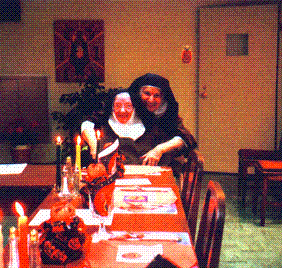
Mother was a night owl from her earliest days. She seemed to have tireless energy and never wanted to go to bed. Her nurses, however, did. When she sensed the moment was about to come when she had to go upstairs to retire for the evening, she would poke the person next to her, roll her eyes and in a stage whisper worthy of Bell Fountain Street, and say, “I guess I am tired.” Her favorite way to leave the gathering was to lift her hand and with a twinkle in her eye say “See you later, folks!” This nightly scene resembled something right out of the closing scene of the “Walton’s” as “Good Night, Mother,” rang from every corner of the room.
At age 104, Mother Teresa embarked on a new apostolate. She began to provide candy favors for needy children and others for major holidays. She would stuff toilet paper rolls to the brim with wrapped candy and then cover them with the appropriate colored paper for the celebration. She took this work very seriously and worked at it morning, noon, and night. It would tickle her to think of the joy some child would have as he or she discovered the sweet treats within. Frequently, she would say, “I had nothing like this when I was a kid.” Half of Seattle began to save us toilet paper rolls. We found them everywhere. Everyone wanted to be a part of Mother Teresa’s project. She was working on her Thanksgiving treats when God intervened.
She had some pretty spectacular birthday celebrations beginning with the celebration for her 100th birthday. Father Spitzer, the president of Gonzaga University, flew to Seattle in order to be the main celebrant for the afternoon liturgy. Mother greeted her two hundred or so guests in the speak room following the liturgy. She was radiant. ‘there must not have been too many flowers available for any other event in Seattle that weekend. Carmel had them all. One florist, who was exhausted trying to keep up with the orders, greeted an unsuspecting customer by saying “yellow is the color Mother chose and she has more than enough flowers at this point. Thank you very much!” Many of Mother’s nieces and nephews, grandnieces and grandnephews came for this celebration making this a truly memorable event. They left thinking this was probably the last birthday for their beloved aunt.
Five years and two additional major celebrations later brought us to the year 105 and the final birthday party. It was wonderful. Guests were in awe that this beautiful woman with wrinkle-free skin and beaming smile could truly be 105. One hardly noticed the oxygen tube that was her constant companion for the last year. By the time of her 105th party, she had reconciled herself to the fact that this tube did her more good providing oxygen to her lungs rather than aerating her eyebrows, the top of her head or providing a cool breeze under her chin. As always, she rose to the occasion, graciously entertaining everyone. She even made the five o’clock news that evening on our local television station.
Eventually, parties end and the reality of Mother’s years became increasingly apparent. We all knew that there would not be a 106th birthday for our dear Mother Teresa. Our beloved community treasure was about to become another jewel of Carmel in God’s heavenly kingdom.

Mother Teresa Two Weeks Before She Died
For over a year, Mother Teresa’s health was very fragile. Poor circulation, ulcerated legs, cold, flu, and congestive heart failure played tag with each other. She had a wonderful Doctor, Dr. Oren Townsend, who, with his staff, did all they could to make Mother’s last years as life-giving as possible. In addition to her very caring and compassionate Doctor, the Visiting Nurse Services of the Northwest supported her and us. They, with us, became a loving circle of friends. They now have a special friend in heaven watching over them as they once watched so carefully over her. There are not enough superlatives to describe this network of caring people.
By the beginning of October, Mother could no longer come to community meals. We began taking turns eating and spending time with her in her cell. These are treasured moments for each one of us. During the first week in November, while moving Mother from one chair to another, she became limp. The hydraulic lift malfunctioned at the same time. As a result, Mother had to be eased to the floor. We were never sure if her hip spontaneously fractured at that point. After the paramedics came and lifted her into bed, she said to Sr. Sean, “I’m on my way.” These were the last words Mother spoke. Nine days later she reached her destination. These final last nine days were unbelievable days for the community. November 12th was the day the community planned to celebrate the transference of vows of Sister Teresa Benedicta from the Tindinyo Carmel in Kenya to our Carmel. Her dear mother, Mrs. Nasambu and her former prioress, Sr. John Mary and Father Dennis Geng were enroute from Kenya to be with Sister for this joyous event. They arrived two days before Mother died. A few hours before Mother’s death, one of our novices, Sister Grace Marie, received word that her own dear mother, living in the Philippines, just died.
Mother expired around two in the morning on November 10th. A few hours before, with all of us gathered around her bed, Father Dennis anointed her for the last time. More than one mind must have recalled the many times we had, as a community, been anointed with Mother. She felt that the Sacrament of the Sick was only meant for someone truly sick and in her mind she did not qualify, but if we all were going to receive this Sacrament that was different. There must not be another community in Carmel who has been anointed as many times as we have over the last five years. Community solidarity is a wonderful thing!
Four hours after the anointing, a very bright flash of light awakened Father Dennis, who was asleep in the downstairs guest apartment. This happened exactly at the time of Mother’s death. Perhaps this was Mother’s way of saying “thank you, Father.”
No one had the presence of mind to call the Sisters in San Raphael and tell them of Mother’s death. They were flying from California early that morning to celebrate with Sister Teresa Benedicta. They had quite a shock awaiting them when they got off the plane in Seattle. It was a blessing for us to have them here. Their sisterly support and care made a yen difficult week so much easier by being surrounded by the larger Carmelite family.
We decided to go ahead with both celebrations, the transfer of vows and the funeral, which is just what Mother would have wanted us to do. She saw to it that everything went along very smoothly and wonderfully.
Mother looked beautiful during the viewing. It was hard to believe she was really 105. A steady stream of people came during the days and nights before the evening Mass of Resurrection which was celebrated on Tuesday evening. Over two hundred friends gathered Monday night to pray the rosary with and for Mother. Likewise, the next evening, two hundred or more friends braved a cold rainy night to celebrate the life of one of God’s very own. It was a glorious celebration. Seventeen priests were in the sanctuary. They concelebrated the Mass of Resurrection with our dear friend, rather Robert Egan S.J.
Mother’s special friend, Father Spitzer, happened to be in Seattle for two speaking engagements that day, and was able to sandwich in a quick trip to the monastery to give Mother a final blessing just before the community closed the coffin and she left the enclosure for her last and most blessed of celebrations. At last, her Going Home Party had arrived.
The following morning, many friends joined us at Calvary Cemetery to lend their prayerful support as we laid mother to rest in our Carmelite plot. Mother is in a space next to Sister Marie, her beloved blood sister.
For those of us who have lived with God’s Masterpiece of Joy, Mother Teresa lives on in our hearts and is part of the fabric of our lives. Her life provides rich color and texture to the beautiful tapestry God is weaving with our Carmel. Our story continues. Other chapters will be written. We trust that our heavenly companions, Mother Raphael, Sister Agnes, Mother Cyril, Mother Ignatius, Sister Mary, Sister Marie. Mother Ann, Sister Mary Teresa, Sister Therese and Mother Teresa will provide light for the journey and see us all home.

We give thanks and remember

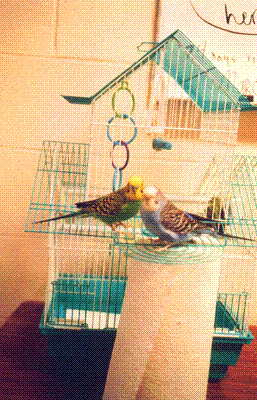
Apart from two parakeets in a cage, a couple small fish swimming lively in a small water tank beside her and a pile of unopened mail on her small table, Mother Teresa spent a great deal of her day in Carmelite solitude. Occasionally she would talk to these creatures who shared her space. In the four years I knew her, Mother Teresa was confined to a wheel-chair and spent much of her day in her cell, either opening junk mail, reading a book, or taking a nap in her high reclining chair. This, however, was before she was introduced to the candy ministry for the kids, which she performed faithfully and diligently until she was finally too weak to do so.
Since her death, the memories of some of her favorite statements have taken on new meaning and significance in my mind. For instance, as soon as someone walked into her cell, she would stop whatever she was doing with a bright smile on her face and say, “Oh, come on in. I am so glad you came in.” Then she’d take a minute to explain what she was doing at the time and ask; “What have you been doing?” Then, with real concern in her eyes and voice, she would inquire where everyone else was at that time and what they were doing. Mother had great interest in people and showed considerable concern towards everyone. She certainly loved and cared for people.
One of my assignments as a new member of the community was to interview Mother Teresa and record her memoirs. I remember the happy afternoons we spent together as she tried to recall the incidents of her long life. It was a joyful time for both of us which often ended in long peals of laughter. As a result we bonded so closely that whenever I would walk into the room where she was, she would always call me by name in a playful tone, saying, “Here comes Agatha!” I miss her warmth and friendliness.
Like the rest of the community I was saddened by Mother’s death though we saw it coming any minute from the time she became too weak to join us for meals. Mother was not one to remain in bed during the day. Even at night she did not look forward to going to bed. As a matter of fact if you wanted to ruin her jolly mood in the evenings all you needed to do is mention that she was being taken to bed. Mother Teresa was a woman for people and she always had something positive to say about everyone. We each treasure sweet memories of her. MAY SHE REST IN ETERNAL PEACE!
Sr. Agatha
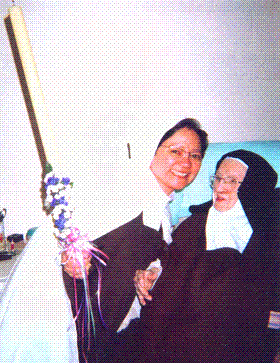
I met Mother Teresa for the first time in March 2004. I came to the monastery and stayed with the sisters for one week to do a ‘Come and See’ inquiry about the religious life and the Carmelite life in particular. I remember that day very well; it was a beautiful sunny day. I walked with Sr. Sean to the corner room where Mother was for the time being, while the repainting of her infirmary room was under way. I felt a bit apprehensive because I did not know how I would relate to a 104 year- old person. Ideas were going through my mind of what she might be like, such as looking very old, fragile and solemn. At least that was how I remembered my 103 year-old paternal great-grandmother back in the early ‘60s when I was just a little child.
As we entered the room, Mother’s back was towards the entrance door and she was facing the window. Sunshine was hearing down on her and she had her eyes closed. As Sr. Sean called out her name, she opened her eyes and her face lit up with the sweetest smile and she vibrantly uttered “Good morning!” Her smile just melted all my apprehensions away. I felt the joy that naturally came out from her. She was very welcoming and I quickly felt at ease with her.
When I joined the community, I was blessed with more time and opportunity to be with Mother Teresa. I experienced her child-like spirit. It was always fun playing Chinese checkers with her. I was amazed how she could make all those moves. And as she made her move, she would say the color she was playing — “yellow, yellow, yelllowww!” She sometimes helped me make my move. She really enjoyed playing that game and would always say that each match is always different and challenging. She was right Mother was so appreciative of everything, especially the same meal (a bowl of soup, one egg, four pieces of cracker, a brownie or chocolate pudding) offered to her day in and day out. She would sincerely remark “Soup for a change!” Mother just loved meal time with the whole community. She was usually the first one down in the refectory and patiently waited for everyone to arrive. Then she’d give the sweetest smile with a wave of her hand as a way of greeting for each one.
Although Mother did not remember my name all the time, she always remembered where I was from. She would always tell me, “You must be cold. I’m sure you did not have this coldness back home.” Then she would hold my cold hands and say, “My, they’re cold! Let’s warm them up.” This was one of her simple ways of showing her care and concern for others.
I had so many fond memories of Mother Teresa in the short time I spent with her. Few of them could be recorded in this brief write-up on her, but in each fond experience with Mother Teresa, I was always impressed with her joy. To me, she is an epitome of joy.
Sr. Grace Marie of the Holy Trinity

Mother made me feel welcome! I could spend time with her at ease, in good company. I treasured her smile and laugh, a quick witty remark always lovingly expressed in her eyes and voice. This was her twinkle in God.
Herr gratitude was constant, always recommending me to God for reward for just the slightest help given to her. She accepted all my help in perfect humility, gratefully expressing joyfulness in being alive.
Since she has passed on to heaven her care of me is deeper, in that I feel her protection now more in my heart. I feel her approval of my vocation, her assurance and maternal support, imparting courage to her child as she faces the unknown.
I have become more aware of Mother’s legacy, which she left behind for me to follow. Her care and tutelage of me as a postulant has not been wanting, for her ways of being happy here, in this calling, are everywhere around me.
Mother’s virtuous example of love in community is with us now as we share each other’s company and truly enjoy ourselves. She was quite herself and so is the whole community. Her peace of soul flows about me here everywhere. It is a part of her legacy I treasure most of all.
Mother’s love of work and her “may God reward you” resounds in my ears for even tiny bits of effort cheerfully done for God and neighbor. It is as if God is just so excited to see good happening He just can’t wait to tell you “Wow — good job.”
Mother’s inspired love in my Prioress and all the Sisters of the community are evident to me, especially in their compassion with my human weakness showing understanding and charity. Her good example and direction are shown in each one caring for a fellow Sister and neighbor.
I love her and ask our Good God to reward her forever.
Mary Therese Macfarlane
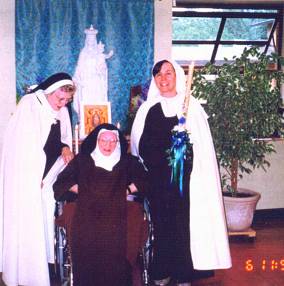
As I remember Mother Teresa, the words that come readily to mind are joy, love, patience, and humor. It is now in her absence that I realize just how much we relied on these beautiful gifts that she brought to community. I’d like to share a few memories capturing each of those gifts.
Her Joy: Mother Teresa had a cell in the infirmary during the last few years of her life, so our best opportunity for seeing her and catching one of her radiant smiles was in the refectory during mealtimes. The sisters would bring her down all bundled up in something warm. One by one, we would walk over and greet her. We never missed the opportunity to slip our hands into her warm hands. Suddenly her smile would break into a serious look of concern as she grasped your hands saying “My goodness...where ya been...in the cooler...?” Our response was always, “warm my hands, warm my hands,” and she was most obliging. I will always remember the warmth of her hands and her smile. Those same warm hands lovingly cared for our community as prioress for many years, and, in later years, were always busy doing something special for others: wrapping candies that were sent over to the soup kitchen at Blessed Sacrament, sorting mail for the prioress, cutting string beans for our midday meal, or playing Chinese checkers with Sr. Miriam.
Her Love: Mother Teresa was a very loving person, who always thought of others first. On countless occasions when we were gathered, she would sense that someone needed something and would ask one of the sisters to assist her. She especially looked out for Sr. Miriam. Once when I was sitting with Mother Teresa in the infirmary, at a time when she was quite sick and we were very concerned about her, she saw me yawning. Sensitive to my afternoon sleepiness, she said “Why don’t you just crawl up on that bed and take a nap! No one will see you.” I laughed and told her that I would rather stay awake and be with her. She also told me that she was often awake at night. During that time she would pray for all the people who couldn’t sleep—those who really needed the rest in order to carry out their responsibilities at home and work the next day.
Her Patience: Mother Teresa was always a night owl and one who liked to burn the midnight oil. During those final years of her life, her routine in the infirmary called for an earlier bedtime (10-10:30 PM) which for her was way too early. However, she smiled and accepted it, though sometimes with a sigh and an expressive look on her face. In fact her expressive looks were rather a trademark with Mother, in addition to the colorful stories she told and the clever way she had of expressing herself in writing. She had a way of communicating exactly what she was thinking by a quick movement of those blue eves and the arching of her brows. One day during Mass she was seated in her wheelchair in the very front of the choir. Her foot began to bother her, and every time she would move it, trying to find a comfortable position, the pedal on the wheelchair would squeak loudly. After several minutes, the infirmarian came and whisked her away...to readjust the shoe. As she was wheeled out of the choir, she shot us all a look and rolled her eyes as if to say “Uh-oh, I’m in trouble now.” We all smiled.
Her Humor: One of the things we deeply loved about Mother Teresa was her great sense of humor. No matter how she was feeling, she always had wonderful “one-liners” that caught everyone off guard and made us laugh out loud. One night as we gathered in the recreation room, one of the sisters was having difficulty keeping her veil on. Mother Teresa, watching her from across the room, suddenly blurted out “It’s gonna go!” We all laughed as sister secured the slippery veil. Then there was the time when we gathered for an informal meal in the recreation room. After finishing, one by one the sisters began to pick up their TV trays and return to the kitchen. Always reading the moment, Mother Teresa proclaimed “Pick up your tray and walk!” We were all in stitches, and she was in her glory.
In the last couple of years, the visiting nurses came to check on Mother Teresa once or twice a week. One day a new nurse appeared in the infirmary. Just as she was beginning to go through her routine with Mother Teresa, we heard the chiming of her cell phone. She excused herself and ducked into the bathroom to answer her cell phone. Mother Teresa winked at me and with a sparkle in her eye said, “Ok, you time it and see how long she’s on the phone. We’ll dock that time from her pay!”
Recalling these beautiful memories of Mother Teresa brings home to me an important dimension of what it means to be a true Carmelite—that of bringing the gift of joy into the lives of others. For one who brings joy to others truly creates an atmosphere of love and rejoicing in community which is the greatest gift of praise!
Sr. Susan Elisabeth

******************************************************************
On my first visit to St Joseph’s Carmel in 1951, I stood trembling at the “turn”, waiting for an answer to the bell I had just rung. Eventually, I heard the sound of very positive footsteps coming past the door to my right (which was locked) and on into the “turn room” from which I heard Mother Teresa’s very cheery and vibrant voice: “DEO GRATIAS!” That voice characterized her whole being: purposeful, vibrant, upbeat, resonant, sustained. Even her so-called “whisper” in choir could be heard clear across the room.
Mother was my Novice Mistress all through Novitiate, even after she became Prioress two years after I entered. I was always amazed at the “fervorinos” which poured from her lips while she held a book in her hand to which she seldom referred. She was a great “temporizer”, preferring to let things take their course rather than bring them to premature conclusions. I marveled at the way she could bounce back from an unpleasant encounter and be her same cheery self toward whomever she had disagreements with, as though nothing had happened. She was not always easy to convince, however, saying: “I’m from Missouri!” And another stock phrase: “The thing of it is...” Vet at the same time she would probably end up saying: “Every spirit bless the Lord!”
Mother Teresa would rather use the phone to thank people rather than write a letter. (Her typing was something else again!) But when there was no other alternative, she would get a cup of coffee around 10:00 PM and hand-write a stack of letters into the wee hours until they were done. Those letters were also unique for their spontaneous, encouraging advice and reassurance.
When she put me in charge of Formation, it came as a great surprise. She had such confidence in me that she never interfered with anything I did, but she was always available for counsel and encouragement. It continually astonished me that she would place such an important office into such incapable hands yet give me free rein.
I succeeded Mother in the office of Prioress and she was a very “hard act to follow”! I was her opposite in every way but she could not have been more encouraging and affirming. When I would discuss difficulties with her, she would listen for a while and then stand up and say: “Come on, let’s go to recreation and forget all our troubles!” And we would both laugh and the tension would evaporate.
Taking care of her with Sr. Sean in her declining years was a pure joy just because of her attitude. It’s a good thing there was no “silence” time in the infirmary because those hours when we prepared her for bed were the funniest and the happiest of our days together. I’m sure she is up there regaling all the angels and saints with her tales of earth. May she rest in JOY & PEACE!
Sister Michael Marie

Mother Teresa was for me, pure joy. I went to her room frequently just to be with her, even if for just a minute. She was a tremendous model, and always so friendly. As soon as I would appear at her door she would announce, “There she comes!” and “how are you?” Immediately she would engage me in conversation. It always amazed mc that every time someone went to her, she could speak different tongues hut one language---and that was the language of love. She listened and made herself available to everyone. Whether a person was great or small didn’t matter to her; she only saw the gift of the person in human trappings.
When I was assigned by Sister Sean to clean the infirmary once a week, I was ecstatic because it gave me a chance to be with Mother Teresa. She was always grateful to me and to others, for anything done, no matter how small. For me, this showed a wonderful spirit of charity; she helped me understand the shared life and vocation we enjoy as Carmelites. Her goodness reminded me of the words of St. Teresa in The Way Of Perfection: Humility, Detachment, Love.
Mother Teresa enfleshed these words. When I joined the community in June, 2002, Mother Teresa was confined to a wheel chair. I thought her days were limited. Even though she was 102 years old at the time, she seemed so energetic and lively. Her face was not creased or sad; she exuded strength and instilled in others the courage to know that life is not that bad. Mother Teresa was an amazing person; she was humble, bending to the requests of anyone who asked for anything. She was the type of person one emulated, as she imitated Christ. In her prayer life, Mother Teresa helped countless people, but especially members of her own Carmelite family. Although she has left us physically, her spirit continues to live among us. The Lord was happy to receive her back and for sure he welcomed his bride by saying. “Come my true and faithful servant and take possession of the kingdom prepared by my Father.” The death of Mother Teresa coincided with my own transference of vows to Saint Joseph’s Carmelite Monastery. — A message that was not lost on me! Mother Teresa pray for me.
Sister Teresa Benedicta

Tremendous kindness and a very loving concern for everyone who came into her life are the outstanding qualities that I remember in our loved Mother Teresa. At the same time, deep gratitude for the smallest things was so constantly part of who she always was. She had a tremendous interest in so many areas and outstanding sense of humor! She was always giving us things to laugh about with her quick remarks and great wit.
So often, in her last years, she would remark that there was no one in her family that had lived as long as she did, and she would wonder how she had been blessed to live so long. I always answered her that it was because God saw how much we needed her here with us. She was just such a tremendous blessing to us and to countless others who had been recipients of her many years of loving prayer, compassion, friendship and the patient acceptance of her many trials, pains and sufferings.
A typical greeting we would hear from her whenever we walked into her room was, “What can I do for you?” Even though her eyesight had been failing for a long time, she wanted to be of help in the community in any way she could. Up until her last months with us she would be especially happy if she was asked to help prepare fresh green beans, or to cut fruit, or whatever project we would bring to her.
God gifted her with an unusually strong voice, which she continued to use with vigor, until the end of her days. Even when we were downstairs, or at the other END of the Monastery, she could be heard calling WH000 - H000 whenever she needed someone to come for whatever reason. Now she is able to join her voice with the heavenly choirs and I am sure, like St. Therese, she lost no time in getting acquainted with each of the saints who patiently awaited her arrival Home.
For the rest of my life and into eternity I will continually be thanking God for the precious grace of living fifty-four of my years in Carmel with such a loving and wonderful saint!
Sister Margaret Mary
We know we have no right to canonize, but on the other hand, we have no right to deny truth, as we know it, either. There was Martha in Mother Teresa. There was Mary in Mother Teresa. Best of all, there was Jesus in Mother Teresa.
Cardinal Newman’s prayer: “Let them look up and see no longer me, but only Jesus” was realized in our Mother Teresa. And “whatever you do, do it in the name of Our Lord Jesus Christ.” May she who lived this way — and she did — rest in peace, Amen.
What a wonderful witness she has been! The depth of her commitment and the joy that was always apparent in all she did, spoke to me so powerfully of the freedom that comes when one gives oneself to God so completely and generously. She made religious life wonderfully attractive.
In one of her notes to me she wrote “Cleave to Christ by loving Him with undivided love. Follow him, which will free you to have only Jesus, and give your will to Christ. What else do we seek? It is not the place, the people, or the work — that makes us most Christ-like. Be a faithful branch on the vine, Jesus- and let His Father the Gardener — do the pruning and the cutting. Smile at Him when He does it and accept whatever He gives - and give whatever it takes cheerfully.
During her 74 years as a Carmelite, she brought great joy and wisdom to her little community here in Seattle, to her family, friends and anyone who had the privilege of being in contact with her. She touched so many and was loved by them because the cross was always a part of her life. She loved the truth of Pope Paul Vl’s statement “Joy is not the absence of suffering but the presence of God.”
Happily for me, I knew Mother Teresa since I was fifteen years old and it was she who welcomed me to Carmel. She was my novice mistress and my prioress for many years.
Mother Teresa was truly unique: a woman of deep faith, unbounded confidence, and Christ—like charity, a humble disposition, fortified by an ever-ready smile and the hidden strength of a Teresa of Avila!
Mother Teresa, you departed from the worldly scene and you are no longer a prisoner of frail mortality. Exulting like a giant to run her course, you went joyfully to Heaven’s Carmel to meet the Bridegroom in whom you believed, in whom you hoped and whom you so dearly loved. The final chapter of your divine romance is completed. Your faith gave way to vision. You are telling us: “Mine eyes have seen the glory of the coming of the Lord,” that glory which “eye had not seen, nor ear heard, nor has it entered into the mind of anyone to conceive.
Mother Teresa, by your life and example, you left us all a legacy of faith as you remind us to walk by faith not by sight; a legacy of hope from your heavenly mansion as you beckon us to join you, a legacy of charity as you live on in the hearts of the Sisters with whom you lived, prayed, sacrificed and worked over your long and fruitful life.
Thank you, dearest Mother Teresa for all you were and are, and for all you have done for us. Please pray for us.
Sister Emmanuel

Love and friendship are mystery that begin at a particular moment in time and continue for all eternity. I will never be able to think about my first years in the Seattle Carmel without also thinking of Mother Teresa. She is the living hook that shared with me the practical depth of Carmelite life. As Sister Michael Marie and I daily cared for Mother, her manner of living became as pages of a book on which were written the depth and beauty of Carmel, the ups and downs of community living, the acceptance of suffering and diminishments, the humor to he found in the ordinary moments of everyday life. Over the years, the pages became chapters, spiritual treasures to be pondered.
I was a part of the community a little less then six months, when Mother fell and broke her ankle. From that day until her death, our lives have been intertwined. Perhaps, because I came to Carmel rather late in life, God saw to it that the very best was provided. There are no words to describe her, every phrase, every adjective falls so short of capturing the essence of this very special woman. Truly, she is a saint of the present moment. She lived her eternal “YES” in the here and now. To the end of her life, she was totally present and content with embracing God’s will as it unfolded day by day.
These chapters are written deep within my heart. She never preached a word; rather she became The Word. Why I have been so gifted to come into the community at the particular time in which I did is not for me to know. What I do know is a heart full of gratitude for this precious gift, a memory full of wonderful stories and humorous happenings and a hope that joyfully anticipates the time when we will all be united once again forever. Many years ago, there was a popular song the words of which are, “Catch a falling star and put it in your pocket, save it for a rainy day.” Mother Teresa is that star for me. How wonderful it would be if everyone had a Mother Teresa in her or his pocket. What a bright place this world would be! Thank you, dear Mother Teresa. I love you.
Sister Sean

Mother Teresa and I were pals. We lived together for sixty-seven sears. No other Sister in the community has lived with Mother as long as I have. Throughout the years we worked together and supported each other in all the joys and sorrows that came our way. We could depend on each other. Mother was both prioress and mistress of novices for many years. When she could not be present to the novices, I replaced her. Our friendship grew and deepened with the passing of the years.
Mother was always outgoing and helpful to anyone who wanted to talk with her at any time. Her easy—going manner made this very inviting and we all took advantage of it.
In her later years, we would play Chinese Checkers in the afternoon. This was a special time for us. Mother had quite a creative approach to the rules of the game which always made each round a new experience. Mother and I have grown old together. Though I miss her, I know she is now enjoying the joy of Eternal Life. I know also she is loving each one of us and praying for us, her community she loved so much.
Sister Miriam
WE MISS HER TOO!

SEE YOU LATER FOLKS!