|
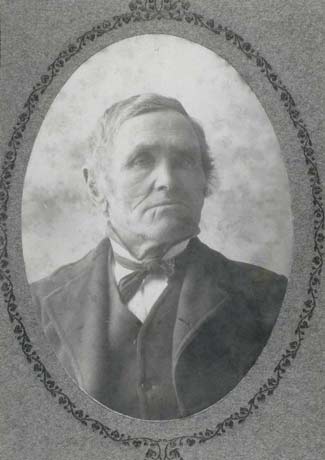
THE JOHN McPHILLIPS FAMILY
John McPhillips (Grandpa) was born in County
Monaghan, Ireland, July 14, 1859. He had his schooling
in a country school in Ireland. Each child carried a
piece of dry “hod” (sod) to school each morning, and
this was burned to keep the schoolroom warm. His parents
and brothers and sister came to America. Pat was the
oldest, then John, Owen, and Susan. They got a homestead
in Spring Green, Wisconsin, and began farming. John
didn’t like farming, so he went to work in Chicago and
learned the carpenter trade. It was in Chicago that he
met Katherine Agnes Powers, his future wife.
Katherine Agnes Powers was born September 16,
1859, in Chicago. Her ancestors came from County
Wexford, Ireland. Her dad was a cooper and made barrel
staves. He died of summer complaint a few weeks after
Katherine was born. (Editor’s note: severe diarrhea)
After his death, Katherine’s mother became a dressmaker
in order to provide for her two children, Katherine and
her older sister, Elizabeth. Later her mother married
again to a Mr. Cook, and had three more
children——Florence, Odelia and Sam, who died when
about a month old. Katherine’s mother also died shortly
after the birth of Sam.
In October, 1871, the year before Katherine’s mother
died, fire broke out in Chicago across the river from
where she lived. Katherine was 12 years old at the tine.
It had been a very dry fall, so when the fire broke out,
the very strong wind made the fire spread, and soon the
flames jumped the river and started burning in several
places in a short time. The people were forced by
policemen to leave their homes. Katherine’s mother
wanted some memento of her first husband, so Katie said
she would run back in the house and get it for her. It
was in an upstairs room in a trunk, and she spent some
time looking at other things in the trunk. She also
stopped to talk with an old man, a Mr. Barrett, who was
sitting on his porch and refused to join the marchers,
as he said it was the end of the world. Katie’s mother
had been forced to move with the crowd and Katie
couldn’t find her. As a result, she was lost for three
days. Her folks searched the morgues every night
looking for her. She was afraid to talk to anyone and
was dirty from soot and smoke, and just kept moving with
the crowd. Her relatives were looking for three days
and at last she spied one of them in the crowd and was
taken back to her mother. They went back after some time
to the place where their home had been, and Katie found
her bank melted but her pennies were there all melted
together. Jimmy Welander, a great grandchild of
Katie, has that relic today. It was given to him by his
Uncle George McPhillips. The McPhillips children
often tried to chop pieces of money off of it. Visitors
in those early days gave children pennies or two—cent
and three—cent pieces. Two—cant pieces were large and
of copper, but three—cent pieces were like silver dimes.
Five— and twenty—dollar gold pieces were common for
people with money and were often on gambling boards and
given as maim prizes in eating houses and drug stores
and saloons.
After the fire, the Cook family built a makeshift
house until they could afford something better. Katie’s
mother was pregnant at that time. About a week after the
birth of the baby boy, Sam, a neighbor came to call and
stood with the door open. Mrs. Cook took a chill and
got a very high fever and died as a result of it. Mr.
Cook sent the baby away to have another woman nurse him
and care for him, but the baby died. After that, the
home broke up and Katie was sent to live with an uncle,
a Mr. Walsh. Elizabeth, who was 15 years old,
(unreadable) earned her own living.
Mr. Cook, the stepfather, took his children to
Iowa to live with his relatives there who were well to
do.
Katherine’s uncle, Mr. Walsh, had a large family,
with one son studying for the priesthood. She had many
cousins in the sisterhood also. Mr. Walsh and
his brothers, her uncles, had merchant ships running on
Lake Michigan to the East to New York. Katherine became
well acquainted with shipyards and boats and often spoke
of them in later years. She worked very hard there and
didn’t get any more schooling. Before long she got a
job with a Mrs. Weeks who was a wealthy woman who
had moved to Chicago from Boston. Katie helped with the
housework and the cooking. They lived in a brown stone
house with three floors. Katie had to live in the
basement, however, and she was often afraid and cried a
lot. She worked for Mrs. Weeks for several years. When
she was in her late teens, she worked in a restaurant as
a waitress. Here she met John McPhillips. He
courted her for some time and then they were married.
Both were 21 years of age when they were married.
Her sister, Elizabeth, had been married a short time
before to a Mr. Hanley, who was a baggage man on the
train out from Chicago. They had one son, Irving.
One time mail robbers entered the train, threw him in
the river, robbed the mail and escaped. His body was
found a short time later. Elizabeth and her son owned a
brown stone front building. She died in this house in
September of the year 1900. All that is known of her
son is that he later married a Swedish girl. Katie was
pregnant with her youngest daughter. Florence.
at the time of Elizabeth’s death, so she couldn’t go to
Chicago. Her step—sister Odelia lived there, but
gave her no particulars about Elizabeth’s death.
Elizabeth owed Katie quite a sum of money which she had
borrowed when both lived in Chicago, but she never got
it back.
Odelia was a ladies’ hat maker and worked for a
wholesale manufacturer. She traveled all over the
United States taking orders and later became head of the
Millinery Department of this company. She had learned
the trade while growing up from a well—to—do woman who
did this work. This woman left her a large sum of money
when she died. She traveled with high society
and had little to do with her step—sister Katherine and
never wrote to her. When Katherine’s daughter Mary
(Mother) was to be married, Odelia was living in Duluth
in a swanky hotel. Mary sent her an invitation which
she acknowledged with a card. Ed McPhillips was
working in Duluth on the street car going to the big
Boat Club. and Odelia frequently went there. When she
heard his name was McPhillips, she spoke to him. Mary
went to Duluth to visit Ed, and he told Odelia she
was coming. So Odelia came to the house but was
disappointed because she thought her half—sister
Katherine would be there. She had little to say and
seemed afraid that Ed’s little girl, Naomie,
would touch her and soil her dress. But she was nice
looking, with dark auburn hair. She died in a hospital
in Pasadena, California, in 1912.
Katie’s other half—sister, Florence, also I lived
out in California. She was married to Norman Melrose
In 1913. She used to write to Mary frequently. She had
been post mistress in Acton, California for years. Her
husband was a lawyer in Los Angeles. They had no
children, but used to send toys and books to the
McPhillips children when they were growing up. They
were well to do and owned a gold mine in Washington.
The last anyone ever heard from them was in October of
1913. She wrote a letter to Mary congratulating her on
the birth of her daughter, Florence. She said not to
expect mail from her for awhile, as they were leaving
for the mine in Washington. That was the last anyone
ever heard of either of them.
Katie and John McPhillips made their home in Chicago
and three children were born there. Ed (John Edward)
was born July 12, 1883; Mary Agnes. December 24, 1884;
and Lillian Therese, January 18, 1886. They lived in an
apartment there.
Lillian, as a baby, had a hard time digesting
food and had trouble with her teeth coming through. The
doctor used to lance them. He recommended that they get
away from the city for awhile in order that Lillian
would get fresh air. So they moved to Spring Green,
Wisconsin, to the McPhillips farm there. John’s
mother had died by this time. Katie took charge of the
house and John took over the farm. Katie learned to
milk cows and other farm chores. There were beautiful
maple trees in the yard. They lived that a year and
Lillian grew strong.
(Sidebar information: His oldest brother had a farm
nearby and his younger brother lived on the farm.)
But John didn’t like farming as well as carpenter work,
so he decided to move to St. Paul. He preferred
not to go back to Chicago. They rented an apartment not
too far from the “market.” Katie would walk there and
get her eggs, vegetables and fruit and carry them home.
When winter came there was a siege of pneumonia in the
apartment and the three children all became ill.
Lillian died. After that they moved to a house on the
west side of the river where there was an Irish
settlement. John used to light the lights on the
piers in the river in the evenings and Ed and Mary would
most often go along in the boat. They loved their dad
very much and enjoyed being with him. He taught them to
catch frogs and fry the legs. There was little traffic
on the road built on a hill to the Mississippi River, so
the children used to slide a whole block down the hill
to the river ice. The family went to St. Michael’s
Church and Ed and Mary went to St. Michael’s School on
Colorado Street. St. Joseph Sisters taught there. Mary
often thought she would like to become a Sister when she
grew up, but that was not to be. She was married to
William Joseph Buckley in St. Michael’s Church by
Father O’Neil (later a monsignor) from Ireland. He spoke
with an Irish brogue. Several, of his nephews from
Ireland succeeded him as pastor of St. Michael’s. Later
the parish Church was moved farther south in the city.
In the late 1890’s there was a carpenter’s strike in St.
Paul and John could find no work, so he got a job
putting up buildings for Mr. McGuire in Rush City.
Later the whole family moved there. They were very
poor at that tine and were glad to have a meal of
cornmeal mush. They lived in the section house. It was
painted gray. They lived there a few years and then
moved back to St. Paul. They lived on Fairfield Avenue
for a time and then moved on the Bluff not far from
where George later lived on Sidney Street.
(Sidebar note: They walked to the KA (unreadable)
tracks to get to town. It was very cold and many caught
a bad cold then rheumatic fever.)
The other children of Katie and John McPhillips
were Owen, who died; George; another
Owen; James; and Florence.
John McPhillips died of pernicious anemia after
six months of illness on June 7, 1920. (Editor’s note:
pernicious anemia is Vitamin B-12 deficiency.) The
previous fall he was doing finishing carpentering on
Armours’ new plant. He worked overtime night after
night in December as they wanted to occupy it in 1920.
Maybe that brought on his illness. The, flu was also
raging at that time and Katie got it and her youngest
daughter, Florence. had it and was extremely ill. John
had visited his daughter Mary’s home in Pine City for
the New Years, but became sick and cut his visit short.
He was one month short of 61 years old when he died.
Katie lived to be 76. She died in 1935.
When Mary graduated from high school, she was
valedictorian of her class. She intended to study in
business school, but there was need for a teacher in a
country school in Sturgeon Lake, Minnesota, and she was
asked to take the position. She had no teacher’s
diploma, but when she was in high school when teachers
got sick, she was often asked to conduct classes for
them, so with that experience, she was considered
qualified for teaching. She really was a born teacher.
The following summer she took the state board
examinations for teachers and received a second grade
certificate. She had passed all the state hoards for
the first grade certificate also, so was told that after
teaching for nine mouths, she would be qualified to
teach in a city school. She enjoyed teaching in
Sturgeon Lake very much. It was the first time she had
ever been away from home. They had only three months of
school in the fall and three months in the spring. But
she wanted a city school where she could teach nine
months and earn higher wages. In Sturgeon Lake she
received only $35 a month. The County Superintendent
knew her and also knew that she wanted to get her nine
months in so she could teach in a city school. He told
her there was an opening in Hinckley, Minnesota, a
country school with six months of school. If she took
that, she would have her nine months in. So she took it
and taught grades 5 and 6 and had 40 pupils. She also
taught Latin and geometry in high school to help out
when the professor became ill.
Mary met William Joseph Buckley on Valentine’s Day in
1908 at a dance. She went to the dance with the
family she was boarding with. There were a lot of
people there and she enjoyed dancing to the music of
violins. Will, as she always called him, asked her to
dance with him. She liked him from the start, but
didn’t go with him again until about April. He came
over to the house where she was boarding. He was just
after buying a new buggy and asked her if she wanted to
go out for a ride with him. So she did, and that’s when
they started going together in earnest. Some of the
neighborhood girls that had known him in earlier years
were a little jealous and would say. “I wonder who
Willie Buckley is coming to see with his new buggy with
the red wheels!” They often went to ball games
together. The first time, there was another fellow who
came to the house and he was visiting with her when Will
came. Will said he wanted to take her to the ball game,
but the other fellow said that is what he wanted to do,
so she had to make a choice and she chose Will. After
that he came to see her often. When school was out she
would be going back to St. Paul, so she asked Will, “Are
you coming down to see me?” and he said “Sure.” So he
came down different times. Once he walked all the way
from Pine City to St. Paul following the railroad
tracks. In August, 1908, he proposed, and she said Yes.
But Mary had to teach school another year because she
didn’t have any money to get married and she didn’t want
to bother her folks for money. Her older brother Ed was
married already and her folks had the other children to
support. She got a school near St. Paul because she
wanted to be near home, but she and Will wrote letters
to each other all the time that year. They were married
August 11. 1909. The ceremony took place in St.
Michael’s Catholic Church in St. Paul. She wore an
alice blue silk dress and a veil. Her bridesmaid was
Paulina Peckman and the bridegroom was Frank
Buckley. Paulina was later married and had a daughter
who was a nun, Sister Eileen.
|