

Gortnaskehy and Birdhill
According to information found the Ryans originated from this part of Ireland. Gortnaskehy is an Irish townland, and ‘Gortnaskehy’ in Gaelic means ‘field of hawthorns’. The Gaelic word ‘Gort’ can be found as part of many townland names. This part of Ireland saw much turmoil during the troubled times (pre 1800) as well as during the Great Famine. In this part of Ireland it appears many Irish were displaced and thrown off their lands somewhere between 1848 and 1850. Some moved overseas such as the Hill family. Others, like our Ryan ancestors, stayed in Ireland for awhile longer but moved to America later.
The following was taken from the “Pictorial Description of Great Britain & Ireland’ first published in New York in 1846:
“The soil in parts of Limerick and Tipperary is perhaps not inferior in fertility to any portion of Europe. The Corkass lands of the former, and the Golden Vale of the latter, are celebrated for their extraordinary richness. These districts are chiefly appropriated to the feeding of black cattle. Wheat husbandry is cultivated throughout the limestone districts of Tipperary, Clare, and Limerick… The potato culture necessary to supply the wants of an over-dense population is eagerly pursued throughout the whole province; and it is a deplorable fact, that a large portion of that population has no other food during the greater part of the year”.
Where was Gortnaskehy? Gortnaskehy is a townland located in Kilnarath Civil Parish. Civil Parishes were old administrative units perhaps first developed during medieval times. These were not the same as Catholic parish boundaries. Below is a map that shows a portion of northern Tipperary and it shows the location of Kilnarath. The civil parishes circled in this map are interesting. Kilnarath is indicated by the number ‘46’ and is where the Edward Hill family originated. Kilcomenty Civil Parish (34) is where Birdhill is located. Finally, Kilvellane Civil Parish is where Newport is located as well as where we find the Boney families living. Most of this area is also included in the Catholic Parish of ‘Newport – Birdhill’.

|
Catholic Parish |
Baptism Records |
Marriage Records |
Civil Parishes |
|
Newport-Birdhill* |
Oct
1795 gap 1810-1811, |
Apr
1795, |
part Kilcomenty; part Kilmastulla; part Kilnarath; part Kilvellane |
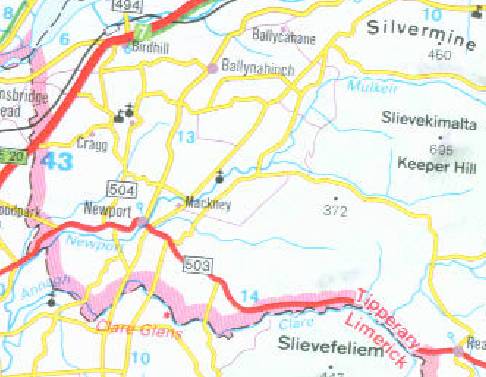
The following was taken from a modern map of Ireland and shows the same area as you see above. The distance from Birdhill to Newport is approximately 4 miles, which is an easy walking distance. The symbols also are of interest. The ‘ball and cross’ symbol refers to a church, generally a Roman Catholic church. The ‘rectangle and flag’ symbol refers to a castle. Information found later appears to describe these places more fully.
The following information was taken from old descriptions of Kilcomenty, Kilnarath and Kilvellane. Please note that there are spelling variations; however, they refer to the same locations.
County Tipperary, Ireland
CIVIL PARISHES
Kilcomenty or Ballinahinch
description from Lewis's Topographical Dictionary of Ireland, 1837
Note: Roman Catholic parish records for those parishes that belong to the Diocese of Cashel and Emly are not available to the public
KILCOMENTY or BALLINAHINCH a parish, in the barony of OWNEY and
ARRA, county of
TIPPERARY, and province of MUNSTER, 2 miles (N. by E.) from
Newport, on the mail coach road from Nenagh to Limerick;
containing 2334 inhabitants.
This parish, which is bounded on the west by the river Shannon, comprises 4817 statute acres, of which about 400 are waste and bog, and the remainder profitable arable and pasture land in a good state of cultivation. The soil is fertile, and the system of agriculture improved; limestone is quarried extensively for agricultural purposes and for building, and marl and sand are also used for manure. Great numbers of cattle are fattened on the lands of Mr. Atkins, who has a very extensive farming establishment. The scenery is strikingly bold and varied, comprising a chain of mountains to the southeast of the parish, among which the lofty Keeper is conspicuous.
The principal seats are Bird Hill, the residence of H. Atkins, Esq.; Cragg, of R. Going, Esq.; Parteen, of R. Twiss, Esq.; and Corrigeen, of G. Maunsell, Esq.
Direct communication is afforded by the canal to Dublin, and numerous rivulets issuing from the mountains intersect the parish. A constabulary police force is stationed here.
The parish is in the diocese of Cashel, and is a rectory and vicarage, forming part of the union of Kilnerath, or St. John's Newport: the tithes amount to £323 1s. 6½d.
In the Roman Catholic divisions also it is included in the union or district of Kilnerath, or Ballinahinch; the chapel is at Bird Hill, at which place a school is about to be established, and there are four private schools, in which are about 340 children.
At Cragg are the ruins of an ancient church and castle; and there are some Danish raths used as places of internment. Philip of Worcester, chief governor of Ireland in 1184, founded here a priory, which he dedicated to St. Philip, St. James, and St. Cumin, and placed in it Benedictine monks from the abbey of Glastonbury, in Somersetshire.
County Tipperary, Ireland
CIVIL PARISHES
Kilnerath or Newport St. John's
description from Lewis's Topographical Dictionary of Ireland, 1837
Note: Roman Catholic parish records for those parishes that belong to the Diocese of Cashel and Emly are not available to the public
KILNERATH or NEWPORT (St. JOHN'S) a parish, in the barony of
OWNEY and ARRA, county of
TIPPERARY, and province of MUNSTER, 2 miles (E.) from
Newport, on the upper road to Nenagh; containing 2749 inhabitants.
It comprises 5147 statute acres, as applotted under the tithe act, and valued at £4180 per annum; with the exception of an extensive tract of bog, affording excellent fuel, the land is in general of good quality and in an improved state of cultivation. The scenery is of very interesting character; the banks of the river are bold and rocky, presenting some very striking features, and masses of rock lying in its channel give an artificial rapidity to its course.
The principal seats are Castle Waller, that of R. Waller, Esq., pleasingly situated in a tastefully embellished demesne; Oakhampton, the property of Lord Bloomfield, and residence of S.W. Philips, Esq.; and Rockvale, the property of the Rev. M. Moore. At Rockvale are considerable flour-mills.
The living is a rectory and vicarage, in the diocese of Cashel, united by act of council to the rectories and vicarages of Kilcomenty, Killoscully, and Kilvolane, together constituting the union of Kilnerath, or St. John's Newport, in the patronage of the Archbishop: the tithes amount to £300, and of the entire benefice to £1407 16s.10½d. There is a glebe-house, and the glebe of the union comprises 8½ acres. The principal church of the union is at Newport; there is also a church in the parish of Killoscully.
In the Roman Catholic divisions the parish is the head of two unions or districts, one called Newport, comprising also parts of the parishes of Kilvolane and Kilcomenty, in each of which is a chapel: and the other called Ballynahinch, comprising also Killoscully, in which latter parish is a chapel. The chapel at Ballynahinch, to which a school-house is attached, was built on ground given by Lord Dunally.
About
400 children are taught in four private schools. There are some remains of the
old church, and also of the chapel of Kilpatrick; near which is a
chalybeate spring, not much used.
County Tipperary, Ireland
CIVIL PARISHES
Kilvolane
description from Lewis's Topographical Dictionary of Ireland, 1837
Note: Roman Catholic parish records for those parishes that belong to the Diocese of Cashel and Emly are not available to the public
KILVOLANE a parish, in the barony of OWNEY and ARRA, county of
TIPPERARY, and province of MUNSTER, on the road from
Thurles to Limerick city; containing, with the post-town of
Newport, 3802 inhabitants.
It comprises 8568 statute acres, as applotted under the tithe act, and valued at £7427 per annum. there were formerly large tracts of wasteland, which, from the facility of procuring lime, have been partly reclaimed and are rapidly coming into cultivation. The system of agriculture is improved; there are large tracts of valuable bog, and several quarries of excellent limestone, which is procured and burnt for manure. Grit-stone of good quality for building is also extensively quarried; and copper mines of good ore were formerly worked with success, but have been discontinued. The scenery is finely diversified; the river Clare intersects the parish, affording advantageous sites for mills, and on the south-eastern side forms a boundary between the counties of Tipperary and Limerick. Clare Glen, which is beautifully picturesque, has been recently planted.
The principal seats are Barna, the residence of H. Lee, Esq., and Mount Philips, of W. Philips, Esq, the demesnes of which are richly embellished with stately oaks; Ballymakeogh, of W. Ryan, Esq.; Mount Rivers, of R. Philips, Esq.; Bloomfield, of E. Scully, Esq.; Fox Hall, of J. O'Brien, Esq.; Clonsingle, of R. Young, Esq.; Derryleagh Castle, of G. Ryan, Esq.; Rose Hill, of H. Hawkshaw, Esq.; and Lacklands, of the Rev. Dr. Pennefather. A corn-mill and a tuck-mill have been erected on the river Clare, near Newport.
It is a rectory and vicarage, in the diocese of Cashel, forming part of the union of Kilnerath, or St. John's Newport; the tithes amount to £461 10s.10d. The church, towards the repair of which the Ecclesiastical Commissioners have recently granted £530, is a neat edifice, situated at Newport.
In the Roman Catholic divisions the parish forms part of the union or district of Newport, in which town is the chapel.
The parochial school, in which about 120 children are taught, is endowed with 20 acres of land and is aided by subscriptions; and there are six private schools, in which are about 260 children. There are some remains of the ancient parochial church at Ballymakeogh; the cemetery is still used as a burial-ground.