Edgar Lynn Turgeon (John's First Cousin)
| Last Name | First Name | Middle | Birth Date | Mother Maiden | Father Last | Sex | Birth Place | Death Place | Residence | Death Date | SSN | Age | Post-ems | Order Record |
|---|---|---|---|---|---|---|---|---|---|---|---|---|---|---|
| TURGEON | EDGAR | F | 04/27/1890 | PATRY | TURGEON | M | SOUTH DAKOTA | SANTA CLARA | 12/05/1958 | 571-46-4430 | 68 yrs | Add |
Newspaper Announcement to leave South Dakota. Click to Enlarge |
Edgar F. Turgeon (Mary Turgeon Smith's brother), son of Phileas and
Merida (Patry) Turgeon We have very little information about Edgar F. Turgeon, although we know that he had lived in Plankinton and Gregory County. While the U.S. Census shows Edgar living in California in 1930, a biography of his son states that he lived part of his childhood was spent on a farm in the Midwest. It is possible that he returned to South Dakota for some brief period of time. The reason we are interested in this family is because his son, Edgar Lynn Turgeon, was considered to be among the top economists of the 20th century. He is probably dad's most "famous" cousin. Below are genealogical/historical information regarding this family. Here is what we know: Edgar Turgeon, Sr. began with the Case & Lathrop Bank as a cashier (Gregory County) and eventually was promoted to Cashier. Edgar Sr., Mary Smith's brother, served in the Air Corp during World War I. This family eventually moved to California and Edgar and his wife are buried in San Bruno military cemetery. Finally, we can link this family with our own through the family's genealogical records, as noted in the genealogical listing above. |
|||||||||||||||||||
|
Click to Enlarge |
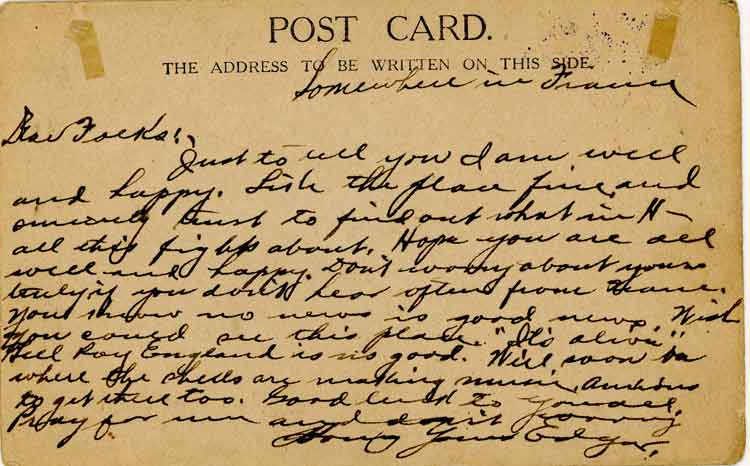
Post Card from Ed Turgeon, while stationed in
France, sent to the William C. Smith family in Stickney (Soldiers Mail
WW1). CLICK TO ENLARGE POSTCARD VIEW |
||||||||||||||||||
Turgen/Fellows Marriage License
Click to Enlarge
|
Cemetery Information:
U.S. Veterans Cemeteries, ca.1800-2004 Record
about Edgar F Turgeon Name: Edgar F Turgeon Veteran's Rank: SGT AIR SERVICE Branch: US Army Last known address: 1300 Sneath Lane San Bruno , CA 94066 Birth Date: 27 Apr 1890 Death Date: 5 Dec 1958 Veteran Service Start Date: 18 Oct 1917 Veteran Service End Date: 7 Apr 1919 Interment Date: 8 Dec 1958 Cemetery: Golden Gate National Cemetery Buried At: Section T Site 258 Post Card from Ed Turgeon, while stationed in France, sent to the William C. Smith family in Stickney (Soldiers Mail WW1). |
U.S. Veterans Cemeteries, ca.1800-2004 Record about Margie Turgeon Name: Margie Turgeon Veteran's Rank: SGT AIR SERVICE Branch: US Army Relation Name: Edgar F Turgeon Relationship: Wife Last known address: 1300 Sneath Lane San Bruno , CA 94066 Birth Date: 9 Mar 1890 Death Date: 5 Apr 1990 Interment Date: 24 Apr 1990 Cemetery: Golden Gate National Cemetery Buried At: Section T Site 258 |
||||||||||||||||||
Lynn Fellows
Years of Service
|
So what is the Lynn Fellows connection? Dad talked about Lynn Fellows quite often, and we knew that they were very close friends of the "Stickney" family. What makes this connection interesting for Tim and myself is that indirectly Lynn Fellows was "related" to our own family. Lynn's sister, Margaret, married Edgar F. Turgeon, Mary (Turgeon) Smith's brother. Prior to World War I, Edgar worked as a car salesman in Plankinton, South Dakota. After the war he returned to South Dakota, specifically Gregory County, and began a career in banking. He also married Margaret after returning from the war. It also explains how Edgar Lynn Turgeon received his middle name. Throughout his illustrious career, he only went by the name of Lynn. The next set of records are obituaries and reflections of his work.
|
|||||||||||||||||||||||||
|
EDGAR LYNN TURGEON was born on August 26, 1920 in Mitchell, South Dakota. (2) In an unpublished memoir (Turgeon 1990), he claimed that growing up during the Great Depression on a small farm in the Midwest influenced his decision to study economics. Since good jobs were scarce for young men in the 1930s, he went to the University of California at Berkeley where he majored in economics before serving as a U.S. Navy supply officer in the Pacific during World War II. During his service he became aware of the waste and misery of war, and made a commitment "to do something, which might contribute to preventing another war ... assuming I survived" (Turgeon 1990:2-3). He anticipated that the next major conflict after World War II might be with the Soviet Union, and he began to study the Russian language. At the end of the war, with the aid of the GI. Bill, Turgeon decided to either pursue a law degree or a Ph.D. in economics. Not quite sure in which direction to go, he decided to visit the famous Keynesian economist Alvin Hansen at Harvard University. Turgeon was impressed with Hansen's prewar writings and felt he could talk frankly with him since he was a fellow South Dakotan (Turgeon 1990:3). After finding Hansen in the Harvard library wearing green eyeshades, Turgeon spoke with him for about a half-hour and was convinced to stay with economics and pursue a graduate degree. He went back to Berkeley to obtain a master's degree in economics, writing a thesis on "The Economic Effect of World War II on the U.S. Electronics Industry," and continued his study of the Russian language. From California he went to New York and studied at the Russian Institute at Columbia University where he became associated with Abram Bergson, a preeminent Sovietologist. Another influence at this time was Paul Sweezy, the co-editor of Monthly Review, who occasionally gave lectures at Columbia University.
|
||||||||||||||||||||||||||
|
On-Line Obituary for Lynn
Turgeon
E. Lynn Turgeon, a longtime professor of economics at Hofstra
University, died last Wednesday at University Hospital in Ann Arbor,
Mich. He was 78.
The cause was cardiac arrest, said his daughter, Kim Turgeon.
Dr. Turgeon, who taught at Hofstra for 33 years before retiring in
1990, was an expert in comparative economic systems and contemporary
capitalist economic policies. He was the author of four books and
was selected twice as a Fulbright scholar.
He served in the Navy during World War II and joined the Hofstra
faculty in 1957. He taught in the former Soviet Union twice, first
as a visiting professor at Moscow State University in 1978 and then
at the Academy of Foreign Trade in Moscow in 1991. His articles
appeared in publications including The Wall Street Review of Books,
Monthly Labor Review, The American Journal of Sociology, The Journal
of Comparative Economic and The Nation.
In addition to his daughter and her husband, William Christensen,
Dr. Turgeon is survived by a sister, Margaret Johnson, and two
grandchildren.
******************************************************
EDGAR LYNN TURGEON was born on August 26, 1920 in Mitchell, South
Dakota. (2) In an unpublished memoir (Turgeon 1990), he claimed that
growing up during the Great Depression on a small farm in the
Midwest influenced his decision to study economics.
****************************************************
In addition, I added the 1920 US census which shows both Margaret
and Edgar in Gregory.
***************************************************
The 1930 US Census shows the following.
Name
Parent/Spouse City,County,State
Estimated Birth Birthplace Relation
Edgar F Turgeon Margaret F. Gilroy,Santa Clara, CA 1891 South Dakota Head
Margaret F.Turgeon Edgar F. Gilroy,Santa Clara, CA 1891 South Dakota Wife
Edgar L. Turgeon Edgar F. Margaret F. Gilroy, Santa Clara,
CA 1921 Son
|
||||||||||||||||||||||||||
| A Friend's perspective of Lynn
Turgeon's Life. - This is actually a "fun" read. It was a privilege for me to have been a friend of Lynn Turgeons. He was responsible for my meeting my wife, Marina, who was a researcher at the Instititute of World Economy and International Relations (IMEMO) in Moscow in the early 1880s. She had been his translator when he served on his Fulbright in Moscow (in 1976, not 1975 as his obituary states) for his lectures at Moscow State University...he gave her away at our wedding and we shall both miss him very much. Over the more recent years Lynn participated in several panels at professional meetings on transitional economy issues, often ones that neither Marina or I would chair or organize...He had had prostate cancer for several years that he knew was incurable and had warned me that he might not make the meetings, which I said I understood. However, during the middle of last year he seemed to be doing better and I was hopeful that he would participating as he lived in Hempstead, New York, not far from the meeting site in New York City. It was only when he pulled out in early December that I realized that the end was near. He had fallen and his cancer had relapsed and he had gone to stay with his daughter who is a physician in Ann Arbor, Michigan. It was clear that he was not going to be going anywhere else again while alive, although he did continue to be active on the PKT list into January. Lynn always enjoyed challenging people with ideas that went against the grain, and I sometimes had trouble figuring out to what extent he actually believed some of the things he was putting forward (I certainly did not agree with all of them). Louis Proyect had commented on how used to appear to argue that fascisim was good for the working class, a position that I do not think he really held. However, he certainly did think Hitler was a practitioner of a form of Keynesianism, perhaps the first "military Keynesian" and he always enjoyed confounding people with his apparently contradictory views on military spending. ;;;he had originally been inspired to study Russian back in World War II out of a desire for world peace and a feeling that the US and USSR should remain allied and be friends. In the early 50s he was apparently the only person at the Rand Corporation not to have a security clearance. In later years he would point out some of the virtues of the Stalinist system even as he criticized its irrationality and oppressiveness. His "Economics of Discrimination" made the point that Gypsies and women were more equal and less discriminated against in Easter and Central Europe during the Stalinist period than at any other, an uncomfortable fact for many of us...he argued that how women are treated is perhaps the real bottom line measure of a society. I think others have said much that is useful, accurate, and wise concerning the life and career of Lynn Turgon. He was indeed someone who traveled widely and made friends wherever he went. I was constantly amazed at the breadth of his contacts and acquaintances, many of whom he kep in contact with and sent his engaging and insightful travelogues to. His curiousity about current developments in the world was unabated and I remember him even in his last illness questioning Marina about farmers market prices in Moscow...he was truly a citizen of theworld and will be sorely missed by many of us. Barkley Rosser |
| In his own words... While driving home from Ann Arbor recently, I stopped over in Ithaca to investigate the "Ithaca Hour,"about which there had been some information on my modem. I had just completed a little account of Franklin Roosevelt's decision to reflate the United States economy in the fall of 1933 by raising the buying price of gold from $20.67 to $35 per ounce. (available on request by snail-mail) FDR had reject ed the advice of the economics establishment and relied instead on George "Rubber dollar" Warren, an obscure agricultural economist at Cornell, who with Frank Pearson, had drawn an historical correlation between the price of gold and the general price level. I wondered if there was any connection between the experience of Warren coming out of Ithaca and the more recent experience with what some traditional economists would call "funny money." My first clue in discovering and talking with Paul Glover, who is the guru of the local currency movement, was outside the HOURs bank located in the Autumn Leaves bookstore, where a local described Glover as the man whno gets around on his bicycle. There was a sign in the bookstore window indicating that the store would change Ithaca Hours into five denominations, with an HOUR worth $10, the going rate for an hour of labor in various services, such as carpentry, plumbing, gardening and baby-sitting. The experiment with local money has been going on for 3 and one-half years and Glover is already making sure that Ithaca's paper currency can't be counterfeited. The next day I picked up a copy of the June-July issue of Ithaca Money, outside the Alternative Federal Credit Union. This 12-page Newspaper lists roughly 1200 local services which can be purchased with "hours." Certain things such as rent can be partially paid for in the local currency. Professionals such as acupuncturists, chiropractors, electricians, and massage therapists are advertising for customers and will accept this local currency. I asked Glover whether there were any doctors who would accept "hours," but he said that their one doctor had retired. I noticed that almost a dozen lawyers were advertising their services. I also asked Glover whether he was familiar with the earlier experience with "rubber dollar" Warren, but he was completedly unaware of his predecessor. He also expressed worry for fear that too great a supply of HOURS would contribute to inflation in Ithaca. Apparently he has been suitably brainwashed by monetarist thinking. He claims that local money is real money, backed by real people, real time and skills and that United States dollars are" funny money" no longer backed by gold or silver and "less than nothing - 4.2 trillion dollars in national debt." My own interpretation of this experience is that it makes sense in any community that is plagued by excess capacity and disguised unemployment. If there is excess capacity in the local community, this addition to the money supply will put local resources to work, raise total income and tax revenue (since such income is taxable). If your community seems to fit this description, I would recommend sending away for a starter kit selling for 2.5 HOURS or $25. Write to Ithaca Money, Box 6578, Ithaca, New York 14851. Glover claims to have sent over 300 kits to communities in 45 states so far. Since returning home, I wa watching a C-Span program on the 21st century economy, where Alvin Toffler was asked whether the Federal Reserve might represent second wave thinking similar to that found in our mass production industries. He seemed to be givingthe green light for localities to take money creation into their own hands in his Third Wave. Can his friend, Newt, be far behind? Lynn |
A memorial service for Lynn Turgeon will be held sometime this week at Hofstra University.
>
> Lynn Turgeon died on Wednesday, March 10th in
> Ann Arbor, Michigan, after a long illness.
>
> He was 78 years old. He joined the Hofstra faculty
> in 1957 was a Visiting Fulbright Professor of
> Economics at Moscow State University in 1975 and
> also at the Academy for Foreign Trade in Moscow
> in 1991.
>
> During the 1966-67 academic year he was awarded
> the University's Distinguished Teaching Award,
> bestowed upon him by Hofstra's student body.
>
> Professor Turgeon was a specialist in comparative
> systems, the Russian economy and Keynesian
> economics. A prolific writer and correspondent on
> the Internet, his full length books included "The
> Contrasting Economies", "The Advanced Capitalist
> System", "State and Discrimination", and "Bastard
> Keynesianism".
>
> He was an unabashed Keynesian and frequently
> contributed to the Canadian journal, "Economic
> Reform", which remains a bastion of Keynesian
> thinking.
>
> Ironically, his favorite mentor at Columbia University,
> where he earned his Ph.D. in 1959, was Robert
> Fellner, an avowed neo-classicist. Professor Turgeon
> taught at Hofstra University for 33 years, and reminded
> his students that often the most important learning
> occurs when you confront ideas diametrically
> opposed to your own.
>
> Dr. Turgeon's views on Economics were iconoclastic--
> often at odds with both conventional economists and
> colleagues who shared his perspective. He believed the
> American economy was perpetually prone to under-
> consumption and therefore advocated continuous
> "active" federal deficits to spur demand rather than
> allow "passive" deficits to result from under-use of
> capacity.
>
> An early and vocal opponent of the Vietnam War,
> he nevertheless argued that large military expenditures
> were perversely "functional" for an economy that was
> unable to provide true full employment. He also
> advocated a neutral monetary policy harkening back
> to the 1940s when the Federal Reserve was subordinate
> to the Treasury and interest rates were kept low.
>
> Dr. Turgeon believed that inflation in the past 50 years
> was largely of the cost-push variety and thus monetarist
> solutions leading to tight money were inappropriate and
> fundamentally destructive.
>
> Professor Turgeon loved to challenge Milton Friedman's
> maxim of "no free lunch". He argued that because our
> economy is normally well below true full employment,
> not only "free lunches", but schools, bridges and many
> other productive goods can be provided at virtually no
> opportunity cost to society.
>
> Dr. Turgeon was well known outside the United States
> and might properly be called a citizen of the world.
> He traveled and lectured extensively in Russia and
> Eastern Europe during the height of the Cold War and
> established many contacts with Eastern European
> scholars whom he hosted here in the United States.
>
> Dr. Turgeon is survived by his daughter, D. Kim
> Turgeon M.D., two grandchildren, Livia Turgeon,
> a sister Margaret Johnston, as well as legions of
> grateful students and friends.
>