Edward Hill -Eviction, Emigration & Emergence
| A New Year's Wish Elizabeth and I were chatting at lunch today about New Year's resolutions. It was the same old things...exercise more...lose weight...get more involved with the Church...etc. I began to realize how fortunate we are to wish for more "altruistic" things, especially when 160 years ago our ancestors were just "surviving" day-to-day with little disposable income. I'm certain that if they were making New Year's resolutions, it would have been praying for a good crop year, good health, and perhaps making a little extra to buy something "nice". In 1848, the Hill family was evicted from their Tipperary farm, and that started a series of events that eventually led them to the heartland of America. As land was in limited supply and jobs scarce, eviction must have been a "scary time" for the Hill family. Many were left with only one option - emigrate to America or Australia. But as difficult it was to emigrate, many destitute Irish eventually prospered in the new world. And over time, their progeny (the descendents of Edward & Margaret Hill) could look forward to each new year with great optimism and hope. We wish you the best for 2007. |
|
Edward Hill lived to be 67 years old, but
we know very little about him or his life. There is no surviving
obituary that "reflects" his life, and the documents that you see here
are the few remaining things we know about him. On your left is a copy of Edward Hills
Will & Last Testament, which was written in August 1879. We
suspected that this legal document was written around the time of
his death, but it was only conjecture, as we initially could not locate a death
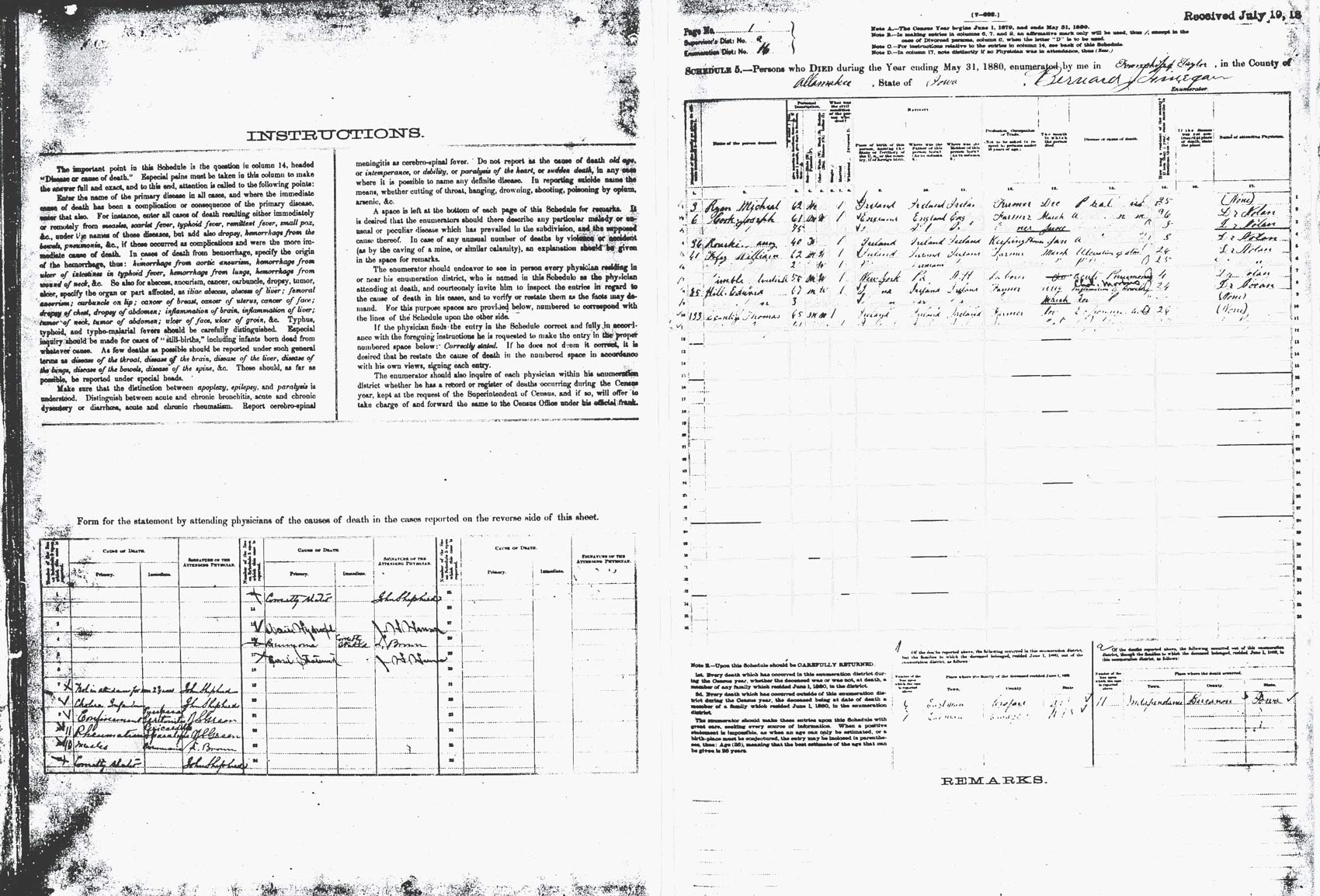
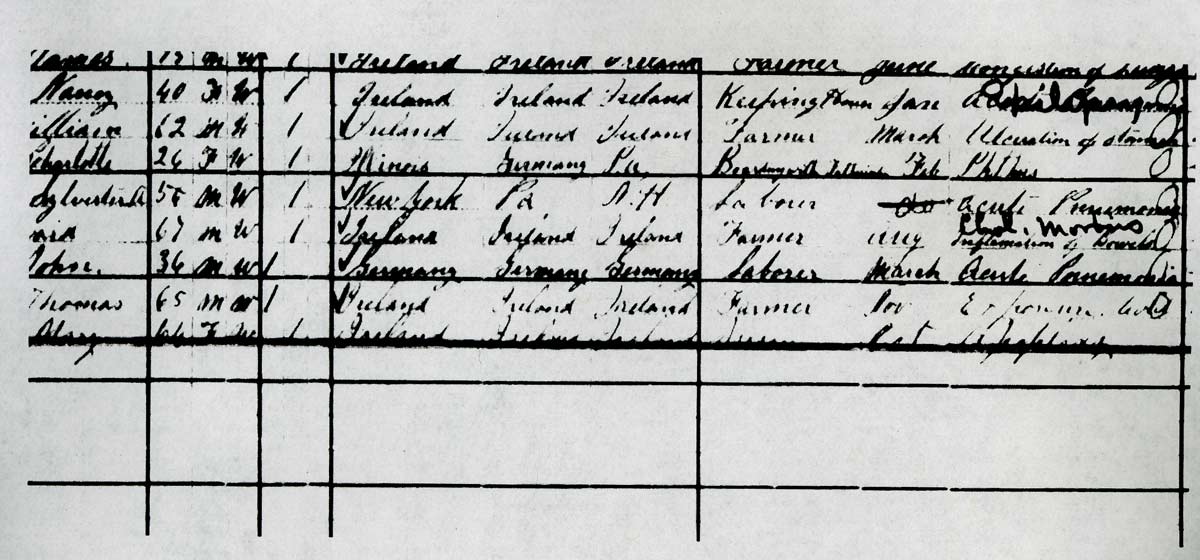
record in Allamakee County. Notice his "mark" on the document. The next three documents were taken from census documents. As part of the census taking process, all those who had died in the previous 12 months were captured in the census of 1880. His cause of death was listed as Cholera Morbus and inflammation of the bowels. Cholera Morbus is a term no longer in scientific use. Today it is known as acute gastroenteritis, and is a disease that occurs seasonally (hot weather) and marked by cramps, diarrhea and vomiting. Acute Gastroenteritis is sometimes confused with a far more common ailment - the stomach flu. This record also provides confirmation for his birth year (1812) and year the family moved to Allamakee (1855). |
|||||||||||||
|
Edward Hill's Life We don't know much about his life, other than what we see in civil records. What we know looks like this:
EVICTION FROM IRELAND We know that the Hill family came to America as a result of eviction from their Tipperary farm, as this census taken in May 1850 shows.
Prior to 1849, "free" immigration was offered after eviction notices for "non-payment of rent" were rendered. Generally these older schemes were designed to increase rents (increases the tenant farmer could not afford) on unwanted tenants. After 1849, new schemes were perpetuated by mortgage holders, who forced landowners to sell their property because of 'debt incurred due to the great famine", which usually meant that the Quit Rent Office terminated leases "when it discovered that a considerable population was dependent on uneconomic holdings." Simply put - Too many people trying to make a living on limited acreage. As an example:
Subsequently it forced many families to leave Ireland. Between 1847 and 1852 thousands left Crown Estates for Canada and the United States. The English Commissioner of Woods, Forests and Land recommended Canada because
Between these years, thousands of Irish sailed to Quebec or New Brunswick (Port of Saint John), but "during the years of the Irish famine, the majority of Irish immigrants who arrived...left immediately for Boston and other New England ports." The Trip to America In researching the old ship manifests, the trip to America was difficult, especially for the aged and infant children. Deaths among these two age groups was not uncommon, and "guides" were provided in local newspapers telling the emigrant how to minimize illness and motion sickness while en-route to their final destination. The newspapers also suggested that the emigrant bring additional supplies (sugar, spices and tea), and provided guidance as to how they should pack and store their possessions. These newspapers also told the emigrant not to buy these additional supplies near the docks as they would be overcharged. England found ways to reduce "the surplus population", and enticed the evicted tenants by paying their passage to the Americas. The fare was as follows:
In return, this amount paid the passage and supplies to the Americas. As an example of the food apportionment, it looked like this (children received half this amount with the exception of meal/biscuits which was apportioned at 3/4th the amount set aside for adults):
|
|||||||||||||
THE EVICTION OF IRISH TENANTS
 Print collection of Maggie Land Blanck |
The Illustrated London Times, December 16, 1848 The Ejectment of Irish Tenantry From early times the land in the west of Ireland was under the control of landlords while tenant farmers maintained small holdings at little or no profit. The landlords learned that they could make more money from grazing cattle and sheep rather than obtaining rents from their tenants. At least they didn't have to "fight" for the rent on an annual basis. The following is an article that was written in 1848 - the same year that the Edward Hill family was forced off their farm.
|
|
|
EVICTIONS OF PEASANTRY IN IRELAND (Illustrated London Times, 1848 - around Christmas time) A vast social change is gradually taking place in Ireland. The increase of emigration on the part of the bulk of the small capitalists, and the ejectment, by wholesale, of the wretched cottiers...is absolutely appalling. The Tipperary Vindicator thus portrays the state of the country:_ "The work of undermining the population is going on stealthily, but steadily. Each succeeding day witnesses its devastation - more terrible than the simoon and more deadly than the plague. We do not say that there exists a conspiracy to uproot the 'mere Irish'; but we do aver, that the fearful system of wholesale ejectment, of which we daily hear, and which we daily behold, is a mockery of the eternal laws of God - a flagrant outrage of the principles of nature. Whole districts are cleared. Not a roof-tree is to be seen where the happy cottage of the labourer or the snug homestead of the farmer at no distant day cheered the landscape. The ditch side, the dripping rain, the cold sleet are the covering of the wretched outcast the moment the cabin is tumbled over him; for who dare give shelter of protection from 'the pelting or the pitiless storm?' Who has the temerity to afford him the ordinary rites of hospitality, when the warrant has been signed for his extinction? There are vast tracts of the most fertile land in the world in this noble country now thrown out of tillage. No spade, no plough goes near them. There are no symptoms of life within their borders, no more than if they were situated in the midst of the Great Desert- no more than if they were cursed by the Creator with the blight of barrenness. Those who laboured to bring these tracts to the condition in which they are capable of raising produce of any description- are hunted like wolves, or they perish without a murmur. The tongue refuses to utter their most deplorable - their unheard- of suffering. The agonies endured by the 'mere Irish' in this day of their unparalleled affliction are far more poignant than the imagination could conceive, or the pencil of a Rembrandt picture. We do not exaggerate; the state of things is absolutely fearful; a demon, with all the vindictive passion by which alone a demon could be influenced, is let loose and menaces destruction. Additional sharpness, too, is imparted to his appetite. Christmas was accustomed to come with many healing balsam, sufficient to remove irritation if not to stanch wounds; but its place is usurped by other and far different qualifications. The howl of misery had succeeded the merry carol which used to usher in the season; no hope is felt that an end will soon be put to this state of wretchedness. The torpor and apathy which have seized on the masses are only surpassed by the atrocities perpetrated by those who set the dictates of humanity and the decrees of the Almighty at equal defiance." Note: Simoon= a hot dry dust-laded wind especially in the Arabian desert
|
||
HOW EVICTION MAY HAVE AFFECTED THE HILL FAMILY
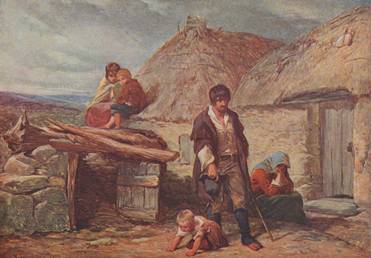 Print collection of Maggie Land Blanck. Reprint bought on eBay, 2005
"An Irish Eviction, 1850 by F Goodall, R. A." |
Eviction While we do not know exactly how our ancestors lived, we can only assume that they lived in the same manner as most Irishmen of their day. Edward Hill, like most men of his time, built his cottage using easily obtained materials such as peat and straw. However if Edward Hill's home had windows, his taxes would have been higher than his neighbors. And if his door was over a certain height and if he made any type of improvements or enlargements to the dwelling, he would have been charged with higher taxes and tithes to the Church of England. In looking at the taxes he paid in 1848 (see Griffith table above), it tells us that his home probably looked like the one shown on your left. Edmund and Jeremiah paid higher rents because their home were also classified as "offices". This generally suggested some type of improvement to their dwelling. |
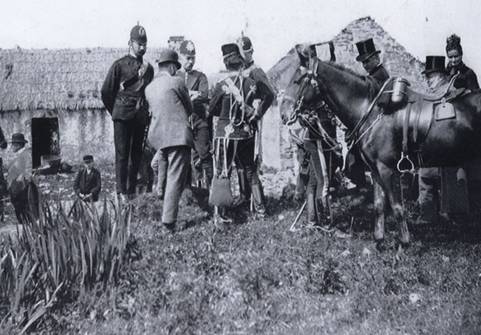
 The Illuminated London News, May 1, 1886 An evicted peasant family and Straw hut on the mountain side, the only shelter after eviction
|
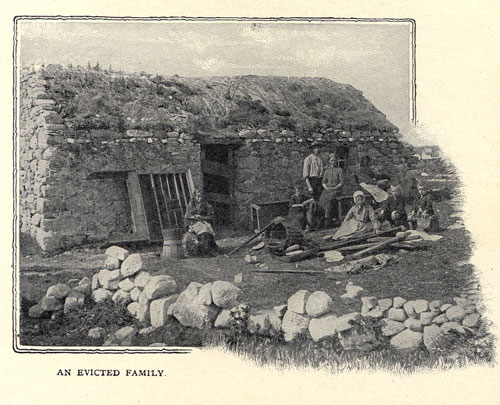 The landlords practiced "Rack Renting" in order to get rid of unwanted tenants. Rents were raised to the point that the tenant could not afford to pay them. The landlord then had the tenant evicted for non payment of rent. There were no appeals and no mercy shown. |
Eviction This event occurred after Edward left Ireland, but is something that some of our ancestors would have attended, such as the Campbells and Ryans. Castlewaller was a little over a mile from our ancestors farm lands (see Newport pictures). Aug 11 1851
|
     NBM  NBM                                                              YRS                                  NATIVE  NATUR              DEAF/                          OWNER
PAGE DWGS FAM  FIRST-NAME/MI   LAST-NAME        AGE SEX    COLOR  MRD WID  RES  BORN             OCCUPATION     VOTER   VOTER  ALIENS  MIL DUMB   BLIND  INSANE  IDIOTIC  LAND   PAUPER
========================================================================================================================================================================================
478  18   1    Edward          Hill             40  M      .      X   .    1    Ireland          Farmer         .       X      .       X   .      .      .       .        X      .
478            Margret         Hill             35  F      .      X   .    1    Ireland          .              .       .      .       .   .      .      .       .        .      .
478            Mary            Hill             12  F      .      .   .    1    Ireland          .              .       .      .       .   .      .      .       .        .      .
478            Bridget         Hill             9   F      .      .   .    1    New Hampshire    .              .       .      .       .   .      .      .       .        .      .
478            Anne            Hill             5   F      .      .   .    1    New Hampshire    .              .       .      .       .   .      .      .       .        .      .
478            Margret         Hill             1   F      .      .   .    .    Iowa             .              .       .      .       .   .      .      .       .        .      .
|
Original Note on this page:
|
Allamakee County
Mortality Schedule 1880 Schedule 2 Persons who died during the year ending 1st June, 1880 |
|
|