Irish John Smith, 1901 Ulster Census
“Irish” John travels to Ireland
After arriving in Dublin, “Irish” John traveled to Ballaybay. From Ballybay John and his traveling mate, Peter Smyth, set out for Aghabog on the Monaghan Road. At some point Peter and John went their own separate way, and “Irish” John continued onward to visit his cousin, John Smyth.

From an old postcard photo for Ballybay, County Monaghan, Ireland
John Smyth of Faltagh
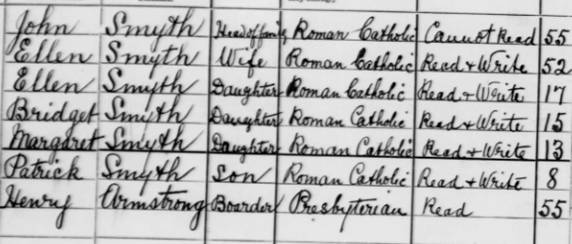
Last year we wrote an article about the 1911 Irish census. That census made clear who John visited in Ireland, EXCEPT we could not easily identify which ‘John Smyth / Smith’ he visited. Two ‘John Smyth / Smith’ families were identified as likely candidates. One family lived in Rossnaglogh East Townland and the other family lived in adjacent Faltagh Townland. These Townlands are between 50 and 60 acres. Rossnaglogh East is where “Irish” John Smith was born. Fortunately the 1901 census shed more light on this puzzle. We believe it was the Faltagh Smyth family that “Irish” John first visited in County Monaghan.
The 1911 Faltagh census did not show John Smyth’s name. According to the Irish Civil Registration Indexes, this John Smyth died sometime between July and September 1910. John’s widow, Ellen, did not remarry as we suggested in our earlier write-up. The National Archives of Ireland re-imaged this 1911 census record and made it more readable. Upon our new review, we could tell Ellen never remarried. This John Smyth was the same age as ‘Irish’ John Smith and the most likely cousin he would have stayed with. See 1901 census for Faltagh below.
“Irish” John would have stayed in a thatched cottage similar to one shown below:

John Smyth of Rossnaglogh
East Rossnaglogh is adjacent to Faltagh Townland. In fact, both ‘John Smith’ lands were side by side. Last year we surmised that “Irish” John Smith may have stayed with the “East Rossnaglogh” family while traveling around Monaghan. “Irish” John Smith was born in East Rossnaglogh Townland. However, we now believe “Irish” John stayed with the Faltagh Smyth family instead. Very likely “Irish” John met members of the ’Rossnaglogh’ Smyth family during his visit. Anne Smith’s census entry shows she worked as a housekeeper and her marital status is identified as ‘widow’.
See 1901 Census for East Rossnaglogh below:

Faltagh Townland Photograph
Below is an interesting picture of Faltagh Townland. The photographer faced north toward East Rossnaglogh Townland and Corravilla Townland. Corravilla Townland is where our ancestor, Susan McPhillips, was born.

John Greenan of Tullycorbett
“Irish” John left Urcher Townland in neighboring Kilmore Civil Parish to see his cousin, John Greenan, in Tullycorbett Townland. John Greenan was a farmer. His wife, Mary, was born in County Armagh; however, the other family members were all born in County Monaghan. Greenan lived in Tullycorbett as indicated by both the 1901 and 1911 Irish census records. According to the Irish Civil Registration Indexes John Greenan probably died between January and March of 1921.
Below is the 1901 census for Tullycorbett Townland, Kilmore Parish

Tullycorbett Graveyard

“Irish” John mentioned visiting a cemetery twice in his journal. He mentioned going to mass with his cousin John Greenan and visiting the graveyard. John also visited the graves of his uncle and aunt in Scotland. Why did John visit this Irish graveyard in Tullycorbett? Perhaps this is where his own father, Peter Smyth, lays in rest.
The two pictures above show the old Ballintra Catholic Cemetery for Tullycorbett Parish. It is located a mile and half east of Ballybay. Look at the picture to your right. It shows a family burial site where graves are marked by rocks. This is common in most Irish graveyards, especially those hit hard during the famine years.
Edward Greenan of Milltown
Edward Greenan was the last cousin “Irish” John visited in County Monaghan. Edward was a farmer who also had a very large family. According to the Irish Civil Registration Indexes, Edward Greenan probably died between July and September 1913.
Below is the 1901 census for Milltown Townland.

Milltown Townland Photograph
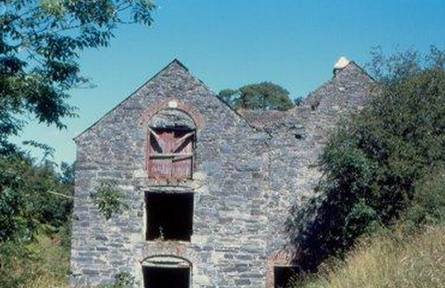
The picture above was photographed in Milltown near the Edward Greenan farm. It is a picture of a two story mill. It is an old, abandoned building of indeterminate age. I could not find any information on this mill or its purpose. However, the linen industry was big business in this part of Ireland during the latter part of the 18th century and early part of the 19th century. Ninety percent of the population in Aghabog Parish, for example, owned a spinning wheel. Perhaps this mill was used in linen processing.
Terence Greenan of Urcher, Kilmore Parish
I could not find the 1901 census record for Urcher Townland where Terrance Greenan lived. It would have been interesting to see the family members listed during this time period, but it is not necessary to see this record. We found Terry Greenan in the 1911 Irish Census. According the Irish Civil Registration Indexes, Terry Greenan died between April and June 1912, aged approximately 70 years.
Photograph of Cahan’s Presbyterian Church - Urcher Townland, Monaghan

This is an old church located near the ‘Urcher’ Greenan clan. None of the Greenan families attended this church.
Peter Greenan of Louth
“Irish” John’s cousin, Peter Greenan, lived in County Louth. In 1901 Peter Greenan was identified as a pensioner with the Royal Constabulary. Peter was born in County Monaghan, and his wife was born in County Louth. Their children were born in either Counties Donegal, Tyrone or Louth - all Ulster locations.

Peter Greenan died soon after “Irish” John’s visit to Ireland. You may have noticed that at least 3 of “Irish” John’s cousins died within a few years of John’s Irish trip.